


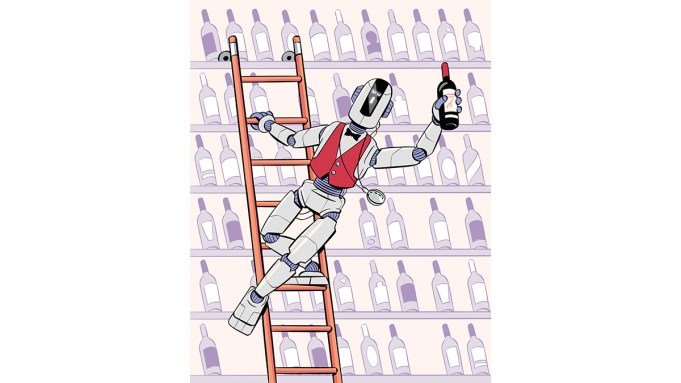
The joy of discovering and acquiring fine wines is often tempered by the work required to store and catalog them—especially as a collection grows. Wine-management apps are here to help. With integrated A.I., they can keep track of bottles, suggest when to drink them and what to serve them with, and even estimate the value of an entire cellar.
At the forefront is CellarTracker, launched in 2003 by former Microsoft product manager Eric LeVine. “We’ve got 1.2 million registered users tracking more than 200 million bottles of 5.5 million different wines,” he says. “I think the aggregate value of what people are tracking is above $25 billion.”
CellarTracker utilizes A.I. to draw on the accumulated knowledge of that vast user base. “We’re using the tools as engines but trying to personalize them very intensively, trying to use the wisdom of our community,” LeVine explains. Standard features are free, and premium subscriptions vary from $40 to $500 per year, though he notes that pricing is “not strictly enforced.”
Five-year-old InVintory is a relative newcomer but is gaining ground. The app offers a free entry-level service, while distinguishing itself with an option for 3-D modeling of a client’s cellar, starting at $1,500 to $5,000. Cofounder and C.E.O. Josh Daiter, who holds a master’s degree in A.I., says the company has several clients with cellars valued at more than $25 million each, though they are hardly typical. “The average paying customer has about one wine fridge and 150 bottles in their collection,” he says.
Then there is eSommelier, which arrived around the same time as CellarTracker. “It’s really sort of meant to be a showpiece in a high-end wine cellar,” notes David Parker, founder and C.E.O. of Benchmark Wine Group, a leading U.S. retailer of rare wines. Though he is not affiliated with the service, Parker says it operates through a supplied 17-inch display and costs about $4,000.
A.I.’s growing role in the category has been accelerated by data specialists, who gather and distribute information for the individual apps to employ. Among the most notable is Wine Labs, established two years ago by A.I. engineer Ilias Miraoui, whose clients include InVintory. “We’re trying to be that infrastructure layer,” Miraoui explains. “The idea is essentially to democratize access to that data.” His long-term goal is to create “prediction markets like we’ve seen with other asset classes.”
Of course, that access will have limits. Parker is also responsible for publishing Wine Market Journal, which follows auction transactions around the world, and he has no intention of allowing A.I. systems to absorb its proprietary data. “We’re not going to open that up to A.I. to just grab and hand it out for free—or misrepresent,” he says. Still, Parker believes the technology’s practical potential is only beginning to emerge. When it comes to what A.I. might eventually do for collectors, he says, “we’re just scratching the surface.”
Authors

Viju Mathew

