


An Emirates Boeing 777-300ER touches down in northern Germany most days of the week, taxis past a terminal complex rebuilt to swallow the Airbus A380, and rolls to a stop on ground that has been receiving aircraft since before the Titanic sank. Hamburg Airport (HAM) has been selling tickets, in one form or another, since January 1911, which makes it, by most reckonings, the oldest continuously operating commercial airport on Earth. It just didn’t start out selling tickets for airplanes.
The word “commercial” is doing more work than it looks like. A different American airfield has operated even longer without interruption, and a defunct Berlin airport once carried a Zeppelin-era pedigree of its own before it was demolished for redevelopment. What actually separates Hamburg from its rivals for the title isn’t simply age; it’s what the field was used for, who controlled it at each stage, and whether it kept selling seats through two world wars, a foreign occupation, and a jet age it was never designed to survive. Hamburg’s answer to all three starts in a hangar built for airships, not airplanes.
Why A Field Built For Airships Still Counts As A Commercial Airport
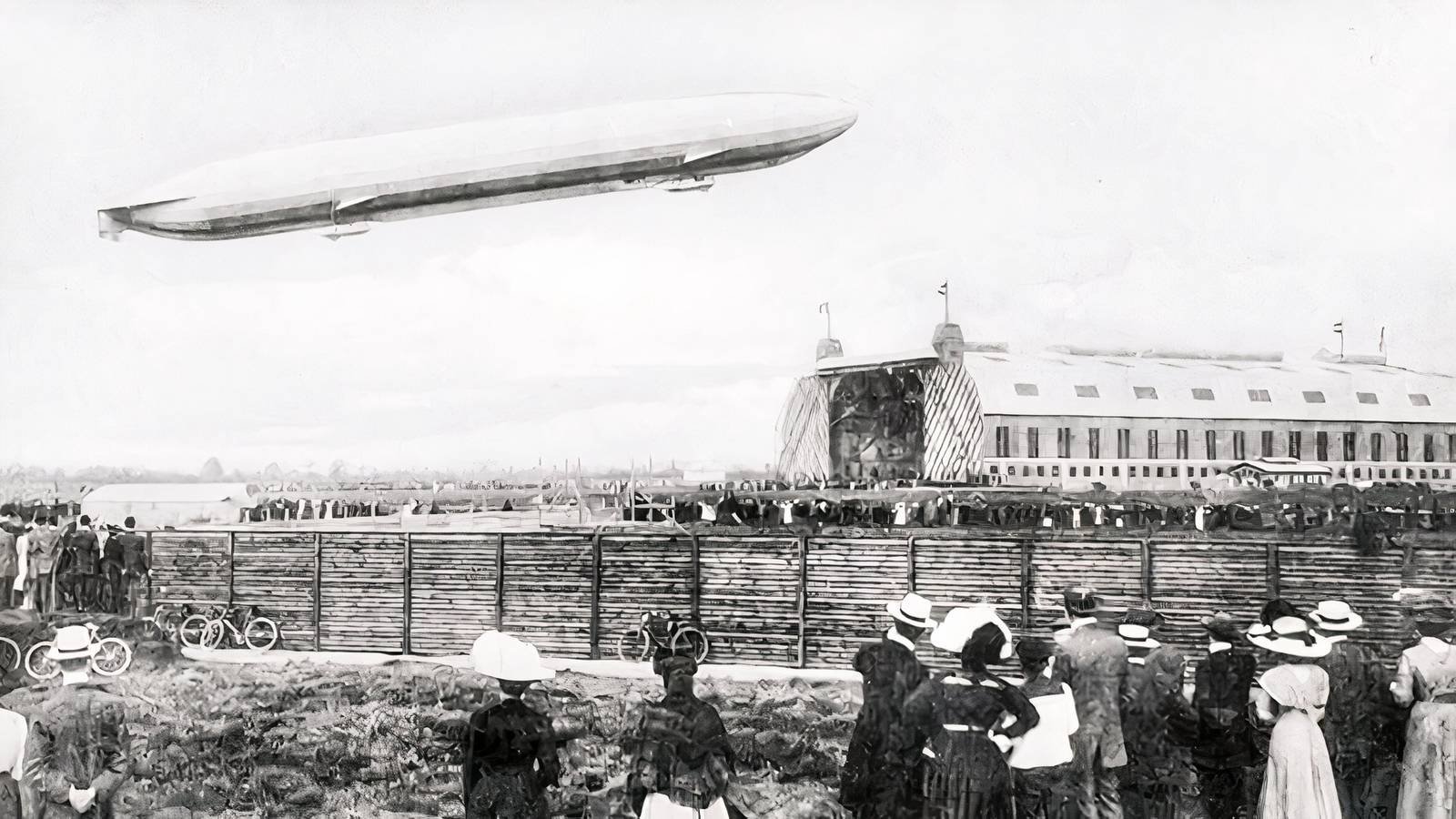
Hamburg Airport’s origin story begins with a public relations pitch, not an airplane. In March 1910, Count Ferdinand von Zeppelin addressed a crowd of Hamburg residents about the commercial future of rigid airships, and the city took the bait. On January 10, 1911, local investors founded Hamburger Luftschiffhallen GmbH, the Hamburg Airship Hangar Company, and set aside roughly 111 acres (45 hectares) of grassland near the village of Fuhlsbüttel for a hangar large enough to hold two Zeppelins at once.
That single decision links the site to DELAG, the Deutsche Luftschiffahrts-Aktiengesellschaft, widely regarded as the world’s first airline, which had already begun flying paying passengers on short pleasure cruises from a different German field two years earlier. The Fuhlsbüttel hangar itself wasn’t finished until 1912, when a festival marked its opening and the first airships lifted off from what is today Hamburg Airport’s apron. Passengers rode in open gondolas and not inside cabins; boarding meant climbing into a wicker basket slung beneath a hydrogen-filled envelope longer than a football field.
It was a strange way to start what would eventually become a modern hub, and it didn’t last long. Airships were expensive, slow, and, as the era’s engineers were about to learn the hard way, dangerously inflammable. Within two years of that 1912 opening festival, Europe would be at war, and the hangar that made Hamburg’s name would end up on the losing side of it.
What Two World Wars Did To Hamburg’s Zeppelin Base

In 1914, the German military requisitioned the Fuhlsbüttel field, and by the time the war ended in 1918, the original airship hangar had been destroyed, a casualty of a conflict that turned early aviation infrastructure across Europe into military assets almost overnight. Under the terms of the Treaty of Versailles, Germany’s rigid-airship program was effectively dismantled, meaning Fuhlsbüttel’s founding purpose had disappeared before the field had even marked its tenth anniversary.
What replaced it was, for the first time, recognizably an airport. Scheduled flights resumed to Fuhlsbüttel in 1919, and in 1920 KLM launched the field’s first international route, linking Rotterdam, Amsterdam, Hamburg, and Copenhagen. Passenger numbers were tiny by modern standards: Hamburg counted exactly 241 passengers in all of 1920, the year record-keeping began, but the total climbed steadily through the years, as documented by the Hamburg airport website. By 1929, the airport had opened its first proper terminal building, combining passenger and cargo handling, administration offices, a restaurant, and an observation deck under one roof.
On August 28, 1939, four days before Germany invaded Poland, the Luftwaffe requisitioned Fuhlsbüttel and placed it “in the service of national defense,” as Hamburg Airport’s historical account puts it. According to WW2.dk’s Luftwaffe airfield records , the airport had already been expanded and militarized by the Luftwaffe in 1936-37, several years before World War II began.Its wartime operational units included 1.(F)/Aufklärungsgruppe 122 equipped with Heinkel He 111 bombers. It was a long-range reconnaissance Staffel which was based at Fuhlsbüttel from March to April 1940 before moving north for the German campaign in Norway. The same records show that Fuhlsbüttel was repeatedly bombed during the war as part of the Allied attacks on the greater Hamburg area.
According to the RAF Museum, Bomber Command flew 3,091 sorties during Operation Gomorrah and dropped 8,344 tons of bombs, while the resulting firestorm killed approximately 45,000 people. Yet Fuhlsbüttel survived largely intact. Hamburg Airport says the Luftwaffe had camouflaged the field with trees, woven mats, and camouflage nets, although it remains unclear how much this influenced the Allies’ targeting decisions.
When Germany surrendered in 1945, Fuhlsbüttel was unusual among German airfields: it had survived two world wars and remained largely operational. The Royal Air Force took control of the airport in May 1945, setting the stage for a completely different chapter in its history.
How Hamburg Went From Raisin Bombers To A Jet-Age Hub

Britain administered Hamburg Airport from 1945 until 1950, a stretch defined by one of the Cold War’s most iconic operations, the Berlin Airlift. Between June 1948 and May 1949, the field served as a launch point for the so-called “raisin bombers”, the Allied cargo aircraft that kept West Berlin supplied by air after Soviet forces blockaded its land routes. Runways built for propeller aircraft flying pleasure trips two decades earlier were suddenly moving flour and coal into a besieged city.
The site was renamed Hamburg Airport once British administration ended in 1950, and the years that followed read like a highlight reel of postwar aviation. According to  Lufthansa’s own history, the newly established airline began scheduled domestic services from Hamburg on April 1, 1955, followed just over two months later by its first North Atlantic service, a Lockheed Super Constellation flying to New York. As reported by Hamburg Airport website, on March 2, 1960, Lufthansa’s first Boeing 707 arrived at Hamburg directly from Seattle, marking the airport’s arrival into the jet age. The scale of the change was soon obvious: as Hamburg Airport records, the first Lufthansa Boeing 747 landed at Fuhlsbüttel on March 30, 1970. The 350-ton (350,000 kg) jumbo jet required a reinforced apron and a new terminal position equipped with Hamburg’s first two passenger bridges.
The former Zeppelin field had gone from the first generation of passenger jets to the world’s largest airliners. But how could Hamburg keep adapting as the airliners kept getting bigger?
How Hamburg Can Now Handle The World’s Biggest Airliners

Hamburg’s answer to its aging infrastructure was HAM21, a modernization program that ran from 2001 to 2009 and cost roughly $390 million (€356 million at the time). The project rebuilt the airport around two passenger terminals, added a dedicated metro rail station, a multistory parking structure, a dynamic parking-guidance system, and wider access roads, preparing Fuhlsbüttel for the demands of modern commercial aviation. It was a very different airport from the one that had welcomed Lufthansa’s first jets just years earlier.
That modernization mattered when Hamburg took another step up in size. As documented by Simple Flying, the airport’s two terminals can now handle roughly 14 million passengers a year, while on October 29, 2018, Hamburg became a certified Airbus A380 destination and welcomed its first scheduled  Emirates A380. The aircraft has a wingspan of 261 feet (79.75 meters) and a maximum takeoff weight at about 1.27 million pounds (575,500 kg), dwarfing the airships that once occupied Fuhlsbüttel hangar. Emirates later replaced the A380 on the Hamburg-Dubai route with Boeing 777-300ERs, as previously reported by Simple Flying, but the 2018 arrival demonstrated that Hamburg’s infrastructure could handle the world’s largest passenger aircraft.
A hangar built for two Zeppelins could now share a runway with the largest passenger jet ever certified for airline service. That is a remarkable run for a single site, but it isn’t technically, the oldest airport still in business. The record belongs to a much smaller field on the other side of the Atlantic, and it complicates Hamburg’s claim in a way that entirely depends on one word.
The Airport That Actually Holds The Older Record

College Park Airport, tucked into a residential stretch of Maryland just outside Washington, D.C., predates Hamburg by two years. According to Airport Technology’s survey of the world’s oldest working airfields, the US Army Signal Corps brought Wilbur Wright to the site in 1909 to train the country’s first two military pilots. The field subsequently became a center of early US military aviation and has remained an active airport ever since, surviving both world wars and the Depression.
Simple Flying’s survey of the oldest airports in the United States includes College Park among America’s historic surviving airfields, but College Park’s airport today is very different from Hamburg’s. It is a general aviation airport serving private pilots, flight training, and other non-airline operations. Its single runway is roughly 2,600 feet (792 meters) long and 60 feet (18 meters) wide, perfectly suited to light aircraft, but nowhere near enough for a Boeing 747 or an A380.
That is the distinction Hamburg’s claim rests on. College Park is the older airport, full stop: Hamburg is the older airport that still functions as a major scheduled-airline gateway. According to Yahoo Travel’s roundup of the world’s oldest operating airports, other century-old European airfields have also lost some of that commercial status, either through closure, as with Berlin Tempelhof, or by becoming general-aviation facilities, as with Venice Nicelli and Prague Kbely. Which raises the real question: how much longer can Hamburg hold on to a title that keeps losing contenders?
What Will Decide Whether Hamburg Keeps The Title

Hamburg’s strongest rival for the title of “oldest commercial airport in the world” has already lost it. Berlin Tempelhof opened in 1909, hosted demonstration flights by Orville Wright, and became Deutsche Luft Hansa’s headquarters in 1926, but it closed permanently in 2008 and its former runways are now part of a public park, as documented by Simple Flying.
Paris-Le Bourget, which opened to commercial traffic in 1919 and became famous when Charles Lindbergh landed there in 1927, remains an active airport, but now focuses essentially on business aviation rather than scheduled passenger services. Even Simple Flying’s account of the century-old Italian airfield used almost exclusively by  Boeing’s oversized Dreamlifter shows how easily an airport can retain its physical existence while losing its role in mainstream commercial aviation.
Hamburg has avoided that fate by continuing to invest rather than simply preserving what it already had. Its modernization did not stop with HAM21: Hamburg Airport now has targets for reducing emissions from its own operation and is investing in measures including sustainable aviation fuel infrastructure as the aviation industry moves toward lower-carbon operations. That approach is consistent with the airport’s entire history. Fuhlsbüttel survived because instead of being preserved as a historical relic, its role repeatedly changed, from Zeppelin base to military field, to airlift hub, and from postwar airport to jet-age gateway.
