


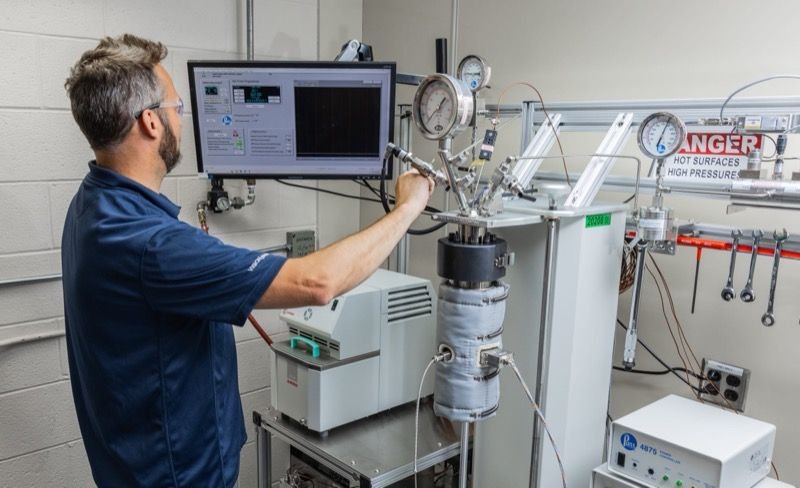
Materials engineering company Greene Tweed has added cryogenic leak and supercritical carbon dioxide rapid gas decompression capabilities to its in-house testing capabilities.
The investments expand the company’s validation support for industries including semiconductor, aerospace and energy, while preparing for emerging opportunities in hydrogen and carbon capture, utilization and storage (CCUS). Greene Tweed said the additions bring more advanced validation in-house, helping it support customers earlier in the design cycle and respond more quickly to evolving application requirements.
The company said the moves reflect rising demand for advanced testing and validation as operating systems grow more complex and their environments more demanding. The expanded capabilities are intended to help customers reduce technical risk and accelerate qualification.
Magen Buterbaugh, president and CEO, said, “Expanding our in-house testing and validation capabilities reflects where our customers and markets are heading. These strategic investments strengthen our ability to tackle complex, high-stakes challenges alongside our customers, while accelerating the journey from development to deployment.”
The cryogenic leak testing system evaluates sealing performance at temperatures as low as 4K (-452°F/-269°C), with a tolerance of ±0.08K. It uses a high-vacuum chamber, specialized thermal shielding and highly sensitive helium leak detection capable of reading helium flow down to 5×10⁻¹² atm·cc/s.
The system extends the company’s internal cryogenic testing range to reflect conditions in cryogenic semiconductor etch processes, aerospace and space systems, and emerging liquid hydrogen applications. It provides application-relevant insight into seal behavior before solutions such as Avalon 40 and Avalon 56 enter the field.
Greene Tweed also added supercritical carbon dioxide rapid gas decompression (RGD) testing to support the growing CCUS market. The process evaluates materials and sealing solutions under harsh supercritical carbon dioxide conditions aligned with industry standards such as ISO 23936-2, or custom application conditions up to 662°F (350°C) and 5,000psi (345 bar).
The RGD testing generates performance data for valves, pipelines, compressors, storage vessels and other CCUS infrastructure. Greene Tweed said this accelerates qualification timelines for existing and next-generation materials.
Cory Massey, senior manager of product engineering and simulation, said, “The next generation of semiconductor, aerospace, hydrogen, and CCUS technologies are pushing the boundaries of material science. Greene Tweed is investing in our testing capabilities now, to provide the future cutting-edge material applications demanded by our customers’ most extreme, can’t-fail operating conditions.”
