


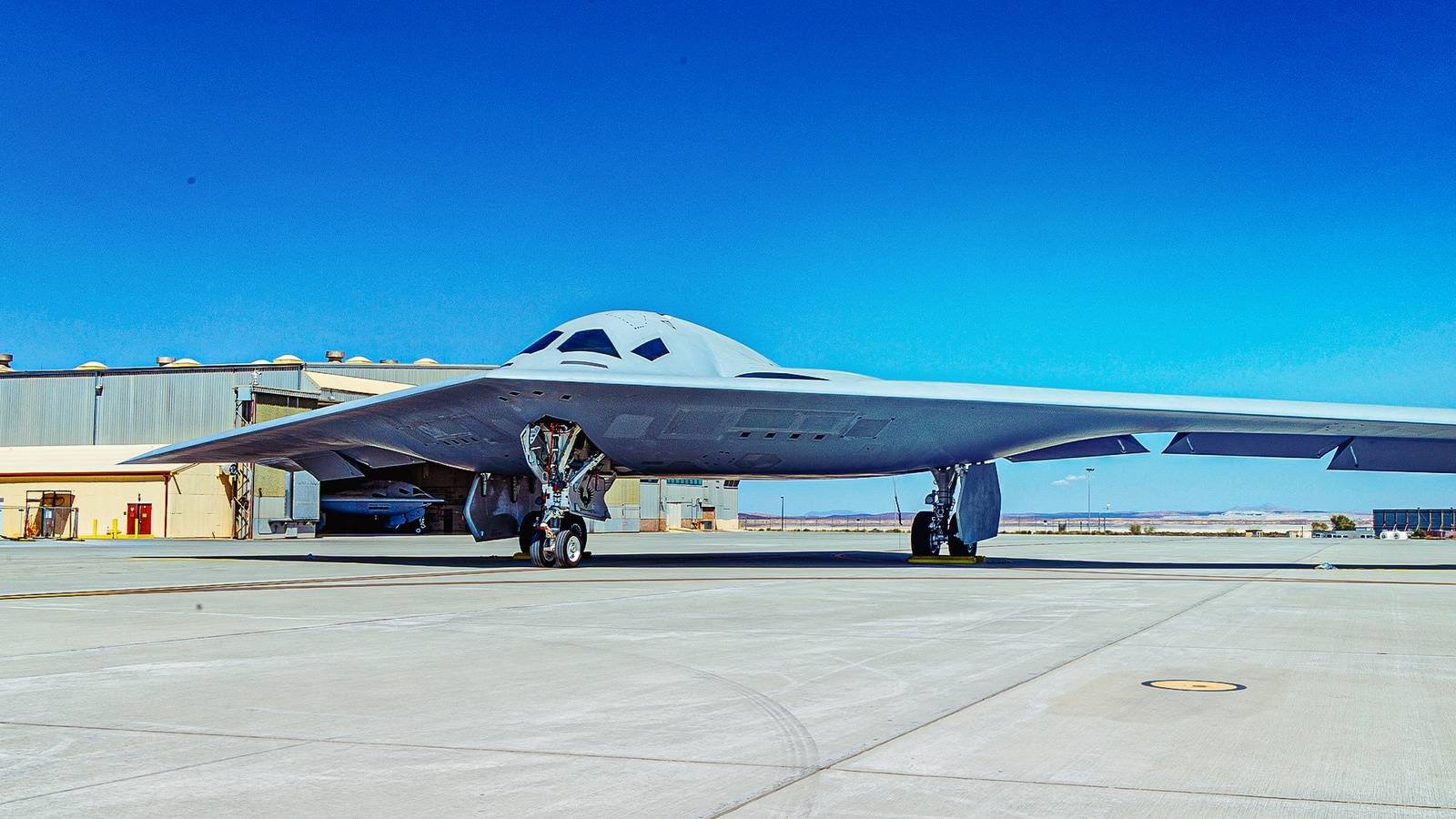
The Northrop Grumman B-21 Raider is the world’s first sixth-generation stealth bomber. Its low-observable flying-wing design represents a highly optimized compromise between extreme all-aspect stealth and endurance. Eliminating a traditional fuselage and tail removes the largest radar-reflecting surfaces, giving it 360-degree stealth across multiple radar bands. Furthermore, the unique aerodynamic efficiency of the ‘Flying Dorito’ unlocks massive unrefueled global combat ranges.
Although it is built around radical geometry, the jet also suffers significant stability penalties due to its flying-wing design. Lacking a vertical fin removes natural yaw stability, forcing the aircraft to rely entirely on complex fly-by-wire computers that modulate split-flap drag rudders at the wingtips to stay airborne. Although the B-21 faces all the same basic engineering challenges as the B-2 Spirit, lessons learned from decades of operations and new technology have given the Raider the opportunity to greatly improve on its predecessor.
Detailed technical specifications are not yet publicly available, but from the limited information that has been released, we can determine some key facts. The B-21 will be smaller and lighter, it will carry somewhere between a 30% and 50% lower payload, and yet it is anticipated to have the same or even greater range. The B-21 will also have much more advanced data links and can function as a kind of flying ‘Mothership’ for future collaborative combat aircraft, or loyal wingman drones.
The Physics-Defying Engineering Of A Tailless Bomber
Due to the B-21 Raider’s flying wing configuration, which allows for total flight control without vertical tails, engineers were able to protect both engine exhausts and inlets from ground-based sensors. The brightest tracking fingerprints found on conventional airplanes are eliminated by removing the flat panels and sharp corners that reflect radar radiation back to its source.
Eliminating the vertical fin compromises natural directional stability. This high-stealth shape comes with high aerodynamic costs. This inherent instability is fixed by sophisticated flight computers. Along the trailing edge of its composite wings, the B-21 has eight specialized control surfaces. The bomber is believed to use differential deflection of adjacent discrete surfaces, rather than the B-2’s split flaps.
Similar to the legacy B-2 Spirit, these surfaces can deflect to provide artificial yaw stability or split open to act as conventional drag rudders. Redundant fly-by-wire computers run these complex aerodynamic calculations many times per second, constantly modulating the surfaces to keep the tailless bomber steady.
The Reality Of Relaxed Static Stability

The only reason a stealth flying wing stays in the sky is because its computers are constantly flying it. A human being physically cannot react fast enough to keep an inherently unstable airframe from pitching or sliding out of control. A standard plane has a tail. If a gust of wind pushes the nose up, the horizontal tail acts like a flight feather on an arrow, naturally catching the wind and forcing the nose back down. This is static stability.
Deleting the tail removes this natural aerodynamic safety net. The aircraft features relaxed static stability. It actively wants to flip over, pitch up, or slide sideways. The B-21 drops from the B-2’s four engines to two and features a significantly simplified W-shaped trailing edge instead of the B-2’s sawtooth edge.
Specification | B-2 Spirit | B-21 Raider |
|---|---|---|
RCS | 1.08 square feet (0.1 m²) | 0.11 square feet (0.01 m²) |
Payload | 40,000 lb (18,144 kg) | 30,000 lb (13,608 kg) |
Range | 6,905 mi (11,112 km) | 7,480 mi (12,038 km) |
Wingspan | 172 feet (52.4 meters) | ~132 feet (~40.2 meters) |
Powerplant | Four General Electric F118-GE-100 | Two Pratt & Whitney F135-derived |
To keep the aircraft smooth and level, the fly-by-wire flight control computers must sample the air and make micro-adjustments to the trailing-edge control surfaces dozens of times every single second. If the computers shut down, aerodynamic forces could tear the aircraft apart.
The B-2 features a wedge-shaped ‘beaver tail’ flap in the center of its trailing edge. The B-21 eliminates this moving center flap to create a cleaner stealth signature. Without a physical mechanical stabilizer in the center, the flight control software must compensate by precisely fluttering the remaining wing-panel surfaces in opposite directions to counteract turbulence.
In a four-engine aircraft like the B-2, losing an engine causes a minor thrust asymmetry. In a two-engine aircraft like the B-21, losing an engine causes a catastrophic yawing motion. Because the B-21 has no vertical tail to act as a rudder, the flight control computer must instantaneously split the wingtip clamshell brakes and subtly alter the remaining engine’s thrust to prevent the aircraft from spinning if an engine fails.
The Most Expensive Aviation Mishap In History

The potentially disastrous results of any design flaws in the B-21 radar are not purely theoretical, as the US Air Force has already had one flying wing stealth bomber crash. In 2008, the B-2 Spirit, named Spirit of Kansas, departed Andersen Air Force Base in Guam after sitting on the apron overnight in heavy rain. Two pilots, Major Ryan Link and Captain Justin Grieve of the 509th Bomb Wing, crewed the aircraft.
Guam’s tropical climate brought heavy, lashing rain and intense humidity before the flight. While the aircraft was parked, moisture entered three of the aircraft’s 24 flush-mounted Port Transducer Units. As the B-2 accelerated down the runway, distorted sensor data caused the cockpit displays to indicate an airspeed 12 knots faster than the aircraft’s actual speed. Believing they had reached takeoff velocity, the pilots rotated early.
The moment the wheels left the ground, the flight control computers switched to the in-flight computer logic, which falsely believed the heavy bomber was in a violent, uncommanded nosedive. To save the jet, the flight computer instantly executed a 1.6-G, uncommanded 30-degree nose-high pitch-up.
The bomber was actually traveling too slowly. This radical pitch instantly starved the wings of air. The aircraft entered an unrecoverable low-altitude aerodynamic stall. The left wing tip gouged the runway environment, and both pilots successfully ejected seconds before the bomber exploded.
At an estimated loss of $1.4 billion, it remains the most expensive single-aircraft crash in history. Although a B-2 crashed, the accident is the ultimate real-world example of the flying-wing design trade-offs engineers have had to address in the newer B-21 Raider.
What Testing And Production Must Still Prove

The B-21 Raider flight-test campaign is already well underway, having moved from basic airworthiness trials to active operational evaluation. The platform completed its first five-hour aerial refueling test on March 10, 2026, after a second flying prototype joined the first at Edwards Air Force Base in September 2025. Northrop Grumman is ramping up the assembly line to full-rate capacity and in anticipation of delivering a minimum of 100 examples, but that number is already up for revision.
Pentagon planners at US Strategic Command are actively analyzing options to expand the total program of record to 145 or more bombers. Achieving this expanded fleet architecture requires aggressively balancing budget funding, manufacturing capacity, and frontline squadron readiness. To speed up the delivery timeline, Congress granted Northrop a $4.5 billion supplementary funding infusion, aiming to increase deliveries by 25% annually.
The US Air Force is dead set on seeing the first B-21 arrive at Ellsworth Air Force Base early next year as part of the first operational Squadron to begin flying combat-capable Raiders. From that milestone onward, the new stealth bombers will begin systematically replacing the aging legacy fleet, which currently comprises 63 B-1B Lancers and 20 B-2 Spirits.
However, this accelerated production rate still isn’t fast enough to replace the older bombers one-for-one without creating a massive capability gap. As a result, the Air Force abandoned its original early-2030s divestment strategy. Planners have pushed the final retirement target for both the B-1B and B-2 fleets out to 2037.
The Evolution Of Air Warfare In 2026 And Beyond

The B-21 will be smaller than the B-2 because the post-Cold War defense environment is a dramatically different security landscape than the great-power contest that came before. Older bombers like the B-1 and B-2 operated as isolated ‘lone wolves’ that had to carry all their own targeting equipment and bombs.
The B-21 functions as an airborne cloud computer and battle manager. It uses a resilient digital network to ingest, decode, and share radar data in real time with satellites, ground troops, and friendly fighter jets. Although the Raider will continue to be an important part of the nuclear deterrence Triad, it will be much more proficient in the role of conventional air support and penetrating strikes behind enemy lines, which the B-2 was forced to adapt to many years after it initially ended service.
Because the B-21 is physically smaller and features ultra-shallow, blended engine intakes, its radar cross-section is significantly shrunk. Instead of flying alone into heavily defended airspace, the B-21 acts as a quarterback for stealth drone swarms. The pilots can use the plane’s internal computers to command cheap, autonomous companion drones flying ahead of them.
New Loyal Wingman drones act as off-board munitions, allowing the pilots of the B-21 to strike by proxy without exposing themselves to enemy fire or revealing their location by opening a bomb bay door or dropping ordnance. This will make the raider the ultimate ‘Eye in the Sky’ on the battlefield tomorrow, because it can see every corner of the Frontline and strike at will with impunity, even against the most advanced adversaries.
