



Inflight connectivity (IFC) is a growing expectation among passengers, and an opportunity for airlines to create differentiated experiences. Many exciting developments will be on show at APEX FTE Expo:
Multi-orbit connectivity
Viasat is building toward multi-orbit in-flight connectivity, and at APEX FTE Expo 2026, it will show what that path looks like. With ViaSat-3 F3 set to enter service over Asia-Pacific, the capacity foundation for the region is coming into place. Looking ahead, Viasat will integrate Telesat Lightspeed capacity and equip aircraft with Viasat AERA, a next-generation electronically steered antenna designed to give airlines the flexibility to operate across orbital layers as that capability comes online.
The result, says Viasat, is connectivity that adapts to route, demand, and network conditions, including resilience to fully service the busiest routes and hubs.
Better connectivity unlocks more than a faster connection. Attendees will see how Viasat’s platform supports live TV, wireless IFE, personalised offers, advertising, and loyalty integrations.
Amazon Leo develops LEO antenna
Amazon Leo has developed the Amazon Leo Aviation Antenna, an electronically steered antenna (ESA) designed to provide inflight internet connectivity at speeds of up to 1 Gbps download and 400 Mbps upload simultaneously. Delta and JetBlue have agreements in place to use the service, according to Amazon Leo, and there is an agreement in place with Airbus to integrate the LEO IFC solution into Airbus’ line-fit and retrofit aircraft catalogue of managed service providers.
The antenna measures 147 cm long, 76 cm wide and 6.6 cm high (58 by 30 by 2.6 inches) and has no moving parts, which Amazon Leo says reduces maintenance downtime. The company also says that the integrated modem and streamlined mounting system allow for single-day installation on the exterior airframe.
A single antenna is designed to serve an entire aircraft, covering passenger entertainment, crew operations and collaboration applications across seat classes and aircraft types ranging from wide-body jets to regional aircraft.
The antenna uses full-duplex phased-array technology and connects to Amazon Leo’s low Earth orbit (LEO) satellite network, handing off between satellites as the aircraft moves. For routes over oceans, polar regions and other areas distant from ground gateways, the network uses inter-satellite laser links to relay data to the nearest available gateway. Amazon Leo says it is building more than 300 ground gateways globally to reduce latency and improve resilience.

NSG deploys Hughes gateway infrastructure
In July 2026, Neo Space Group (NSG) announced the successful deployment of three advanced ground gateway systems in collaboration with Hughes Network Systems, leveraging the Jupiter 3 ground system to support next-generation IFC services powered by NSG SATCOM.
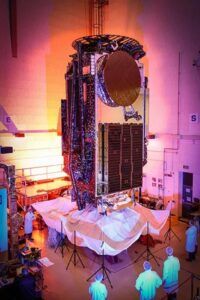
This deployment is an important step in NSG’s mission to build a sovereign, future-ready connectivity ecosystem integrating satellite capacity, ground infrastructure, and aviation technologies to deliver reliable, scalable connectivity across the Middle East, Europe, Africa, and parts of Asia.
The newly deployed gateway systems are strategically located in Jeddah, Saudi Arabia; Sintra, Portugal; and the Canary Islands, forming an infrastructure designed to enhance coverage, redundancy, scalability, and seamless connectivity across major international flight corridors.
The deployment is part of NSG’s broader strategy to expand its aviation connectivity portfolio, including NSG Skywaves, enabling airlines to deliver high-speed broadband, uninterrupted passenger connectivity, and enhanced onboard digital experiences across long-haul and regional routes.
During initial flight testing, the system delivered speeds exceeding 100 Mbps, with peak performance reaching approximately 200 Mbps.
ThinKom secures Boeing line-fit offerability
ThinKom has secured line-fit offerability for its ThinAir Ka2517 terminal across Boeing’s range of commercial aircraft, marking a big step in the maturation of the company’s multi-orbit connectivity strategy.
While line-fit announcements have become increasingly prominent as airlines lock in connectivity decisions earlier in the aircraft procurement cycle, achieving offerability remains one of the more challenging milestones for SATCOM providers. Beyond completing Boeing’s Technical Services Agreement, suppliers must demonstrate long-term production readiness, configuration control, and the ability to support Boeing’s manufacturing cadence without introducing programme risk. This is particularly true for next-generation ESA architectures designed to support evolving multi-orbit networks.
The announcement positions ThinKom alongside a small group of connectivity suppliers with factory-install status as airlines increasingly prioritise upgradeable hardware over service-specific installations. As fleet planning shifts toward long-term digital infrastructure, line-fit optionality has become a strategic differentiator, allowing operators to preserve flexibility as network architectures continue to evolve.
The Ka2517 is available immediately for selection on new Boeing deliveries, including Neo Space Group’s installation on Thai Airways’ Boeing 787 programme.
“Support for multi-constellation, multi-orbit communications are table stakes for airlines today,” says Jeff Sare, ThinKom’s chief commercial officer – IFC.

What comes after connectivity?
As high-speed connectivity reaches more aircraft, Bluebox Aviation Systems is bringing a different question to APEX FTE Expo 2026: what should airlines do with it?
Bluebox will showcase Blueview Cloud, its ground-hosted platform designed to help airlines turn connectivity into richer passenger experiences and new commercial opportunities.
Rather than treating entertainment, retail and passenger services as separate onboard functions, Blueview Cloud brings them together in one digital environment. This enables more personalised content, live commerce and payments, relevant partner offers, destination services, and journey information that can respond to passenger context.
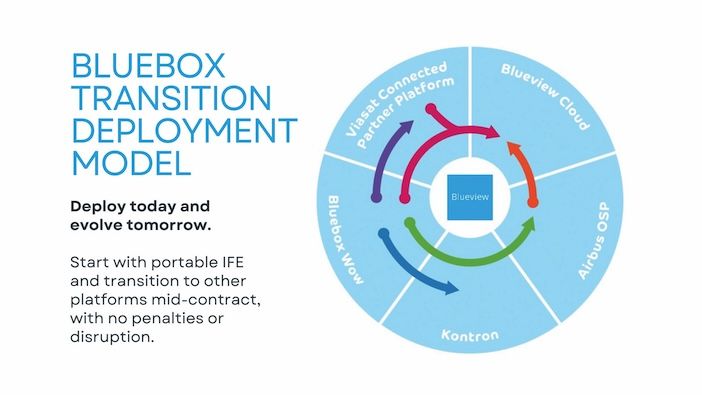
Bluebox will also be showing expo visitors its Transition Deployment Model, designed to give airlines greater flexibility to evolve their digital passenger experience as aircraft, infrastructure and connectivity strategies change.
Bluebox’s message for Singapore is simple: connectivity is the enabler, not the end product. The bigger opportunity lies in what airlines can build on top of it.
Anuvu adds Eutelsat 10B capacity
Anuvu has signed a new multi-year agreement for high-throughput Ku capacity on the Eutelsat 10B satellite to enhance its inflight connectivity services, including service for a major global airline. The satellite is located at 10° East, an orbital position that offers visibility spanning from the Americas to Asia.
The all-electric Eutelsat 10B satellite has a powerful fifth-generation digital transparent processor, designed to enable capacity allocation flexibility and optimal spectrum use, and carries multi-beam HTS Ku-band payloads specifically tailored to the mobile connectivity sector.

Moment expands presence in Asia-Pacific region
Moment has expanded its presence across the Asia-Pacific region with the opening of two new offices, in Singapore and Kuala Lumpur.
The company’s IFEC technologies are available for use by nearly 20 million passengers per year in the Asia-Pacific region, including its Flymingo Box W-IFE system that delivers content and services onboard, and has been deployed by several airlines in Southeast Asia, including Nok Air, Malaysia Airlines, and Airfast Indonesia.
“The Asia-Pacific region represents the largest share of global air passengers and includes airlines eager to embrace advanced onboard services and must-have connectivity technologies,” says Manon Seban, APAC sales director at Moment.
