


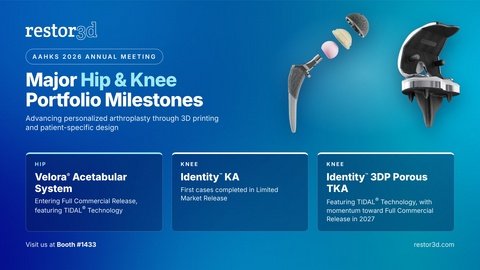
US orthopedic company restor3d is putting its Velora Acetabular System into full commercial release this month. Velora is a 3D printed titanium hip cup that has finished its limited market release. The company has also completed the first surgical cases using Identity Kinematic Alignment (KA), the newest planning option on its patient-specific knee platform.
It is presenting both milestones at the 2026 American Association of Hip and Knee Surgeons (AAHKS) Annual Meeting, along with its porous 3D printed total knee system, which it plans to bring to full commercial release in 2027.
“AAHKS is an exciting opportunity to showcase how quickly our hip and knee portfolio continues to evolve,” said Kurt Jacobus, Chairman and Chief Executive Officer of restor3d. “Across both joints, we are building a portfolio that brings together advanced 3D printing, differentiated design, efficient surgical workflows and personalization. These milestones represent another important step in our mission to improve the way orthopedic care is designed and delivered.”
Bigger Femoral Heads Without Bigger Cups
Velora’s main design feature is its head-to-cup ratio. Surgeons can fit a larger femoral head without moving to a larger acetabular component. The system takes a 36mm head in a 48mm cup and a 40mm head in a 52mm cup. Larger heads support greater range of motion and joint stability, and keeping the cup small preserves the patient’s bone.
The cup is printed in titanium using restor3d’s proprietary TIDAL Technology. Its porous architecture is fully interconnected and designed to encourage bone ingrowth for strong initial fixation and durable biologic fixation over the long term. The off-the-shelf range covers cup sizes from 40 to 70mm in multi-hole, limited-hole and no-hole versions. Liners come in standard, lipped, face-changing and lateralized options.
All of Velora’s instruments fit in a single surgical tray. That reduces sterile processing and suits fast-paced operating rooms and ambulatory surgery centers. Paired with restor3d’s Actera and Cordera femoral stems, the cup rounds out a primary hip portfolio that covers a range of patient populations and surgical approaches.
Identity Knees Add Alignment Planning and Cementless Fixation
On the knee side, the Identity platform designs each femoral component from the patient’s CT scan to recreate their individual J-curves and native joint mechanics. Identity KA builds kinematic alignment principles into that workflow. The surgical plan restores each patient’s constitutional leg alignment, the alignment they were born with, rather than forcing a standardized mechanical axis, and gives surgeons more flexibility in the operating room. restor3d will keep gathering surgeon experience with KA during the limited release before a wider launch.
The Identity 3DP Porous Total Knee Arthroplasty System combines the same patient-specific geometry with TIDAL porous printing across the femoral, tibial and patellar components. It pairs a 3D printed cobalt chrome femur with a titanium tibial baseplate and is FDA-cleared for both cemented and cementless use. restor3d says it is the first and only patient-specific cementless total knee available. The tibial baseplate is shaped to match the cortical rim of each patient’s tibia, improving stability without compromising rotational alignment.
AAHKS attendees can see the systems at Booth #1433. On November 6, restor3d will host a peer-to-peer surgeon session from 5:30 to 7:30 p.m. CST at Zeppole at the Gaylord Texan.
Scaling Personalized Arthroplasty Beyond One-Off Cases
restor3d’s strategy runs two tracks on one manufacturing base. One produces standardized porous implants such as Velora for high-volume procedures. The other produces anatomy-matched devices for surgeons who want personalization. The company pairs AI-driven design software with in-house additive manufacturing and rapid surgical planning.
Porous printed hip cups have a long clinical track record. LimaCorporate’s Trabecular Titanium cup was first implanted in 2007 and was still performing a decade later, with roughly 100,000 patients treated using Arcam’s EBM systems alone. On the knee side, Stryker’s early metal 3D printing investment targeted a cementless knee, a printed patella and a tibial baseplate with porous structures to encourage bone growth.
Personalization at volume is the more recent frontier. Onkos Surgical’s My3D pelvic platform has passed 1,000 surgical cases, and the company is using that milestone to counter the long-standing objections to patient-specific implants: lead time and cost. Earlier, ConforMIS built custom knees from each patient’s CT scan, shaping them to align the whole leg.

restor3d is betting that one porous printing platform can serve both off-the-shelf hips and patient-specific cementless knees. The 2027 full commercial release of Identity 3DP Porous will be the real test.
To stay up to date with the latest 3D printing news, don’t forget to subscribe to the 3D Printing Industry newsletter or follow us on LinkedIn.
Explore the full Future of 3D Printing and Executive Survey series from 3D Printing Industry, featuring perspectives from CEOs, engineers, and industry leaders on the industrialization of additive manufacturing, 3D printing industry trends 2026, qualification, supply chains, and additive manufacturing industry analysis.
Featured image shows Commercial and clinical milestones across its hip and knee portfolio. Image via restor3d.
