


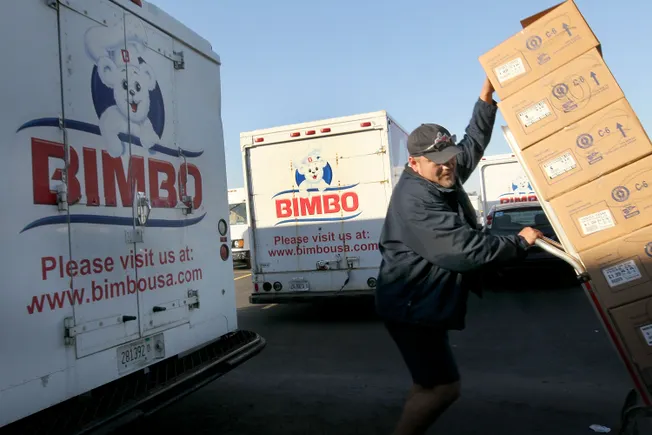
Grupo Bimbo, by many measures the world’s largest baking company, is undergoing a decade-long process of migrating an assortment of ERP systems to Oracle Fusion Cloud Applications.
Among its ambitious goals for centralizing on one SaaS application platform are end-to-end supply chain visibility and logistics efficiency, which makes sense for a company that operates in 93 countries directly or through partnerships. Its huge distribution network covers 249 bakeries and plants, 1,700-plus sales centers and more than 54,000 delivery routes.
“We spend more money on supply chain than we do on anything else in the business, so there’s a huge opportunity to get cash out, bring down waste, make sure trucks are loaded and that we’re getting the most efficiencies and effectivity of getting product to market,” said Rob Dombkowski, senior director of business technology, in an interview at the Oracle AI World conference in Las Vegas.
Consolidating on Fusion Cloud also reduces infrastructure costs and the number of systems to manage, while positioning Grupo Bimbo to take advantage of Fusion Cloud’s AI features, according to Dombkowski. But it also forces the company to change at a time when market and societal pressures are challenging enough.
Cloud ERP revamp on a global scale
Based in Mexico City, Grupo Bimbo earns $23 billion in annual revenue from selling more than 9,000 kinds of baked goods and salty snacks. Arnold, Entenmann’s, Freihofer’s, Sara Lee and Thomas’ are among its U.S. brands.
Before the migration project, half the world was on Release 11 of Oracle E-Business Suite, the on-premises ERP predecessor to Fusion Cloud, and the other half on R12, Dombkowski said. The warehouse and transportation management modules in the Oracle Fusion Cloud Supply Chain and Manufacturing suite were among the first to be deployed. The company also uses Fusion financials, procurement, order management and manufacturing and is continuing to roll out the ERP, HR and CX components. Enterprise asset management is also in the works, he said.
A former SAP shop, Bimbo Canada, serves as the “lighthouse” for the migration because 90% of its software is Oracle, except for a handheld system used by independent operators, Dombkowski said. The company is replicating that model in the U.S. and Mexico, then other countries, to establish an Oracle template.
“Probably in the last two years in the U.S. alone, we’ve implemented 56 bakeries and roughly 62 locations and distribution centers onto the solution,” he said, for a global total of more than 300 facilities.
“Manufacturing, distribution and even some of our sales centers have visibility into it,” he continued. “Now, we’re trying to leverage the supply chain planning parts to make sure we’re seeing end to end, then carving out savings as we go forward.”
Generational changes create challenges
The migration’s biggest challenges are typical of change management, especially getting people to change their work processes, according to Dombkowski. He is dealing with it amid major shifts in the work experience and technical savvy of the different generations leaving and joining the company.
“There seems to be a gap between about 30 years old and 45 years old in the industry, where — especially in supply chain — they don’t have a lot of process knowledge,” he said.
That cohort sits between the older generation that set up the business processes and retired around 2010, and the youngest, under-30 group arriving with degrees in supply chain management and a habit of querying AI instead of interacting directly with enterprise systems.
“You had this group in between that was just kind of picking things up and never really did an install or built out a new procedure,” he said.
The “old business guys” who knew how everything worked and could run the operation used ERP software to create standard operating procedures and hand them off to others, who then became the experts, Dombkowski said.
“Each time we hand that off, it’s like having a 40-year legacy system. You lose all the guys who really knew how the whole thing ran, and [newer workers] start to miss out on how the process runs,” he said.
The situation only worsened when the COVID-19 pandemic made it unsafe for workers to be on plant floors. Now, Dombkowski requires managers to visit plants and distribution centers to identify inefficiencies – a lean management practice called the Gemba walk. He envisions managers doing value stream mapping during walks by asking AI questions so it can suggest process improvements and spot omissions.
Today, younger workers come to their jobs trained to ask AI questions instead of noodling through problems on their own, he said.
“They are already using AI in everything they do and coming in and firing on all cylinders to take us to the next level. They think differently,” he said.
As a result, instead of learning to only use the Fusion software, workers must understand how a process or procedure works and what to ask for.
“We’ve got to train a whole new group of folks how to do that,” Dombkowski said.
The need to train younger workers has sparked a resurgence in basic courses from APICS, the main organization for supply chain training and certifications. Grupo Bimbo also has its own supply chain institute to teach core principles, process documentation and error detection.
AI to the rescue
Getting data ready for AI is another challenge.
“That’s one of the keys that we’re really pushing the business to understand — that they own the data and they have to truly own it,” Dombkowski said. “It’s not just about putting a number in there and saying it didn’t work today and the system is broken. No, you didn’t put the right information in there at the right price. That’s why I couldn’t get it to market today.”
The company has a team devoted to data management while others focus on implementation and maintenance.
AI use at Grupo Bimbo is in early stages and mostly involves features built into Microsoft 365 applications for rewriting letters and asking questions chatbots can answer by searching company documents, according to Dombkowski.
Now, employees are starting to try the AI apps in Oracle Fusion Cloud. One that Dombkowski finds exciting is the Logistics Execution Control Center, an AI-powered cockpit that unifies data from the warehouse and transportation management modules. He said he was impressed by a conference demo of Oracle Fusion Claw agentic AI that optimizes trucking capacity in response to user queries.
“That’s the piece that excites me the most because it’s finally getting to a point where you can ask questions and quickly get the answers at your fingertips, not wait weeks,” he said.
David Essex is a senior editor who creates in-depth content on enterprise applications, emerging technology and market trends for TechTarget’s CIO group.
