


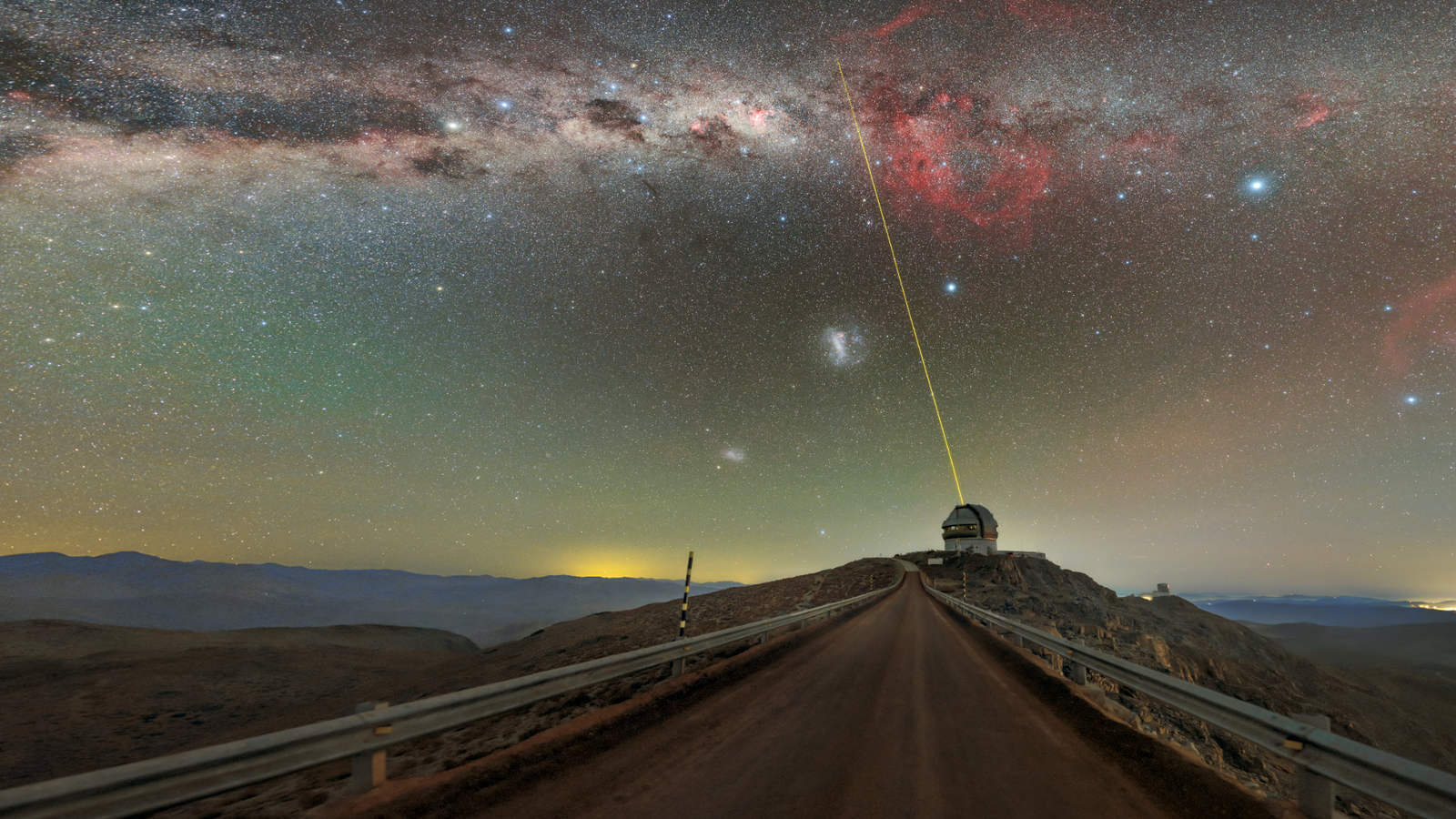
A laser star guide beams up from the Gemini South Observatory and into the Milky Way on Cerro Pachón, a mountain in central Chile.
What is it?
The Gemini South Observatory, located in Chile, is one of two Gemini Observatories with the other located in Hawaii (named Gemini North, or ‘Alopeke) on the volcano Mauna Kea.
Each Gemini Observatory has a 26.6-foot (8.1-meter) telescope. On the same mountain in Chile sits the 13.4-foot (4.1-meter) SOAR telescope.

In this photograph captured by Petr Horálek, an audiovisual ambassador for the U.S. national center for ground-based, nighttime optical astronomy at NOIRLab (the National Optical-Infrared Astronomy Research Laboratory), it looks like Gemini South is about to be beamed up into the night sky.
However, there isn’t some alien ship behind that laser beam. Instead, Gemini South is beaming up a laser guide star, or a powerful laser that creates the appearance of a fake star in the night sky. This fake star acts as a reference point, helping the telescope to calibrate and correct any light distortions.
Why is it incredible?
Even from just this photograph, which shows an observatory in action, it’s clear why this mountain is a hotspot for astronomical observing.
These peaks are chosen for many reasons, including their altitude and how far they are from bright lights that could affect observations. But even in a regular photograph, Horálek was able to show the incredible beauty of the glow of the Milky Way’s heart above the mountain range, with every color in the rainbow popping up in the gas and dust across our galaxy.
Even the framing of the shot draws you in, as the viewer feels almost pulled down the road toward the observatory and right up into the Milky Way.
