


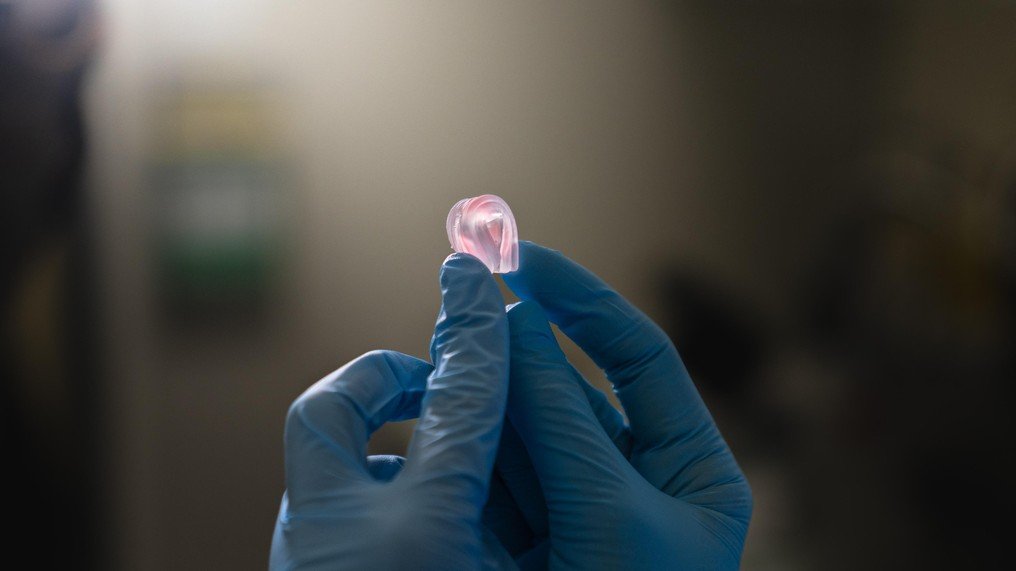
A new study in Science Advances finds that a rubbery material first engineered for 3D printing may resolve a problem that has long dogged materials science: producing printable elastomers that are simultaneously tough and durable.
Researchers at EPFL’s Soft Materials Laboratory (SMaL) report that the same architecture giving their double network granular elastomers (DNGEs) exceptional printability carries an unexpected bonus, strong resistance to both fracture and fatigue. That pairing is rare, since elastomers built to resist fracture tend to degrade under repeated stress, shortening their useful life, while fatigue-resistant ones often snap when overstretched or jolted.
The SMaL team, part of EPFL’s School of Engineering, first introduced DNGEs in 2024: flexible, rubber-like materials built from microscopic elastomer particles held together by a softer elastomer network, conceived as printing “inks” for structures with precisely tuned mechanical behavior.
“Originally, our focus was on improving processibility, but once we had the granular structure, we discovered that these materials are also very tough,” says SMaL head Esther Amstad. “Then, we realized that a lot of this toughness came from repetitive energy dissipation mechanisms, the material could absorb energy over and over without irreversibly breaking.”
Two Networks Sharing the Load
Amstad attributes the material’s ability to sidestep the usual toughness-versus-fatigue compromise to its unusually varied internal structure. “Essentially, the two different networks – one made of granular elastomer particles and one of soft elastomer – share mechanical strain between them, making the material stronger overall.”
The measurements bear this out. In testing, optimized DNGEs reached fracture toughness up to 15 times that of comparable elastomers and fatigue resistance up to three times higher. When the material is stretched, stress shifts away from the rigid microparticles into the softer zones around them, where strain energy is repeatedly released as polymer chains slide and rearrange rather than snap, keeping permanent damage to a minimum.
The granular layout also reroutes cracks: instead of running straight, they wander through the softer regions between particles, a meandering path that slows their advance and postpones failure.
From Lab to Longer-Lasting Devices
The work suggests that an architecture built to unlock advanced 3D printing could double as a blueprint for soft materials that simply last longer. Likely candidates include soft robots, flexible electronics, and biomedical devices, all of which endure repeated stress and deformation over extended lifetimes.
The group is now refining the material with sustainability in mind, exploring biodegradable elastomers and versions made from recycled feedstock.
“Our aim is to implement more sustainable materials without compromising on mechanics,” Amstad says. “By increasing the scope of materials we can use, we can not only reduce the DNGEs’ environmental footprint, but also make them even more widely accessible to any lab with a commercial 3D printer.”

Limits and Open Challenges
The approach carries clear trade-offs, and the main one is stiffness. Adding soft microparticles raises the elastomer’s stiffness only slightly, so DNGEs end up softer than the bulk double-network elastomers they outperform on toughness. Printing multi-material composites brings back some rigidity, but only partly, and the authors say improving this further is still future work.
Durability has a limit too. The repeatable, low-damage energy dissipation that gives DNGEs their fatigue resistance works only up to moderate strains. Stretch the material harder and covalent bonds start breaking inside the stiff microparticles, and that damage builds up until the part can fail. Repeated cycling can also heat the material, which is undesirable in some engineering uses, though the effect stayed limited in the tests, which ran well above the material’s glass transition temperature.
Fabrication adds its own constraints. Because the curing UV light penetrates the granular ink only so far, the team limited sample thickness to about 5 millimeters to keep curing even; making thicker parts would require a different way of forming the second network.
The study was authored by Eva Baur, John Kolinski, and Esther Amstad, all affiliated with EPFL, where Amstad heads the Soft Materials Laboratory. The work was financially supported by the Swiss National Center of Competence in Research (NCCR) Bioinspired Materials (grant 205603).
Engineering Durability Into Printable Soft Matter
EPFL builds performance into the material’s structure, not its chemistry. Its granular double-network design is both easy to extrude and unusually resilient, so the same ink that prints cleanly also withstands sustained, repeated flexing. That addresses the field’s central gap: soft components for robots, wearables, and implants tend to wear out under exactly the repeated stresses their jobs demand.
The drive to give printed soft matter better mechanics is a busy research front. Harvard’s multimaterial MM3D method combines soft elastomers with stiffer polymers and embedded channels in a single build, producing origami-like walking robots that carry several times their own weight, while CU Boulder’s OpenVCAD tool helps designers plan such graded-stiffness structures.
Together these efforts point toward printed soft materials that are not just flexible but built to endure. EPFL’s DNGEs advance that goal by solving toughness and fatigue at the same time.
3D Printing Industry is inviting speakers for its 2026 Additive Manufacturing Applications (AMA) series, covering Energy, Healthcare, Automotive and Mobility, Aerospace, Space and Defense, and Software. Each online event focuses on real production deployments, qualification, and supply chain integration. Practitioners interested in contributing can complete the call for speakers form here.
To stay up to date with the latest 3D printing news, don’t forget to subscribe to the 3D Printing Industry newsletter or follow us on LinkedIn.
Explore the full Future of 3D Printing and Executive Survey series from 3D Printing Industry, featuring perspectives from CEOs, engineers, and industry leaders on the industrialization of additive manufacturing, 3D printing industry trends 2026, qualification, supply chains, and additive manufacturing industry analysis.
Featured image shows double network granular elastomers (DNGEs). Photo via Titouan Veuillet.
