


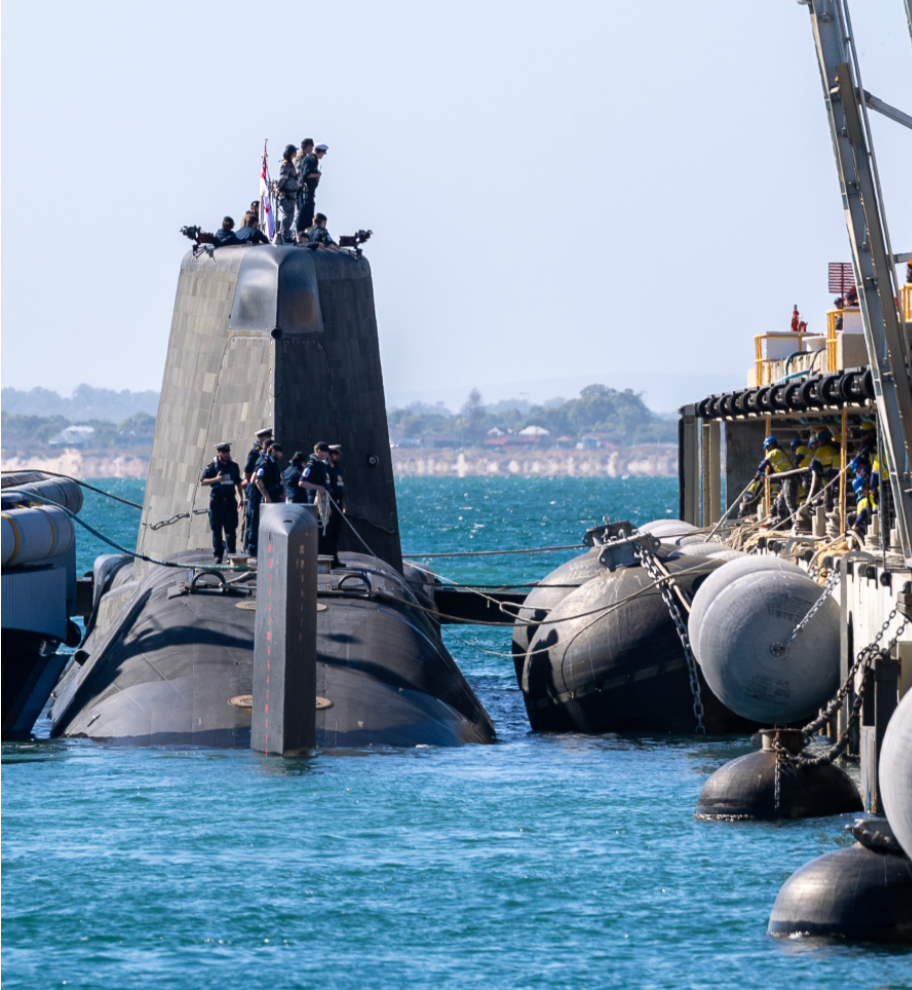
When Royal Australian Navy submarine HMS Anson required replacement components during a routine Submarine Maintenance Period (SMP) at HMAS Stirling, the conventional supply chain wasn’t an option. British defence technology QinetiQ stepped in, using additive manufacturing to design, produce, and deliver the parts in four weeks, a process that would typically take months or years.
It is the first time the Royal Navy has used advanced manufacturing to support a routine SMP in Australia, and a concrete step toward operationalising Submarine Rotational Force – West under AUKUS Pillar 1.
From UK Design to Australian Production
The operation was made possible by QinetiQ’s global footprint. Engineers in the UK reverse engineered the required components and securely transferred the technical data to QinetiQ Australia, which then coordinated production with local additive manufacturing SMEs in Perth, with additional parts produced on the East Coast and by QinetiQ Australia directly.
Once manufactured, the parts were reviewed and approved by the Submarine Delivery Group Additive Manufacturing Team before being delivered to the crew of HMS Anson, who installed them during the maintenance period.
“QinetiQ’s global reach and established local engineering capability enabled us to move quickly to support HMS Anson in Australia. We will continue to support AUKUS Pillar 1 activities and provide opportunities to Australian companies to be part of this internationally significant, complex supply chain,” said Corry Neale, Chief Executive, QinetiQ Australia.
AUKUS and the Push for Sovereign Naval AM Capability
QinetiQ’s deployment sits within a rapidly expanding effort across AUKUS partners to embed additive manufacturing into naval supply chains, not as a backup option, but as a primary tool for operational resilience.
Australia’s role in that effort is growing. In 2025, WAAM specialist AML3D delivered 3D printed components for the US Navy’s Virginia-Class nuclear submarine program, manufacturing the Copper-Nickel parts in under five weeks against a 17-month lead time by conventional methods. Later, ASC and Austal formalised a collaboration to advance Australia’s domestic additive manufacturing supply chain for both Collins Class and Virginia Class submarines, alongside workforce training programs.

The HMS Anson operation adds to this picture, demonstrating that distributed, cross-border AM production can meet the certification and timeline demands of live maintenance, not just procurement pipelines.
3D Printing Industry is inviting speakers for its 2026 Additive Manufacturing Applications (AMA) series, covering Energy, Healthcare, Automotive and Mobility, Aerospace, Space and Defense, and Software. Each online event focuses on real production deployments, qualification, and supply chain integration. Practitioners interested in contributing can complete the call for speakers form here.
To stay up to date with the latest 3D printing news, don’t forget to subscribe to the 3D Printing Industry newsletter or follow us on LinkedIn.
Explore the full Future of 3D Printing and Executive Survey series from 3D Printing Industry, featuring perspectives from CEOs, engineers, and industry leaders on the industrialization of additive manufacturing, 3D printing industry trends 2026, qualification, supply chains, and additive manufacturing industry analysis.
Featured image shows QinetiQ supports HMS Anson deployment. Photo via QinetiQ.
