



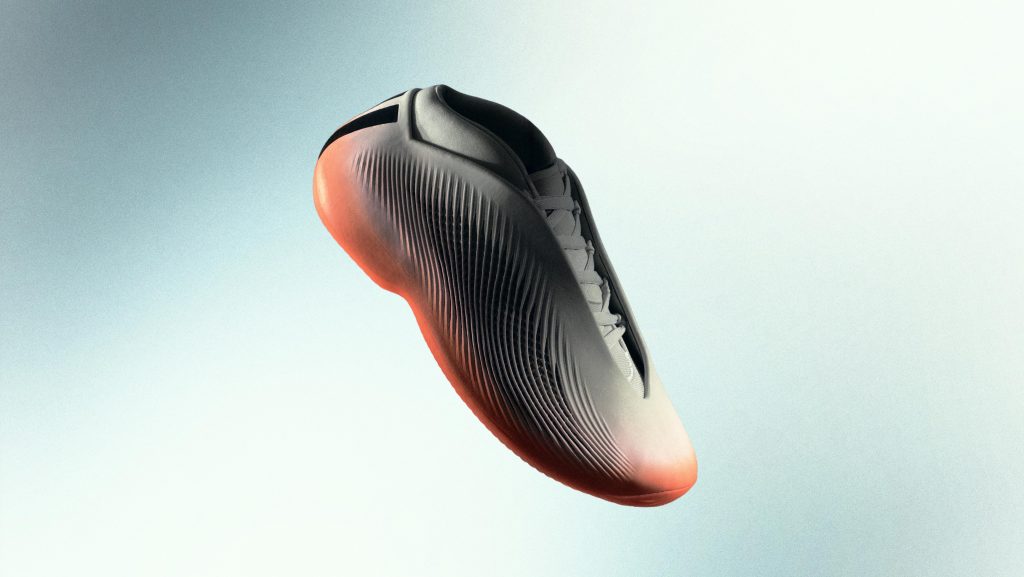
Philadelphia Union midfielder Cavan Sullivan made history on July 23, 2026, becoming the first footballer to wear a fully 3D printed boot in a top-level competitive match. The 16-year-old debuted Adidas’ Project R.A.P. (Radical Athlete Perception) football boot during Philadelphia’s 3–1 MLS victory over the New York Red Bulls, wearing a pair custom-printed to the exact specifications of his feet.
Project R.A.P. uses additive manufacturing to create footwear tailored to an individual athlete’s anatomy and the specific demands of their sport. Adidas describes the boot as a “future-facing live innovation concept,” with no launch date or consumer release yet confirmed.
Adidas Chief Creative Officer Alasdhair Willis said Sullivan was the ideal athlete to introduce the technology in a competitive match rather than a training environment. “Cavan is the perfect athlete to showcase the potential of this innovation, a future star on and off the field, with an open and curious mindset matched by an exciting playing style.”
The rollout is set to continue with two established Adidas athletes. Paris Saint-Germain winger Khvicha Kvaratskhelia and Atlético Madrid forward Ademola Lookman both contributed feedback during the boot’s development. Lookman was previously photographed testing a prototype in training, and both players are expected to wear the boots during the upcoming European season.
A platform that started with basketball, not football
Although the football boot is Project R.A.P.’s most high-profile release, it is actually the platform’s second product. The first was the BB.01 basketball shoe, which launched in an intentionally limited run of 169 pairs worldwide. Fifty pairs were sold at Adidas’ Las Vegas flagship store on July 10, 89 pairs were released through the Adidas CONFIRMED app on July 14 for $250, and the remaining 30 pairs were allocated to Greater China.
The BB.01 features a fully 3D printed lattice structure designed to deliver what Adidas describes as “a bespoke future feel to every movement.” It made its on-court debut at the NBA Summer League on Adidas athlete Mikel Brown Jr.
Alexander Taylor, Adidas’ Senior Vice President of Innovation Design and Concepts, said the platform is built around the belief that advanced manufacturing can unlock new levels of athletic performance. “We built Project: R.A.P. around a simple belief that athletes are capable of more, and the right technology can unlock it.”
Adidas isn’t alone in chasing athlete-specific fit
Project R.A.P. sits inside a wave of recent releases chasing the same idea: build the product around one athlete’s data rather than a standard size. Just days before Sullivan’s debut, Actble and Something Added 3D printed a pointe shoe designed to last five times longer than a conventional one, splitting the shoe into a 3D printed inner sole, a compression-fit knitted “skin,” and laces so a dancer’s most heavily worn component can be replaced without rebuilding the whole shoe. In cycling, German startup HEZO uses a smartphone app to capture roughly 1,000 data points per foot and prints each pair individually to order, targeting riders with asymmetrical feet or pressure-related discomfort that standard sizing can’t fix.
Adidas itself has kept building beyond R.A.P.: in March 2026, it scaled its 3D printed Climacool Laced sneaker to a global release fronted by NBA player Jalen Williams and WNBA player Kahleah Copper, positioning printed cushioning and airflow specifically around athletes’ post-game recovery rather than general retail comfort.
What’s different this time is the direction the process runs in. Earlier 3D printed releases largely still started from a standard shoe and modified it; Project R.A.P. is built around starting from an individual athlete’s data and generating the product from there.
3D Printing Industry is inviting speakers for its 2026 Additive Manufacturing Applications (AMA) series, covering Energy, Healthcare, Automotive and Mobility, Aerospace, Space and Defense, and Software. Each online event focuses on real production deployments, qualification, and supply chain integration. Practitioners interested in contributing can complete the call for speakers form here.
To stay up to date with the latest 3D printing news, don’t forget to subscribe to the 3D Printing Industry newsletter or follow us on LinkedIn.
Explore the full Future of 3D Printing and Executive Survey series from 3D Printing Industry, featuring perspectives from CEOs, engineers, and industry leaders on the industrialization of additive manufacturing, 3D printing industry trends 2026, qualification, supply chains, and additive manufacturing industry analysis.
Featured image shows Cavan Sullivan brings the RAP Project to football. Photo via Adidas.
