


Two days of presentations in Toulouse last week showed how test engineers are blending simulation with physical testing, putting AI to work and getting more from their data, as well as what hydrogen will demand of their sensors
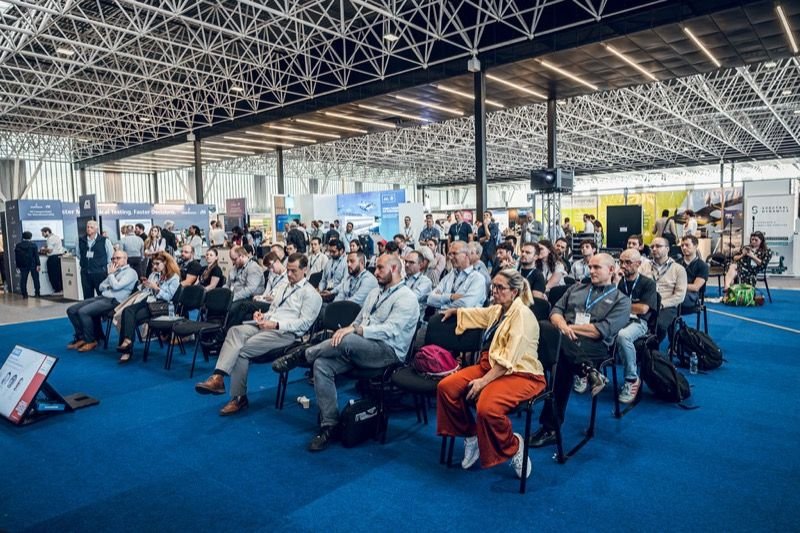
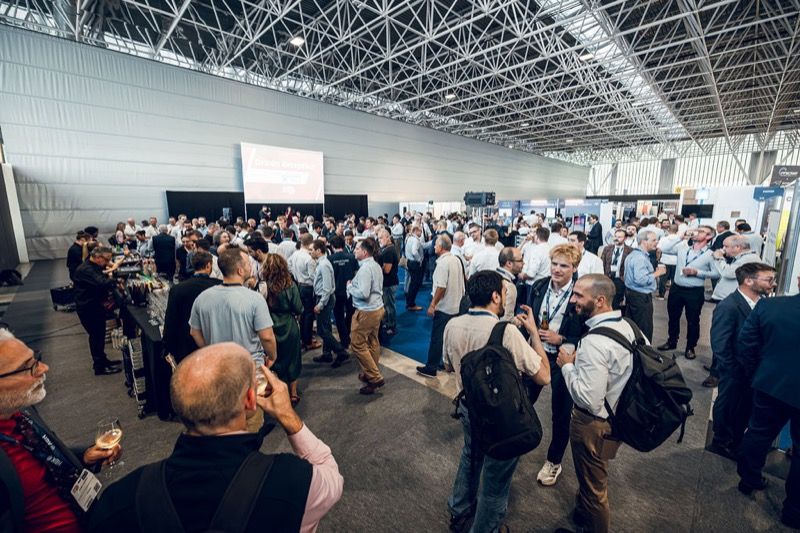
The Open Testing Forum at the Aerospace Test & Development Show (ATDS) 2026 opened with an unplanned reminder of why testing matters. As more than 2,000 visitors gathered at MEETT in Toulouse on September 29, the Airbus A350F flew overhead on its first flight.
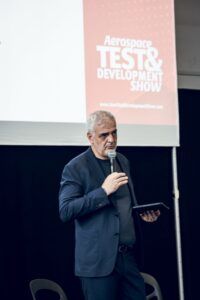
“It’s a fantastic symbol to open this show,” said Frédéric Marchetto, deputy director of strategy for the aerospace sector from Aerospace Valley. The regional aerospace cluster is a long time supporter of the ATDS event, and Marchetto revealed to the audience the exhibition had grown 20% on last year to 150 exhibitors.
More than 30 presentations and two panel discussions filled the Forum over two days. Four main themes ran through most of them: hybrid testing, AI, data handling and new sensing and measurement technologies. A fifth theme, hydrogen, gave a preview of the hardest testing problems to come.
Hybrid testing moves from ambition to method
Thierry Raffy, vice president of test and analytics engineering at Airbus, set the tone in the opening keynote. Airbus is challenging itself to halve testing time for its next aircraft, he said.
The European aircraft manufacturer is looking to three tools to achieve this: completely virtual testing, hybrid testing, which keeps real hardware in the loop with simulation around it and automation that keeps rigs running through the weekend.
Raffy described how engineers in India already operate rigs in Europe remotely on a follow-the-sun basis. The aim is to do more on the ground, so that the company can “fly to confirm, not to discover”, he added.
Jean-Philippe Navarro, expert in advanced modelling, hybrid testing technical leader, Airbus explained how the same goal applies to structures. With structures the test pyramid – from coupons and components up to full-scale tests – underpins certification. Advanced simulation offers a way to optimize structures testing.
However, asked outright by a delegate if new structures could one day be certified without physical tests, Navarro said he found it difficult to imagine. “I don’t like the word eliminate, reduce or replace,” he said
Nils Röttger, head of architecture and platform DAQ solutions at HBK, described smart testing as virtual and physical testing “connected by a strong data backbone”. At DLR’s Virtual Product House in Bremen, Kristof Risse showed the WISDOM rig. It tests flight control movables for high-aspect-ratio wings in the loop with a real-time aircraft model.
AVL’s Copper Bird approach, presented by the company’s vice president of industry solutions Sascha Heinecke, applies the same principle to hybrid-electric propulsion. It emulates motors and fuel cells around real inverters and cabling. A test case that takes three to four days on a conventional testbed runs in around five seconds in emulation, he said.
AI as the test engineer’s assistant
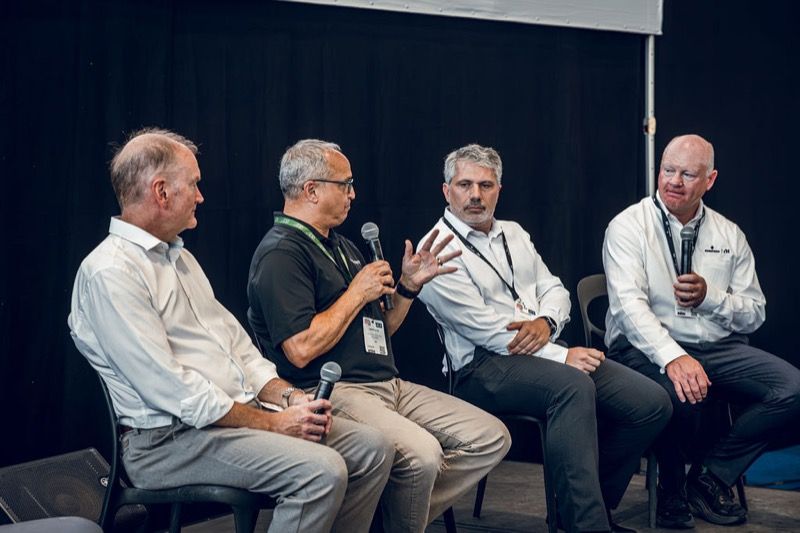
Steve Summers director of offering management at NI chaired the Day 1 panel on AI. He admitted he was surprised how little AI had been discussed compared with other conferences. Where it did appear, speakers presented it as support for engineering judgment.
On the panel, Darryn La Zar senior director of business development at ACS said his company now uses AI to write the custom manuals that accompany its bespoke test systems. Wes Ramm, director of engineering at Lat 51 Space Systems described using AI to reverse engineer undocumented 1990s assembly code in mission-critical hardware, checking each step with an oscilloscope. “AI makes it cheap to get an answer, but it’s expensive to get the right answer,” he said.
The panel also raised a concern. If AI handles routine work, junior engineers may never build the experience their seniors gained by doing it.
Data handling: using what is already collected
Raffy estimated that Airbus uses less than 20% of its test data. Weak signals missed during testing can surface as in-service problems years later, he said.
Matthias Baert co-founder and CEO of Marple described the scale of the challenge during his presentation. A flight test campaign with 10,000 signals sampled at up to 10,000Hz generates a million data points per second or more. Marple’s answer is a queryable data lake that links time-series data with test cards and metadata. It supports automatic test plan validation and anomaly detection.
Jean-François Lescure, field product specialist at Teradyne presented the example of testing active electronically scanned array (AESA) radars, which he said are turning into “huge data factories”. Testing them demands scalable ports, protocol-aware instruments and real-time storage.
Data also brings security obligations. During his presentation Summers warned that the EU Cyber Resilience Act will stop unprepared suppliers selling into Europe from December 2027. “If you’re starting now, you’re late,” he said.
Trusting the measurement
New sensors and instrumentation featured strongly throughout the two days. Carmine Salzano, international manager of aerospace and defense and test sector of PCB Piezotronics described sensors for hydrogen environments on day one. They include an accelerometer and cable rated to 2,000V to withstand arcing in liquid hydrogen, and charge-output sensors rated to -436°F (-260°C).
On day two, Philipp Ziegler senior application engineer from Xarion Laser Acoustics presented its NDT technology – laser-excited ultrasonic testing, which needs no contact or water couplant. He said it is already qualified in production for helicopter tail booms.
The day two panel on signal integrity and the evidence chain asked how engineers can trust what their instrumentation reports. “Just about anything can go wrong at any time,” warned Kevin Cornacchio of Precision Filters. He argued for sensor and cable health monitoring, pre-test verification with known signals and live fault monitoring during the test. Röttger, who also sat on the panel, said AI could support measurement at every stage, from test setup to real-time uncertainty analysis and post-test analytics.
Hydrogen sets the hardest test problems
Helen Leadbetter, technical strategy lead zero emissions flight at the UK’s Civil Aviation Authority, said the regulator had identified 70 requirements to change in CS-23, the certification specification for small aircraft. Industry is at around technology readiness level (TRL) 6 for gaseous hydrogen and TRL 3 or below for liquid hydrogen, she said.
Guidance can take 18 months to produce and legislation up to three years, so she urged developers to engage regulators early. She estimated that around half the time, no regulation yet exists to support a new technology.
Arne te Nijenhuis from the Netherlands Aerospace Centre (NLR) presented the ICEFlight benches for cryogenic thermal-pressure cycling and vibration testing of superconducting powertrain equipment to the Forum. In addition, showing hydrogen development is still progressing in Europe, Bastien Schnitzler, strategy and IP engineer from Beyond Aero described how the company now runs a 1.2MW half-aircraft hydrogen-electric powertrain rig in Toulouse.
Physical testing keeps the final word
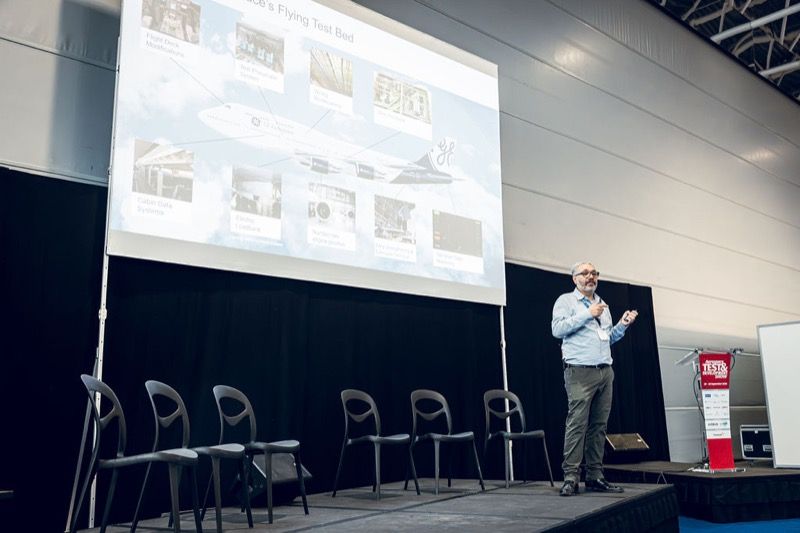
Despite all the talk of simulation and AI, flight test was well represented at the Open Testing Forum. Carlos Santos opened day two with an indepth description of GE Aerospace’s 747 flying testbed, which is due to fly CFM’s RISE open fan demonstrator. Alessandro Ramazzotti of the Empire Test Pilots’ School (ETPS) reminded delegates of the flight test engineer’s creed during his presentation: when flight results contradict the theory, it is usually the theory that is wrong.
Nevertheless, the challenge Raffy set out in the opening keynote framed much of the discussion that followed. Testing teams are being asked to test more complex systems, to test earlier and to test faster, without compromising on safety.
No speaker presented a simple, one line answer to this challenge. Hybrid testing, AI, better data handling and new sensors and instrumentation each take a share of the problem, but each still depends on experienced engineers who know where the physical test has the final say.
So this year’s show theme, “Testing at the rate of demand”, was an apt one. Marchetto summed it up neatly with a rugby analogy in his opening address. Certification or a first flight is the try, he said, but it rests on the scrums and tackles that happen out of sight in the laboratory. “No test, no first flight.”
ATDS returns to MEETT, Toulouse, on 29-30 September 2027. Secure your booth or space now!
