


As the AMA:Energy conference returns on April 30th to highlight qualified parts, real-world deployment, and energy-sector constraints, hydrogen production and storage technologies are becoming an increasingly prominent focus. Previous discussions pointed to the challenges of scaling electrolysis systems, particularly in relation to material limitations, system complexity, and long-term reliability.
Within this context, ceramic additive manufacturing is being explored as a potential route to redesign solid oxide electrolysis systems, enabling new geometries and improved performance.
3DCeram Sinto is developing even further ceramic 3D printing technology for solid oxide electrolysis cells (SOECs), targeting improved hydrogen production and energy storage. The France-based company focuses on stereolithography (SLA)-based additive manufacturing, using a top-down process and low-viscosity ceramic slurries to enable scalable production of complex components.
Ceramic 3D printing addresses SOEC limitations
Conventional SOEC systems rely on flat ceramic membranes produced through tape casting or screen printing, which are highly sensitive to pressure variations. Pressure differences above approximately 40 millibars can induce mechanical failure, requiring complex pressurized vessels and limiting scalability.
Within the HYP3D project, partners are developing compact, high-pressure electrolysis systems using zirconia 8Y, a material selected for its ionic conductivity, chemical stability, and thermal resistance.
Corrugated zirconia cells improve performance and durability
Using additive manufacturing, the project introduces a corrugated cell design with thicknesses of 250–300 µm, increasing reactive surface area by approximately 60%. The geometry also improves electrochemical efficiency, requiring lower voltage to achieve comparable current density.
Simulation and testing indicate significantly improved mechanical performance compared to flat cells. The corrugated structures withstand pressure differentials of up to approximately 1,100 millibars, compared to failure thresholds near 40 millibars for conventional designs.
This increase in pressure tolerance enables the removal of external pressurized vessels, simplifying system architecture. The design also allows metallic interconnects to be reduced to flat components, further decreasing system complexity.
From materials development to scalable production
Development efforts focused on optimizing zirconia 8Y slurry formulations to balance printability and dimensional stability. Adjustments to ceramic loading, powder properties, and binder composition enabled the production of thin, large-area components while minimizing deformation during sintering.
Validated designs were scaled across multiple machine platforms and integrated into stack configurations. Early tests achieved current densities of approximately 450 mA/cm², with ongoing work addressing contact losses and system integration.
Increasing productivity for industrial deployment
To support industrial-scale hydrogen systems, manufacturing throughput has been increased through machine redesign. Updates include multi-laser configurations, expanded build platforms, and dual-platform operation to reduce downtime.
These changes have resulted in more than a fourfold increase in cell output and a sixfold increase in processed surface area. The system has been deployed with a project partner for further validation.
Hydrogen storage as a driver for adoption
The work aligns with broader European efforts to expand hydrogen as an energy carrier for renewable systems. Hydrogen enables long-term storage of energy generated from intermittent sources such as wind and solar, supporting decarbonization across energy-intensive sectors.
Ceramic additive manufacturing advances toward industrial production
3DCeram Sinto has previously introduced AI-driven tools to optimize printing performance and reliability, while broader efforts are exploring automation and advanced materials for serial production. Ceramic 3D printing is enabling components for demanding environments, including aerospace propulsion systems, driving adoption of ceramic additive manufacturing in high-performance industries.
3D Printing Industry is inviting speakers for its 2026 Additive Manufacturing Applications (AMA) series, covering Energy, Healthcare, Automotive and Mobility, Aerospace, Space and Defense, and Software. Each online event focuses on real production deployments, qualification, and supply chain integration. Practitioners interested in contributing can complete the call for speakers form here.
To stay up to date with the latest 3D printing news, don’t forget to subscribe to the 3D Printing Industry newsletter or follow us on LinkedIn.
Explore the full Future of 3D Printing and Executive Survey series from 3D Printing Industry, featuring perspectives from CEOs, engineers, and industry leaders on the industrialization of additive manufacturing, 3D printing industry trends 2026, qualification, supply chains, and additive manufacturing industry analysis.
Register now for AMA: Energy 2026.
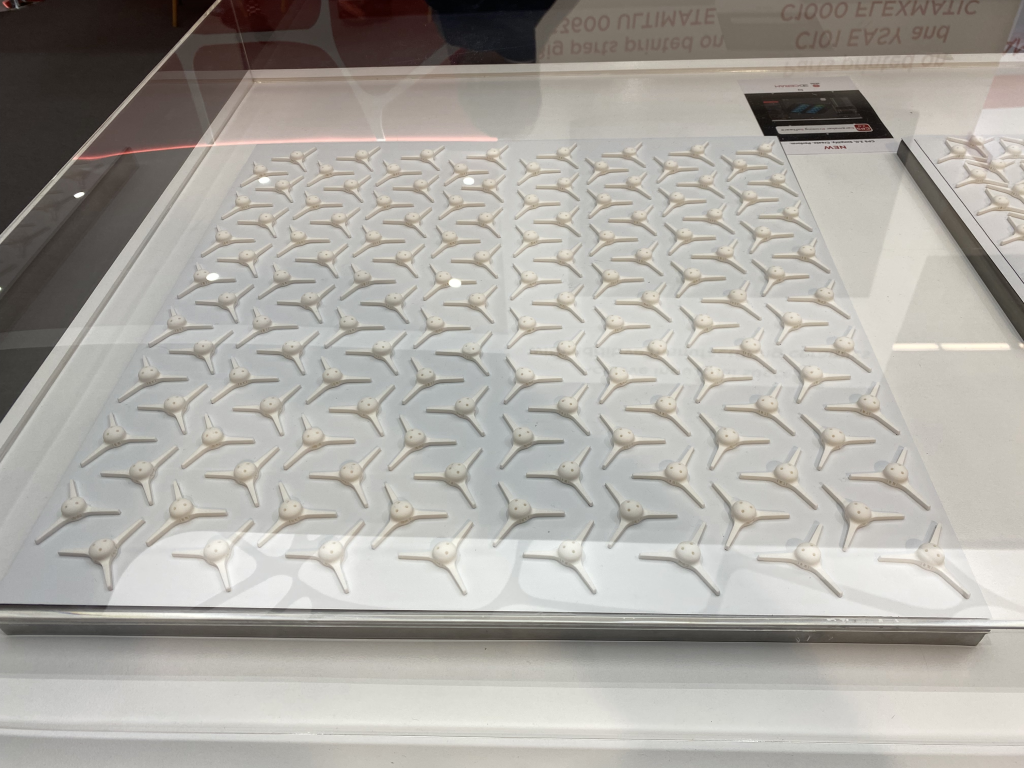
Feature image shows a production run of ceramic parts 3D printed by 3DCeram Sinto. Photo by 3D Printing Industry.
