


As the industry prepares for AMA: Healthcare on June 4th, few material challenges in 3D printing healthcare have proven as persistent as silicone. Too liquid to stack, too chemically sensitive to alter, and too regulated to compromise, it has long resisted conventional printing approaches.
Elastomeric AM solution provider Lynxter has spent nearly a decade working to change that. The French manufacturer has moved silicone extrusion beyond laboratory settings into functional medical device production, positioning its material extrusion platform as the primary pathway for healthcare organizations seeking end-use parts that meet the durability and chemical inertia demands of clinical environments.
“The question was never whether silicone could be printed. The question was whether it could be printed to a standard that clinicians would trust. That is what we have spent the last decade answering,” said Thomas Batigne, CEO of Lynxter.
Get more medical insights, register now for our AMA: Healthcare 2026 online conference!
From Engineering School Project to Elastomer Specialist
What began as a student printer project at a French engineering school became a commercial operation after Airbus identified the technology and placed an order, effectively founding Lynxter in 2016. Based in Bayonne with a team of 35 and a partner-driven international distribution model, the company has since concentrated its development on a segment most additive manufacturing players have avoided, liquid elastomers, and silicone in particular.
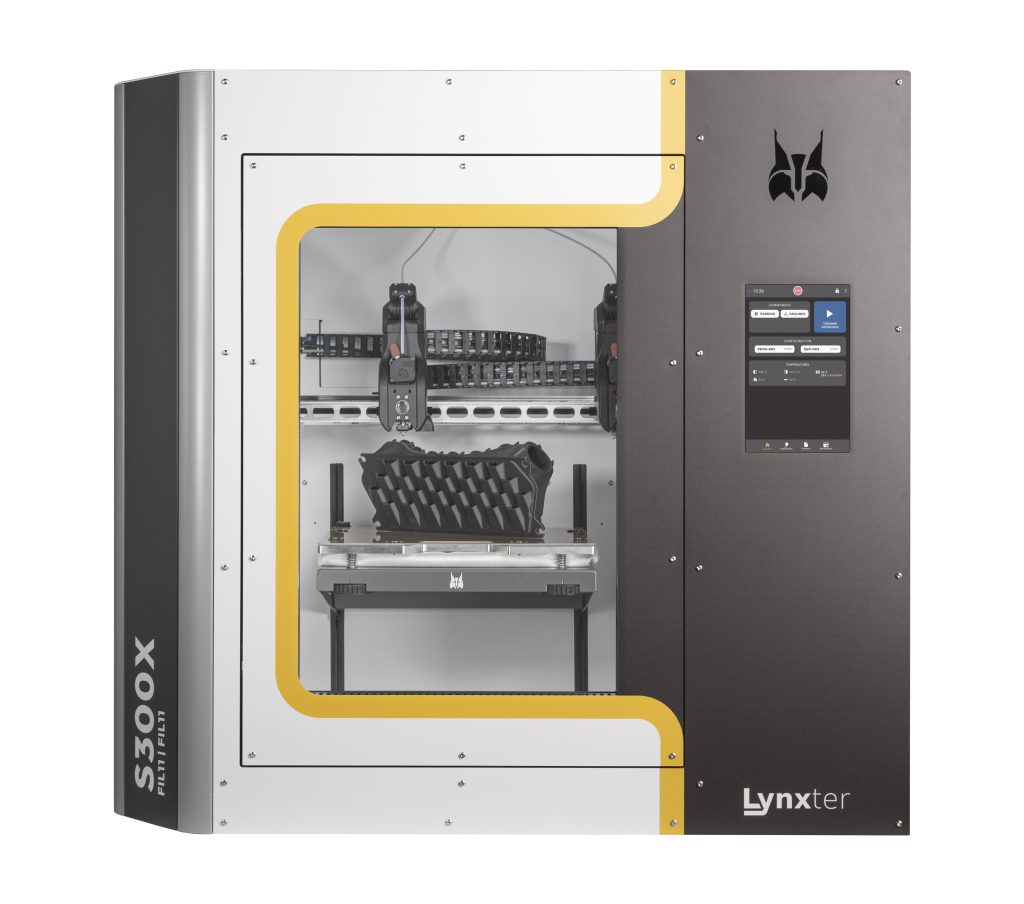
The company offers two hardware platforms. The S600D is a modular system accepting interchangeable tool heads for thermoplastics, liquid elastomers, ceramic pastes, and experimental bio gels. The S300X – LIQ 21 | LIQ11 is a purpose-built silicone printer incorporating a water-soluble secondary support head, offering higher throughput and features specifically engineered for complex healthcare geometries.
Silicone Resisted Additive Manufacturing
Silicone has historically been processed through injection or casting, with material selection driven by viscosity, part geometry, and production volume. As a one or two-part system that crosslinks either through moisture or through the reaction between components, it has served industries from aerospace to healthcare reliably for decades.
“The problem was never performance, it was access. For low-volume customized production, prototyping, and spare parts, injection and casting impose tooling costs and lead times that make small runs commercially unviable. No additive manufacturing solution existed that could deliver silicone’s material properties without compromising them in the process,” said Batigne.
Lynxter’s response was material extrusion, a deliberate choice that trades resolution for functional integrity. The platform miniaturizes the injection pump into a dual micro-dosing system capable of combining silicone parts A and B at ratios accurate to a tenth of a milliliter. The two components meet in a static mixer during extrusion, triggering crosslinking without any heat input. The process looks like FDM printing. The chemistry is injection molding.
The primary engineering challenge that followed was structural: silicone in its liquid state has no inherent resistance to collapse between layers. Lynxter’s process control know-how, governing both the chemistry parameters and the print parameters simultaneously, keeps each extruded line in place and ensures layers fuse correctly as the part builds.
A further discovery emerged during development: crosslinking gradually across groups of layers rather than layer by layer produces a homogenous part with isotropic mechanical properties, meaning the finished silicone performs consistently in every direction. That characteristic, comparable to what injection molding delivers and rare in additive manufacturing, is what makes the parts predictable enough for regulated applications.
The remaining geometric challenge was overhangs. Standard scaffold supports fuse permanently with silicone during printing and cannot be removed without damaging the part. Lynxter resolved this by developing a second tool head that deposits a gel-like support material, enabling complex geometries while preserving the isotropic properties of the final part.

From Water-Soluble Gel to Functional Powder
Beyond the core extrusion process, the platform supports three distinct approaches for handling complex geometries. The first uses a water-soluble gel support that dissolves in pure water with no solvent required, the same mechanism familiar from FDM thermoplastic printing, adapted for silicone.
The second places the part directly inside a vat of gel, eliminating the need for discrete support structures entirely and enabling lattice geometries and vase-mode strategies while preserving the same material properties throughout. The third, developed in partnership with 3Deus Dynamics, replaces the gel with a functional powder that either dissolves post-print or contributes material properties to the finished part, ceramic filling for flame retardancy, copper for thermal conductivity.
The platform also supports surface printing for texture generation, color and filler customization, and the incorporation of sensors and inserts during the extrusion process, capabilities that extend the application range without requiring post-processing steps.
Silicone Printing Meets Clinical Practice
The clinical application portfolio that has emerged from these capabilities spans patient-specific devices, surgical training infrastructure, simulation systems, and manufacturing tooling. Personalized ostomy bag adapters, printed to individual anatomy to eliminate leakage, represent one of the clearest cases for additive manufacturing over conventional production: the geometry is unique to each patient, the material must be medical grade and body-compatible, and no injection tooling can be economically justified at that volume.

Surgical training has become one of the platform’s most active application areas. In collaboration with 3Deus Dynamics, Lynxter’s technology is producing aortic simulators with controlled porosity that replicates the tear dynamics of actual tissue.
“The same dual-head architecture has been repurposed to deposit synthetic blood within vascular models, adding procedural realism to training scenarios that previously relied on animal or cadaver material, properties that are simply unachievable through any other manufacturing process,” said Batigne..
Regulatory Pathways and Institutional Partnerships
Two institutional partnerships are shaping the technology’s regulatory trajectory. The Paris Hospital and its PRIM3D platform are working with Lynxter to develop anatomical models, establish simulation standards, and advance the qualification of point-of-care medical device printing as a hospital-level practice.
The second partnership, with 3Deus Dynamics, takes a different form: the company has qualified its manufacturing plant for on-demand certified medical device production, providing a pathway for organizations that require the highest certification levels without internalizing the qualification process themselves.
On regulatory readiness, Batigne was precise: the material is not the constraint. Off-the-shelf silicones processed by Lynxter systems already carry skin-contact and prosthetic liner qualifications, and implantable-grade materials are processable.
“What determines certification is the post-print cleaning protocol, the production environment, and whether the part geometry allows cleaning access,” said Batigne.
Silicone in Medical Devices: The Manufacturing Gap Additive Is Working to Close
Silicone has been the material of choice for soft medical devices for decades precisely because of its biocompatibility, flexibility, and chemical inertia. The manufacturing constraint has never been the material, but the tooling. Conventional injection molding and casting require significant upfront investment that makes low-volume, patient-specific production economically unviable.
Custom silicone ostomy bag adapters producer Odapt, identified this gap precisely, more than 13 million people globally rely on ostomy devices, yet no additive manufacturing solution existed that could deliver patient-specific silicone geometries to clinical standards. Their co-founder noted the challenge directly: “You need to certify not only the machine and the material but the whole process.”
That certification challenge is what the field is actively working to resolve. Spectroplast completed a Series A round in late 2024 to expand its silicone platform specifically into patient-specific medical applications, such as hearing aids, prosthetics, and implants — with clinical certification as the stated next milestone.
3Deus Dynamics obtained ISO 13485 for its medical silicone production in 2023, establishing the quality management framework, traceability, risk management, and process control that clinical-grade silicone manufacturing requires. At Formnext 2025, Stratasys introduced P3 Silicone 25A for biocompatible applications, signaling that major platform manufacturers are now treating certified silicone production as a mainstream medical offering.
What these efforts share is a common understanding: the material is not the barrier. The process, the environment, and the documentation around it are what determine whether printed silicone can reach clinical use, and that work is still being established across the sector.
3D Printing Industry is inviting speakers for its 2026 Additive Manufacturing Applications (AMA) series, covering Energy, Healthcare, Automotive and Mobility, Aerospace, Space and Defense, and Software. Each online event focuses on real production deployments, qualification, and supply chain integration. Practitioners interested in contributing can complete the call for speakers form here.
To stay up to date with the latest 3D printing news, don’t forget to subscribe to the 3D Printing Industry newsletter or follow us on LinkedIn.
Explore the full Future of 3D Printing and Executive Survey series from 3D Printing Industry, featuring perspectives from CEOs, engineers, and industry leaders on the industrialization of additive manufacturing, 3D printing industry trends 2026, qualification, supply chains, and additive manufacturing industry analysis.
Register now to learn from healthcare AM leaders and expand your medical 3D printing network.
Featured image shows AMA Healthcare. Photo via 3D Printing Industry.
