


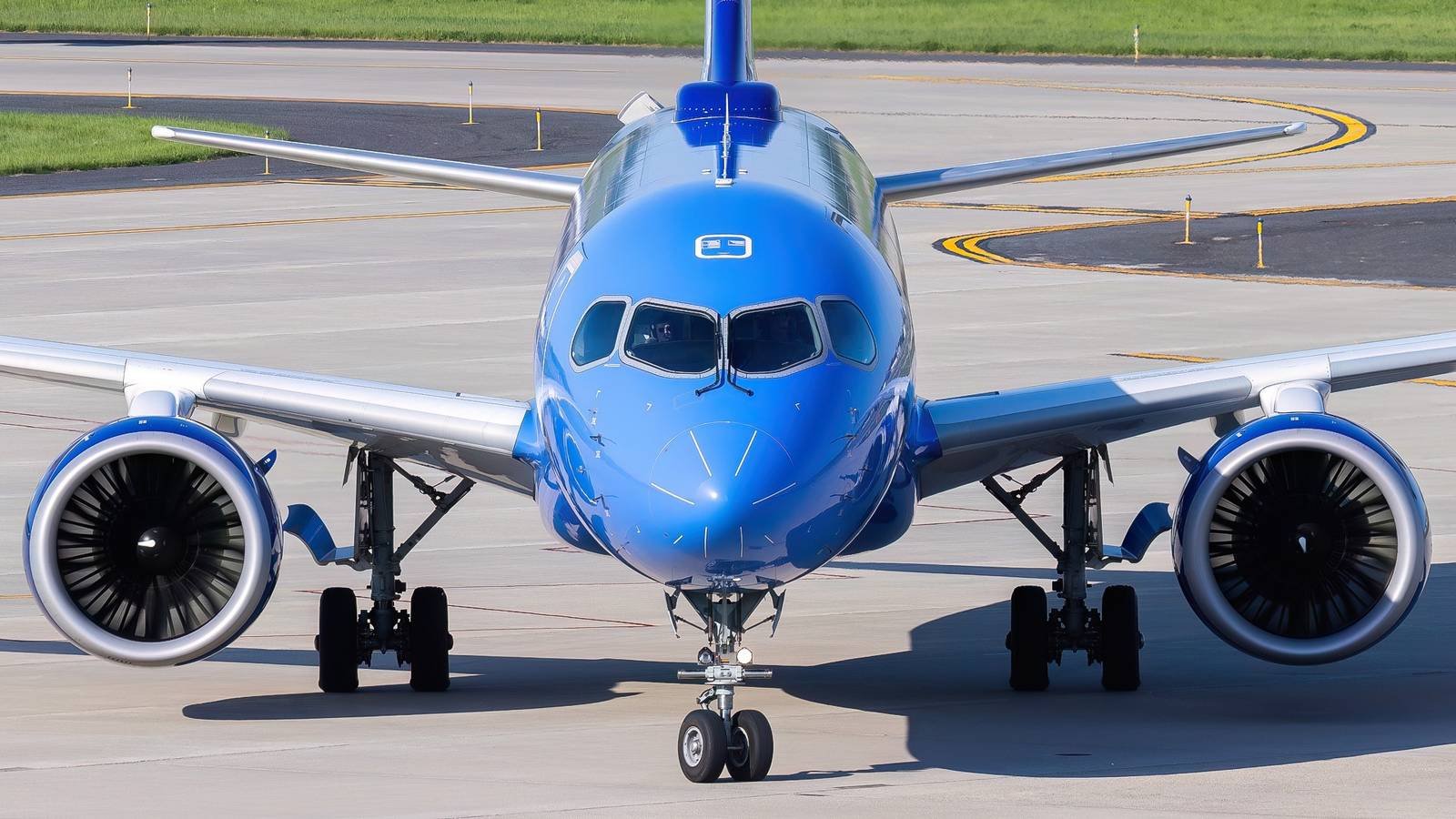
Breeze Airways is adding three more cities to its growing network, continuing a strategy built around smaller and underserved markets that often sit outside the focus of the largest US airlines. The carrier has announced 11 new nonstop routes, three new cities, and several one-stop BreezeThru links, with service beginning between September and January .
The expansion adds Baltimore, Dayton, and Trenton to Breeze’s map, while also bringing new service to large Breeze bases such as Raleigh–Durham International Airport (RDU), Charleston Air Force Base-International Airport (CHS) and Southwest Florida International Airport (RSW). It is the latest sign that Breeze is still chasing breadth across the US, but it also comes as the airline begins to show more signs of network depth in several key cities.
Three New Cities Join The Breeze Map
The largest of the three new cities is Baltimore, which will also be the most competitive. Baltimore/Washington International Thurgood Marshall Airport (BWI) is dominated by  Southwest Airlines, which makes Breeze’s entry notable. However, Breeze is not trying to challenge Southwest on big trunk routes. Instead, it is adding Baltimore to Burlington and Vero Beach, two thinner markets where a low-frequency nonstop can be more compelling than a connection. That fits the Breeze model: avoid the biggest fare wars, find overlooked city pairs, and use nonstop service as the selling point.
New Breeze City | Airport | Largest Incumbents | Notes |
|---|---|---|---|
Baltimore | BWI | Southwest | Large Southwest airport; Breeze is targeting thinner niche routes |
Dayton | DAY | American, Delta, United | Legacy-carrier market with leisure opportunity to Florida |
Trenton | TTN | Frontier, Allegiant | Small low-cost airport with new Breeze competition |
James M Cox Dayton International Airport (DAY) is perhaps the most classic Breeze-style addition. The Ohio airport has only 16 non-stop destinations, primarily legacy carriers feeding passengers to their respective hubs, with the largest operator being  American Airlines. Breeze is entering with new, uncontested routes to Fort Lauderdale, Fort Myers, and Raleigh-Durham, plus a BreezeThru connection to Sarasota-Bradenton. For Dayton travelers, the pitch is simple: direct access to Florida and a growing Breeze focus city at RDU, without requiring a connection through a major hub.
Trenton-Mercer Airport (TTN) is the most intriguing addition. The New Jersey airport has historically been closely associated with Frontier Airlines, which has historically offered low-cost routes to Florida. More recently, Allegiant Air has also moved in, and now Breeze is entering the market with nonstop flights to Charleston, Fort Myers, and Vero Beach, plus a BreezeThru link to Fort Lauderdale. This gives Trenton a third carrier, while giving Breeze access to a small airport serving eastern New Jersey and the Philadelphia suburbs.
It is notable that these three new cities also come after Breeze has already added several other cities earlier this year, including Atlantic City, Brownsville, Nassau, Birmingham, Tallahassee, San José in Costa Rica, and St. Thomas.
Eleven New Routes, Plus BreezeThru Links

Unsurprisingly, the new route list is heavily tilted toward Florida, which remains central to Breeze’s growth strategy. Vero Beach Airport (VRB) is the biggest winner, gaining new nonstop links to Atlantic City, Baltimore, Raleigh-Durham, and Trenton, plus BreezeThru one-stop service to Burlington and Provo.
New Nonstop Route | Frequency | Launch Date |
|---|---|---|
Charleston – Trenton | 2x weekly | September 20 |
Trenton – Vero Beach | 2x weekly | September 30 |
Baltimore – Vero Beach | 3x weekly | October 1 |
Atlantic City – Vero Beach | 2x weekly | October 2 |
Provo – Raleigh-Durham | 2x weekly | October 2 |
Raleigh-Durham – Vero Beach | 2x weekly | October 2 |
Baltimore – Burlington | 3x weekly | October 4 |
Dayton – Fort Lauderdale | 2x weekly | October 9 |
Fort Myers – Madison | 2x weekly | October 21 |
Dayton – Fort Myers | 2x weekly | October 23 |
Dayton – Raleigh-Durham | 2x weekly | November 6 |
Fort Myers – Trenton | 2x weekly | January 8 |
One oddity is that Breeze describes the expansion as adding “11 new routes”, but deeper examination of the route list appears to show 12 unique nonstop city pairs. Either way, the broader picture is clear: the airline is adding another wave of low-frequency, point-to-point routes that link smaller cities with leisure destinations, fast-growing secondary airports, and underserved Northeast, Midwest, and Florida markets.
Raleigh-Durham also stands out again. RDU gains nonstop service to Provo, Dayton, and Vero Beach, further cementing its position as Breeze’s busiest airport. Breeze has rapidly built RDU into one of the clearest examples of its network strategy, combining leisure routes and underserved point-to-point markets. The carrier has increased RDU flights by 82% in Q2 2026 compared to a year earlier, and is challenging  United Airliness and Southwest to become the third-largest carrier at the airport.
In addition to the nonstop routes, Breeze is also adding BreezeThru one-stop, no-change-of-plane service on Burlington–Vero Beach, Dayton–Sarasota-Bradenton, Fort Lauderdale–Trenton, and Provo–Vero Beach.
Breeze Airways Launches 5 International Routes: See All Flights Now [Map]
Breeze is expanding to a total of 14 international routes, as Tampa becomes its new gateway.
Breeze Is Chasing Both Breadth And Depth

A common criticism of Breeze, spurred on by regular route expansion announcements like these, is that the carrier is adding too many routes at too-low frequencies. Many of its new flights operate only twice-weekly, which makes them useful for some leisure travelers, but less attractive for those who need flexibility. A two-times-weekly route can work for a Florida vacation, but it is unlikely to become part of a traveler’s normal airline routine in the way a daily flight can.
That criticism is fair, but it is not the whole story. Breeze is starting to show some more depth in selected cities. Raleigh-Durham is certainly one of these, but Tampa, Orlando, Providence, Charleston, and Fort Lauderdale also now have 5-10 of their Breeze routes that are flown daily or close to daily.
 Fort Lauderdale-Hollywood International Airport (FLL) is the clearest and most recent example. Breeze only added FLL to its network in November last year, but spurred on by the vacuum left by Spirit Airlines, it has rapidly added 14 new routes there already, and five of those operate daily or more frequently. This includes twice-daily flights to Tampa International Airport (TPA), and daily flights to Jacksonville, Myrtle Beach, and Pensacola.
This is likely the next phase of Breeze’s evolution. Founder David Neeleman has repeatedly emphasized that Breeze is chasing scale and a willingness to experiment to find what markets work best for the airline. That means more new routes and more new cities are almost certainly coming. But beyond the headlines, the more important development will be the slow deepening of the network in the months ahead.
Breeze does not need every route to be daily, because many of the markets it serves likely cannot support daily service. What it does need is enough frequency in enough places to become more than an occasional bargain. The airline’s challenge is to keep adding new dots. while turning its strongest cities into real Breeze strongholds.
