


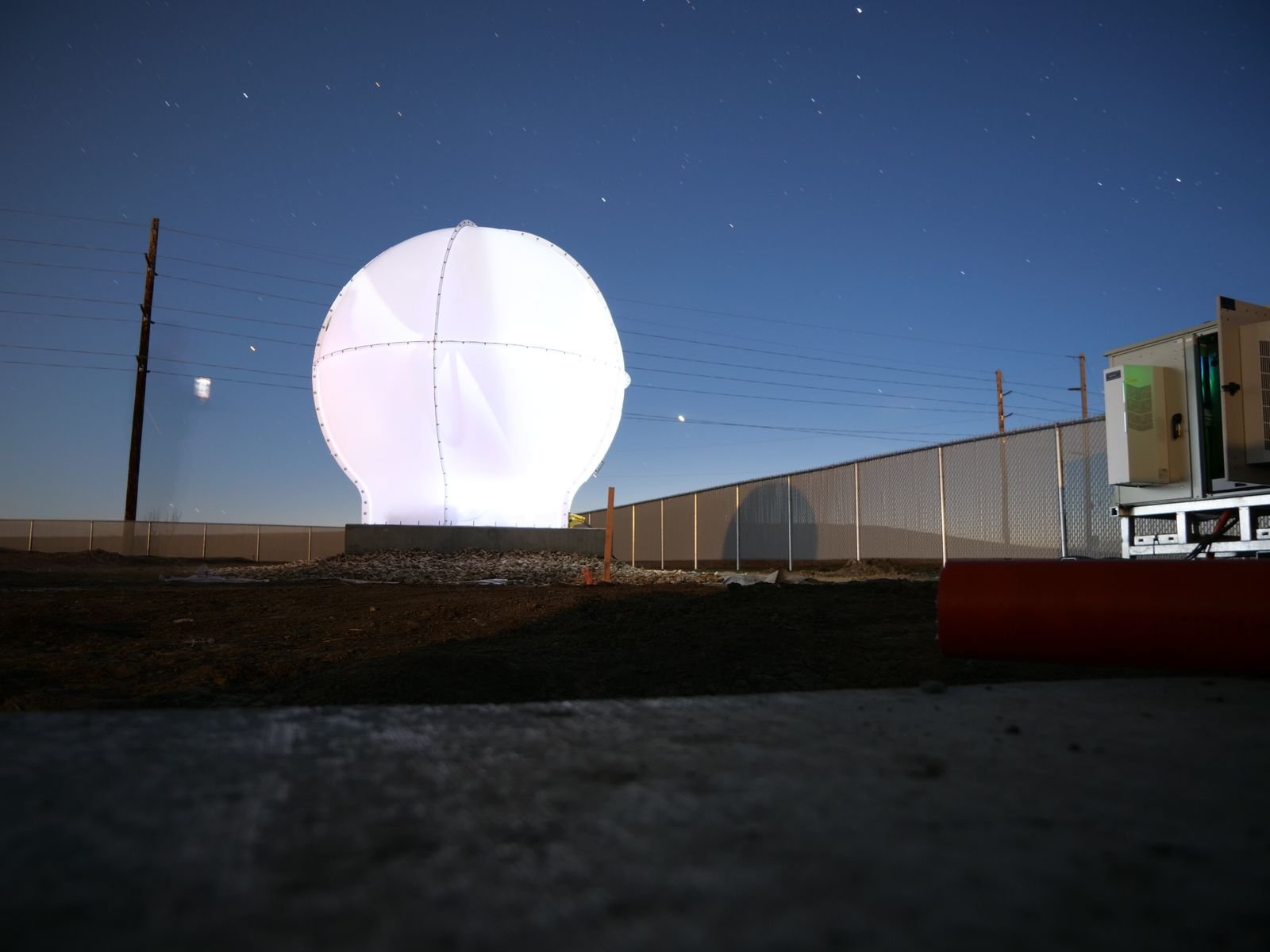
WASHINGTON — The U.S. Space Force is launching a new competition for mobile satellite-control antennas, formally restarting a program it canceled after abandoning a $1.7 billion contract with AeroVironment and shifting toward a more commercial procurement strategy.
The Space Force’s Rapid Capabilities Office earlier this month issued a pre-solicitation under the Satellite Communication Augmentation Resource program, known as SCAR, seeking industry proposals for electronically steered phased-array antennas that can supplement the military’s aging Satellite Control Network.
The solicitation is the latest step in the government’s effort to reset a program originally awarded in 2022 to BlueHalo, later acquired by AeroVironment. The contract was terminated after the government decided to shift its acquisition strategy away from a single-vendor arrangement toward an open competition built around commercially developed systems rather than a customized design.
SCAR was created to address growing capacity constraints in the Satellite Control Network, a global system of military ground stations used to track, monitor and command U.S. satellites. These network terminals rely on large mechanically steered dishes that typically communicate with one spacecraft at a time, limiting throughput as the number of military satellites grows.
Under the new approach, the Space Force is seeking commercially derived phased-array systems that can be produced at scale.
The Commercial Solutions Opening, or CSO, is expected to serve as the first step toward a new procurement that officials have said will introduce additional vendors and emphasize manufacturing capacity, supply-chain resilience and fixed-price production.
New competitors
The new competition is expected to draw established defense contractors as well as newer commercial entrants. AeroVironment has said it intends to submit a version of its BADGER antenna, the system originally developed under the SCAR agreement.
The restart also opens a lane for companies such as Northwood Space, a California startup developing commercial phased-array ground systems. Northwood recently raised $100 million and has been positioning itself as a supplier of ground infrastructure for satellite command-and-control and data communications.
In January, Northwood won a $49.8 million Space Force contract through the Joint Antenna Marketplace to augment capacity for the Satellite Control Network. That separate initiative allows the Space Force to tap commercial antenna capacity rather than relying only on government-owned ground stations.
Northwood is developing two main products. Portal is a modular phased-array ground station designed to support multiple simultaneous satellite links through electronic beam steering rather than mechanically moving dishes. The company says a single Portal installation can support up to eight concurrent connections.
Its second product, Prism, is aimed at high-volume satellite communications and data delivery.
Northwood recently hired Patrick Little, a former Space Force program director who worked on the Satellite Control Network and related ground systems, as director of U.S. government growth. Little said the current acquisition environment is creating openings for nontraditional suppliers.
“I think the government’s doing a really good job” bringing in commercial competitors into programs, Little told SpaceNews. “Barriers are rapidly coming down, which is great. There’s lots of opportunity for commercial.”
