


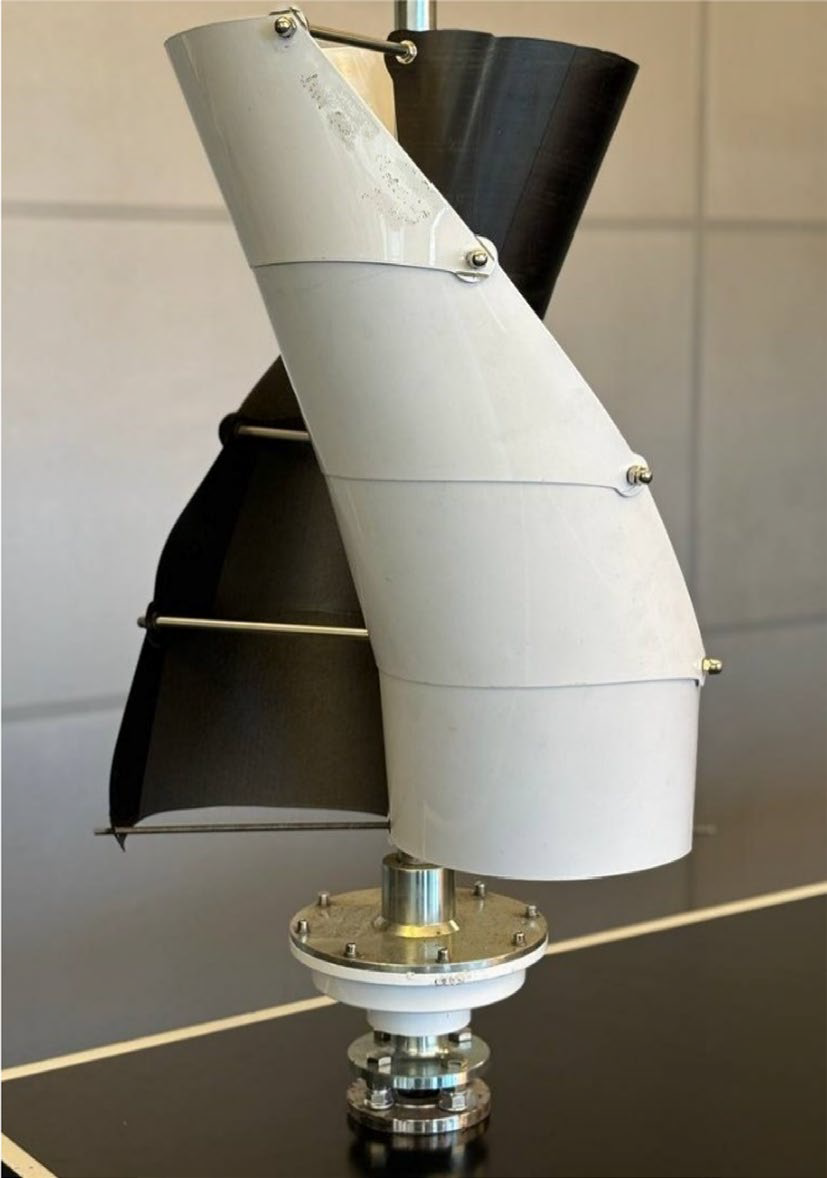
Researchers at Concordia University have developed an inverse 4D printing of composites method for producing curved vertical-axis wind turbine blades from carbon fiber-reinforced epoxy. The process forms the blades on a flat mold, removing the need for tooling that matches the final curved geometry.
The method, detailed in Polymer Composites by Emad Fakhimi and Suong Van Hoa of the Concordia Centre for Composites, was tested on a commercial Savonius-type vertical-axis turbine. Instead of relying on conventional polymer 3D printing, the process stacks continuous-fiber composite prepreg layers so that differences in thermal expansion force the initially flat laminate to curve as it cools after curing.
Avoiding complex curved molds could reduce the time and cost of composite manufacturing, the researchers state. The resulting blade segments were also substantially lighter than the turbine’s original aluminum components. Researchers identified this reduction in mass as one possible reason for the higher rotational speeds recorded during testing.
Designing a curved blade from a flat laminate
Concordia’s approach differs from regular 4D printing methods based on stimulus-responsive materials such as shape-memory polymers, liquid-crystal elastomers and hydrogels.
Instead, the process exploits the anisotropic behavior of carbon/epoxy laminates containing continuous fibers, which typically account for between 50% and 60% of the material by volume. The prepreg can be laid manually or deposited using an automated fiber placement system.
The key is an unsymmetrical stacking sequence. As the epoxy cures under heat and bonds the layers, differences in thermal expansion between fibers oriented in different directions generate internal forces during cooling. These forces bend the flat laminate into a targeted curved geometry.
Earlier research into this effect followed what the authors call a forward-design workflow: select a lay-up sequence and determine the shape it produces. The new study reverses that process.
Fakhimi and Hoa started with the measured geometry of an existing blade segment and worked backward to identify a lay-up sequence capable of reproducing it. The researchers describe this inverse procedure as the paper’s main contribution.
The team selected the RX-SV2 vertical-axis turbine from R & X Technology as its test platform. The commercial system has a rotor diameter of 0.48 meters and a nominal output of 200 W. Its two twisted aluminum blades are each assembled from five curved segments.
Researchers measured one segment using a laser projection system and recorded coordinates at 200 points. MATLAB was then used to reconstruct the surface and calculate its principal curvatures.
Results showed that the segment curved strongly along one axis while remaining nearly straight along the other. This provided the target geometry for the laminate design.
From material lay-up to blade assembly
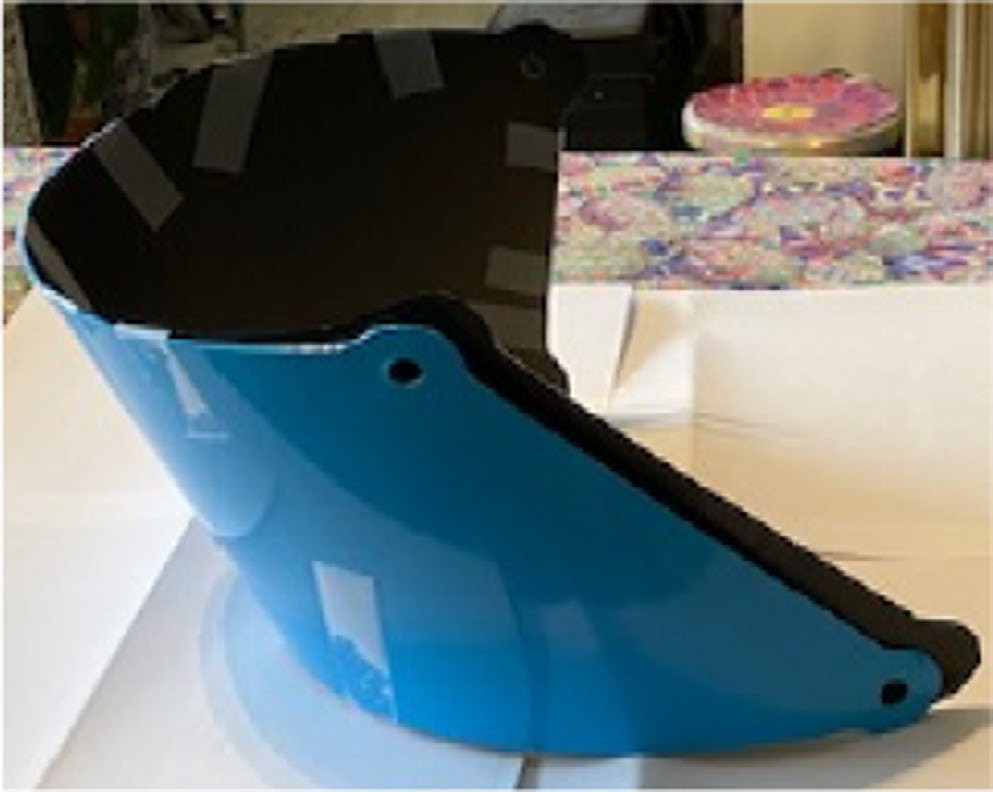
Using Rock West Composites 1409-D carbon/epoxy prepreg, the researchers modeled several laminate arrangements. They selected a three-ply [0/90₂] configuration because it produced curvature within the required range while limiting material use. The finished laminate was approximately 0.45 mm thick.
To reproduce changes in the orientation of the blade surface, the flat blank was divided into four sections. Fiber directions were progressively rotated across these regions while retaining the same underlying lay-up arrangement.
The prepreg was heated to 135°C, held at that temperature for 90 minutes and then cooled. Pressure of approximately 273 kPa was applied throughout the curing cycle.
After cooling, the laminate generally matched the original aluminum component. The largest discrepancy occurred at one edge and measured approximately 9% of the segment radius. According to the researchers, this difference could be corrected by constraining the segments during assembly.
Five segments were produced and assembled into a complete blade. Their dimensions remained within 1% of one another, indicating consistency across the small production batch.
Composite blades reach higher rotational speeds
Airflow tests compared a turbine fitted with aluminum blades against one using the carbon/epoxy replacements.
The aluminum turbine reached 27, 48 and 71 rpm across three fan settings. The composite version reached 30, 52 and 76 rpm under the same conditions.
Weight represented the largest measured difference between the components. Each aluminum segment weighed 256.2 g, compared with 51.3 g for the carbon/epoxy version. This equates to an approximately 80% reduction in segment mass, which the researchers identified as one possible reason for the higher rotational speeds.
However, the experiment did not measure electrical output or generator efficiency. Maximum airflow reached only 4.6 m/s, well below the turbine’s rated wind speed of 12 m/s. The setup therefore provides a controlled comparison rather than validation under representative operating conditions.
The authors also identified bending stiffness, fatigue performance, environmental durability and resistance to centrifugal and aerodynamic loads as areas requiring further investigation. These factors would need to be assessed before the blades could be considered for safe and economical operation.
The study therefore demonstrates a manufacturing and inverse-design method rather than a commercially validated turbine upgrade. Its main result is the repeatable production of curved composite segments from flat laminates without dedicated curved tooling.

Mold-free methods target composite tooling constraints
Recent additive manufacturing research has also focused on reducing composites’ dependence on dedicated molds. Oak Ridge National Laboratory developed an origami-inspired process that deposits composite material onto a flexible fabric substrate as a flat panel before folding it into its final three-dimensional form. In a comparison involving an equivalent unique design, ORNL reported a 95% reduction in fabrication time and a 90% reduction in cost relative to mold-based manufacturing. However, the patented process remains at the laboratory and licensing stage.
Researchers at Colorado State University and Arizona State University have taken another route by curing carbon fiber-reinforced thermoset material during deposition. Their robotic process uses laser-induced heating to cure the composite locally, removing the need for shaped tooling, support structures and a separate oven-curing stage. The team demonstrated curved, unsupported continuous-fiber paths over distances of up to 1.8 meters.
3D Printing Industry is inviting speakers for its 2026 Additive Manufacturing Applications (AMA) series, covering Energy, Healthcare, Automotive and Mobility, Aerospace, Space and Defense, and Software. Each online event focuses on real production deployments, qualification, and supply chain integration. Practitioners interested in contributing can complete the call for speakers form here.
To stay up to date with the latest 3D printing news, don’t forget to subscribe to the 3D Printing Industry newsletter or follow us on LinkedIn.
Explore the full Future of 3D Printing and Executive Survey series from 3D Printing Industry, featuring perspectives from CEOs, engineers, and industry leaders on the industrialization of additive manufacturing, 3D printing industry trends 2026, qualification, supply chains, and additive manufacturing industry analysis.
Featured image shows the vertical-axis wind turbine fitted with aluminum and carbon/epoxy blades. Photo via Emad Fakhimi and Suong Van Hoa, Concordia University.
