


AAVI recently caught up with Nitin Rakheja, who leads manufacturing intelligence at Zoox, to discuss using autonomous-vehicle motion to anticipate wireless connectivity loss
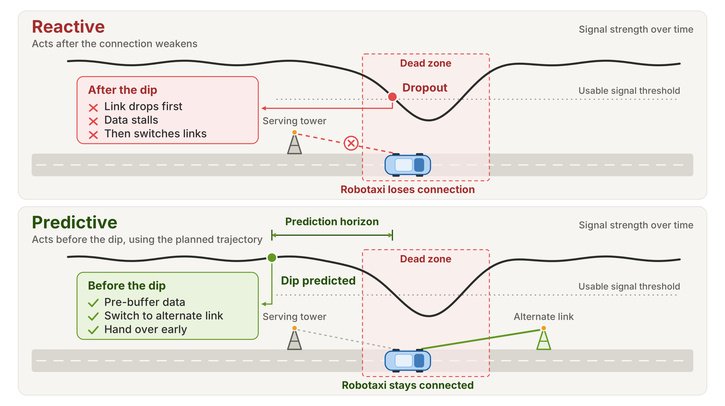
An autonomous vehicle knows where it is going before it gets there. That simple fact is the starting point for a paper published this July in IEEE Access by Rakheja. His work asks a question at the intersection of two fields rarely discussed together: if a vehicle’s motion is planned and known in advance, can that knowledge be used to predict a wireless dropout before it happens, rather than reacting once the connection has already weakened? Read on to discover the idea, the results, and where the work goes next.
What made you look at a vehicle’s own motion as useful information, rather than something to filter out?
Most approaches to short-term signal prediction work from history alone. A model looks at a stream of recent signal readings and tries to estimate the next one, in much the same way someone might extrapolate a stock price from its recent movement. That works reasonably well when conditions are stable, but it has no way to separate a predictable trend, such as a vehicle moving steadily away from a cell tower, from the random noise layered on top of it. What struck me is that an autonomous vehicle’s motion is not random the way a human driver’s is. It comes from a planning stack that computes a trajectory in advance. That is information the system already has, and standard prediction models were simply discarding it.
How does the model actually put that information to use?
The approach pairs two estimates. One is a standard machine-learning model, a Long Short-Term Memory network trained on historical signal readings, which captures patterns that geometry alone cannot explain. The other is a physics-based estimate built from the vehicle’s own position: a Kalman filter smooths the raw location data, and a standard propagation model converts that cleaned-up position into an independent prediction of what the signal strength ought to be at that distance. The two estimates are then combined, with the system leaning more heavily on whichever one has been performing more reliably in recent moments. The fusion model uses the identical network architecture as the baseline, with no additional capacity added. The gain comes entirely from giving the system information it already possessed.
What did the results actually show?
In simulation, the mobility-aware approach consistently reduced prediction error across a wide range of noise conditions, and the improvement held up even as conditions grew noisier. The more significant test was real-world data: six independent driving sessions using LTE signal measurements. Across those sessions, the mobility-aware method reduced prediction error by an average of 48.5%, a result that held up to statistical scrutiny. In practical terms, that is the difference between a system discovering a dead zone after the connection has already dropped and one that sees it coming a few steps ahead.
Why does that distinction matter for how autonomous vehicles actually operate?
Autonomous vehicles depend on wireless connectivity for more than passenger convenience. They rely on it for coordination with fleet infrastructure, for redundancy, and increasingly for drawing on a mix of connectivity types as fleets scale. A system that can see a weakening connection coming, rather than discovering it after the fact, can pre-buffer data before a dropout, switch to an alternate link before quality degrades, or time a handover proactively instead of reactively. For a single vehicle that might mean a smoother ride. Across a large fleet of robotaxis or delivery robots, it compounds into meaningfully fewer connectivity interruptions and less reliance on recovering after something has already gone wrong.
This connects to some earlier work of yours in India. How does that tie in, and what comes next?
More than a decade ago I worked on a very different connectivity problem: extending broadband access to rural communities in India using television white space, spectrum that sits unused in areas where a licensed broadcaster is not transmitting. That project, ROSALNet, treated an underused and variable resource as something to work with rather than discard. The connection to this paper is more direct than it might seem. Both start from the same instinct, that a signal written off as unreliable or irrelevant often still carries usable structure, if the system is built to notice it. As for what comes next, the real-world testing so far covers a single suburban route, so testing across a wider range of environments is an obvious step, along with giving the system a way to judge its own confidence in the motion-based estimate directly rather than inferring it indirectly. More broadly, I am now looking at how these predictions could feed into a fuller connectivity architecture, one that could drive proactive handovers across different kinds of links, including 5G, TV white space and satellite.
The paper is open access, and its central claim is straightforward. A vehicle’s own motion is not noise to be filtered out of a wireless prediction problem. It is a signal in its own right, available to any system that already knows, in advance, exactly where it is going.
Nitin Rakheja leads manufacturing intelligence at Zoox, advancing production systems for autonomous robotaxis. His career spans autonomous systems, wireless communications and large-scale engineering operations. He holds an MTech from IIT Delhi and an MBA from MIT Sloan. His earlier work includes ROSALNet, a rural connectivity network in India using TV white space spectrum. He is a senior member of IEEE, a fellow of IETE, an author of peer-reviewed research, and an inventor on patents related to vehicle communications.
