


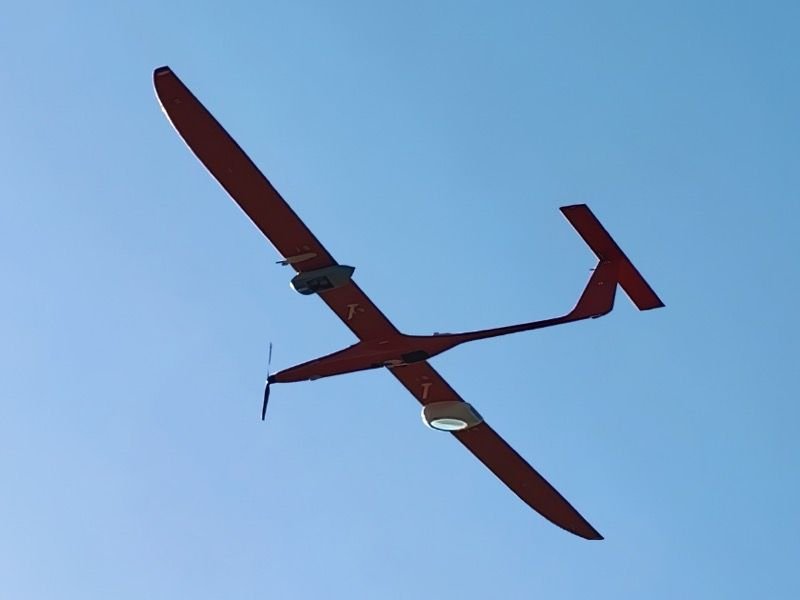
PowerLight Technologies and Kraus Hamdani Aerospace have demonstrated sustained wireless laser power beaming to a military drone while in flight, in what PowerLight describes as an industry first.
The demonstration took place at Poinsett Electronic Combat Range, part of Shaw Air Force Base in South Carolina, and paired PowerLight’s mobile autonomous beaming system with the K1000ULE, a Group 2 Unmanned Aircraft System (UAS) built by California-based Kraus Hamdani Aerospace.
The laser transmitter delivered close to 1kW of power to the aircraft at altitudes of up to 5,000ft (1,524m) while the platform maintained Intelligence, Surveillance and Reconnaissance (ISR) duties and active communications links.
The flights were hosted by the AFCENT Battle Lab and sponsored by US Central Command (CENTCOM) and the Department of War’s Operational Energy – Innovation Directorate. They form part of the Power TRansmitted Over Laser to UAS (PTROL-UAS) programme, which aims to decouple endurance from onboard fuel or battery capacity.
PowerLight’s system autonomously acquired and tracked the aircraft, adapting the laser link in real time to aircraft movement and atmospheric conditions. The airborne receiver, a lightweight unit mounted on the K1000ULE, converted the non-visible laser energy into electrical power to sustain the aircraft’s batteries during the flight.
According to PowerLight, prior wireless power beaming demonstrations have been limited to short ranges, small rotary-wing platforms and power levels insufficient to support an operational payload. The Shaw flights were intended to validate an end-to-end operation target, including acquisition, precision tracking, beam delivery and safety management at operationally relevant altitudes and power levels with a platform already cleared for military use.
The K1000ULE is a fully electric, solar-assisted fixed-wing aircraft on the US Department of War’s Blue UAS Cleared and Select Lists. Kraus Hamdani Aerospace claims a 75-hour 35-minute continuous flight for the type, recorded at Pendleton UAS Range in Oregon in 2023. The platform is the subject of a sole-source indefinite delivery, indefinite quantity contract worth up to US$270 million awarded by US Air Forces Central earlier this month.
Stefan Kraus, CTO and co-founder of Kraus Hamdani Aerospace, said, “Integrating PowerLight’s power beaming capability extends that persistence further and reduces the need to land. That expands the K1000ULE’s ability to maintain continuous coverage in operational environments where interruption is not acceptable.”
Tim Jenks, CEO of PowerLight Technologies, said, “The Shaw demonstrations validated the core system and established a roadmap for scaling this capability from a single transmitter to a distributed network. That includes higher power output, greater altitude and range, and the ability to sustain multiple aircraft simultaneously across a theater.”
Both companies said work with CENTCOM and the AFCENT Battle Lab is now focused on progressing the technology from flight demonstration to field evaluation and operational use.
