


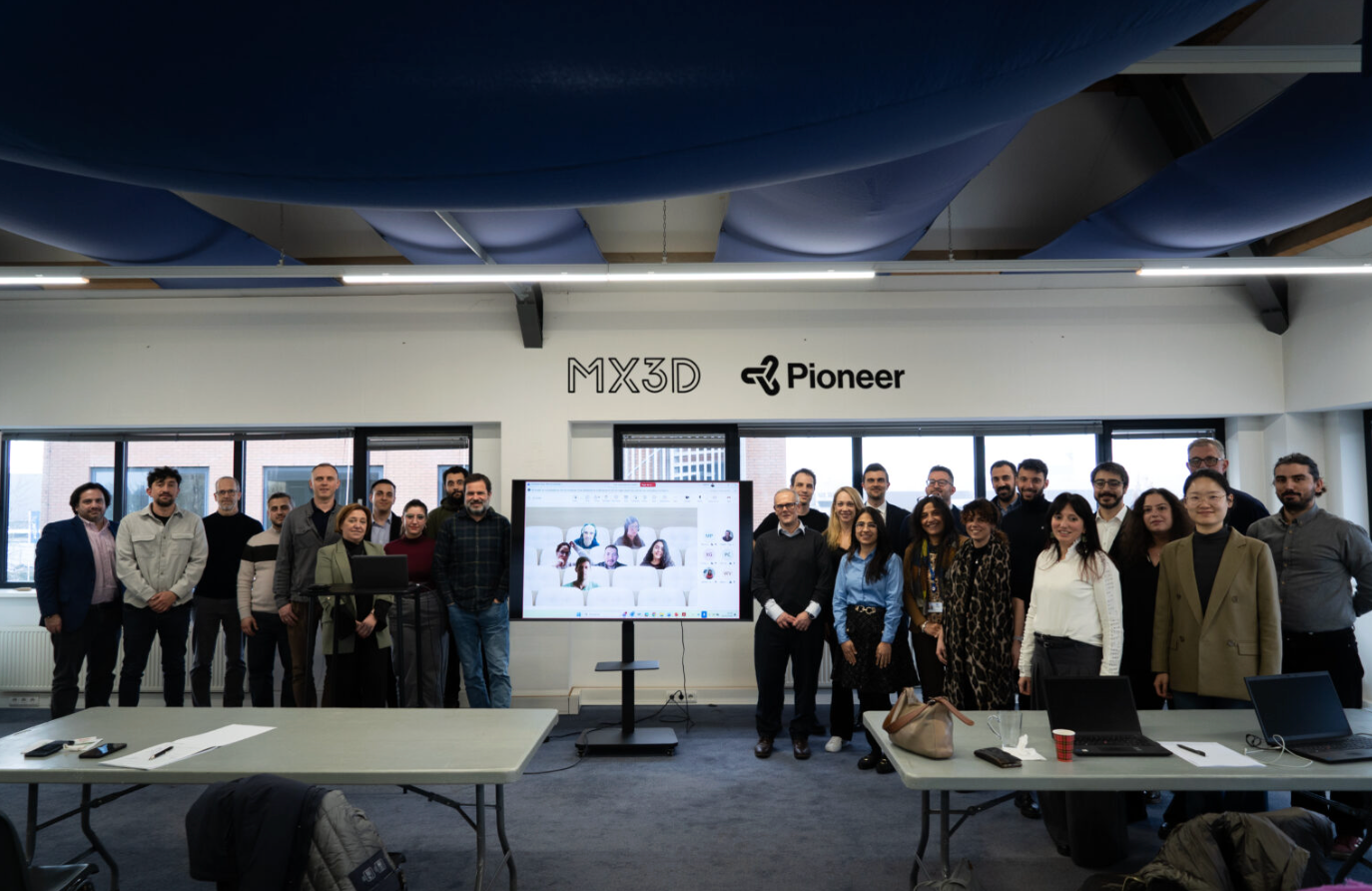
MX3D, a Dutch company specializing in robotic Wire Arc Additive Manufacturing (WAAM), has announced the conclusion of the PIONEER project, an EU Horizon-funded initiative in which the company served as a pilot line leader within a broader European consortium. The effort centered on industrializing automated design, fabrication, and certification workflows for structurally optimized, load-bearing hybrid steel components targeting the civil engineering sector.
A central partner in the project was Imperial College London, specifically the structural engineering department led by Professor Leroy Gardner, an institution that has maintained an ongoing collaboration with MX3D since 2016, beginning with the landmark MX3D Bridge and continuing through the EU Horizon 2020 Integradde initiative. Equipped with one of the most advanced MX3D MX Systems in the world, Imperial College contributed structural design expertise, experimental testing, and component validation under realistic loading conditions throughout the project.
Optimization support was also provided by UK-based engineering software company Limitstate, whose module was specifically calibrated for WAAM connector geometries.
Hybrid Design Delivers Outsized Structural Gains
The PIONEER pilot line introduced a new manufacturing approach that merges conventional rolled steelwork with parametrically designed WAAM elements. Rather than replacing standard profiles, the method reinforces them by depositing printed material only at structurally critical points, reducing overall steel consumption and embodied carbon by as much as 50–75% in select applications.
Validation through Imperial College’s testing program confirmed several structural achievements. Applying WAAM directly to standard square hollow section profiles delivered an average capacity improvement of 300% while using only double the original material. Targeted deposition on high-stress zones in I-beams increased load-carrying capacity by 35% to 84% for a mass increase of just 5% to 16%. The project’s culminating demonstration brought all of this together in the assembly of 22 first-time-right WAAM-printed nodes into a 10-meter load-bearing truss.
From Pilot to Production-Ready
Voices from the project underscored the transition from experimental concept to deployable industrial solution.
“The PIONEER project demonstrates that hybrid WAAM is not just an innovative idea, but a structurally viable solution,” said Pinelopi Kyvelou, Assistant Professor in Structural Engineering at Imperial College London. “By systematically testing components and full-scale systems, we have been able to demonstrate not only performance gains, but also consistency and reliability, both of which are essential for real-world implementation in structural engineering.”
Filippo Gilardi, R&D Manager at MX3D, reflected on what the project signals for the broader industry: “From our side at MX3D, PIONEER showed that WAAM can fit into real production environments for hybrid infrastructure, and that it’s ready to move from pilot projects into broader industrial use, especially as our integrated digital workflows, 3D scanning and smarter toolpath planning have come together in a practical way”, said Filippo Gilardi, R&D Manager at MX3D.

The Industry Gap PIONEER Set Out to Close
Standard steel profiles are predictable and approved, but over-engineered by design, built for worst-case loads across their entire span rather than optimized for where stress actually concentrates. WAAM technology has long promised a more surgical approach, depositing material precisely where it is needed, but the absence of integrated digital workflows and formal approval frameworks kept it confined to research settings. PIONEER was MX3D’s answer to that gap: not just proving performance in a lab, but demonstrating a repeatable, certifiable pipeline that industry could actually adopt.
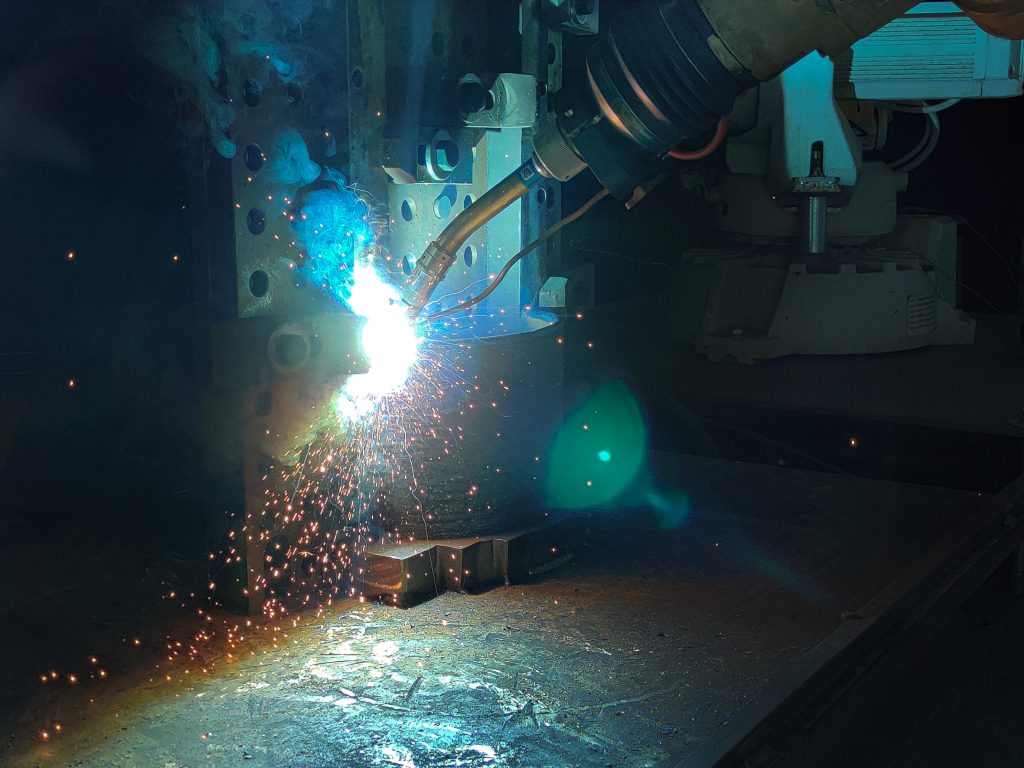
Similar efforts are emerging across the broader WAAM landscape. MX3D and partners previously unveiled a hybrid WAAM Clamp, a partly 3D printed pipeline component for high-pressure leak sealing in the chemical and oil and gas sectors, developed under the EU Horizon 2020 program and validated through materials testing, process qualification, and non-destructive inspection by a multi-party consortium.
Elsewhere, DEEP Manufacturing expanded its large-scale WAAM operations into Houston in early 2026, targeting energy, defense, and maritime sectors with a focus on reducing lead times for high-integrity components, a signal that the industry is moving past the prototype phase and toward validated, operational deployment.
PIONEER offers a replicable model where printed steel and rolled steel are not competing approaches, but complementary ones, and the frameworks it established are now the clearest path toward making that combination standard practice in civil infrastructure.
3D Printing Industry is inviting speakers for its 2026 Additive Manufacturing Applications (AMA) series, covering Energy, Healthcare, Automotive and Mobility, Aerospace, Space and Defense, and Software. Each online event focuses on real production deployments, qualification, and supply chain integration. Practitioners interested in contributing can complete the call for speakers form here.
To stay up to date with the latest 3D printing news, don’t forget to subscribe to the 3D Printing Industry newsletter or follow us on LinkedIn.
Explore the full Future of 3D Printing and Executive Survey series from 3D Printing Industry, featuring perspectives from CEOs, engineers, and industry leaders on the industrialization of additive manufacturing, 3D printing industry trends 2026, qualification, supply chains, and additive manufacturing industry analysis.
Featured image shows MX3D hosted the Final Review Meeting of the Pioneer Project. Photo via MX3D
