


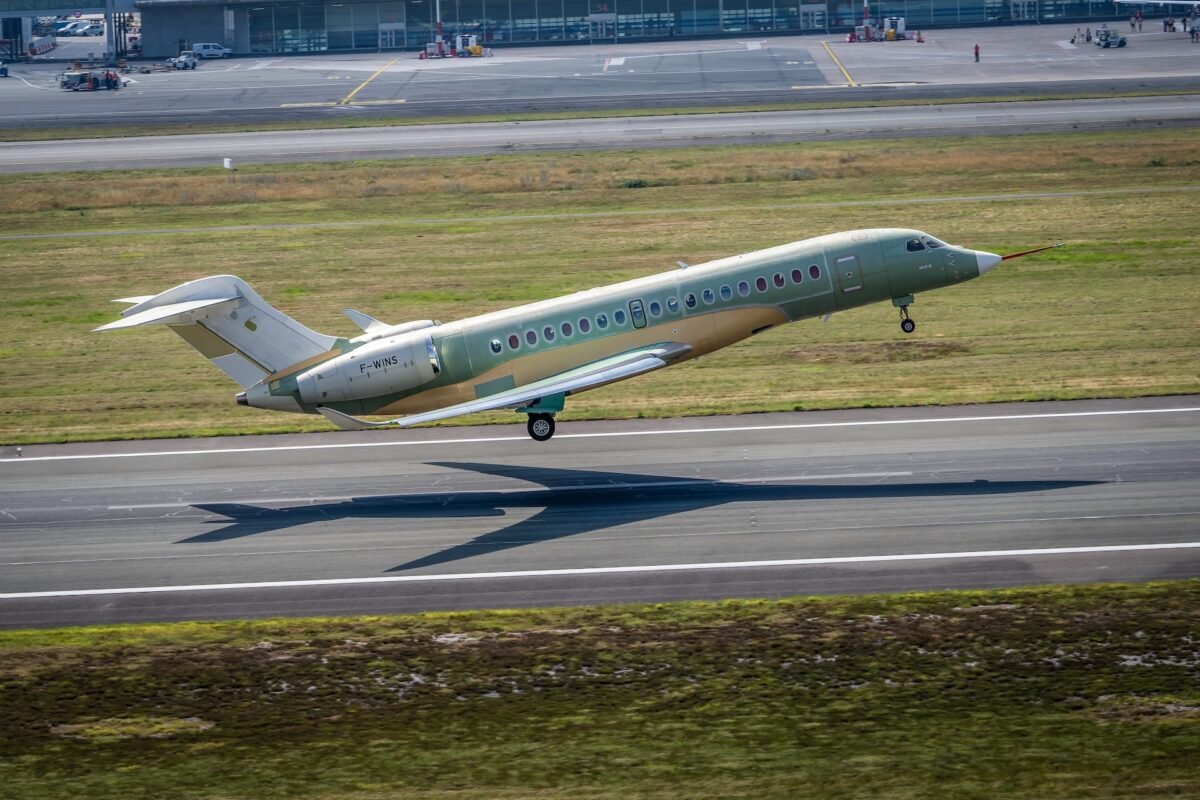
In a decision that is likely to be controversial, the European Court of Justice ruled in favor of French aircraft manufacturer Dassault on June 24, 2026, stating that business jet manufacturers cannot be excluded from so-called “transitional activities” within the EU’s 2023 “Green Taxonomy”.
This “transitional” category gathers economic activities that have a hard-to-abate environmental impact, even when performed with the most environmentally friendly methods enabled by current technology but nevertheless offer a realistic path to decarbonization in the foreseeable future.
The exclusion of executive aviation from this category on account of its relatively high emissions per passenger was legally challenged by Dassault, the maker of the Falcon family of executive jets (the latest model of which, the ultra-long-range Falcon 10X, had its maiden flight on June 19, 2026).
The ruling represents a boost for executive aviation, an industry that has been severely criticized due to its emissions footprint. The status within the EU’s “Green Taxonomy” is not just a symbolic and reputational matter, it also has implications when it comes to accessing capital, whether it is in the form of investment from institutional investors with ESG mandates or public support schemes.
In issuing its ruling, the European tribunal considered the fact that Dassault had a direct interest in the matter since it affected its core business, and it accepted the premise that other methods of transportation do not provide a comparable alternative to the capabilities of private jets in terms of speed and flexibility, particularly between city pairs that lack direct connections. It also considered the fact that executive jets can reduce their carbon footprint using Sustainable Aviation Fuel (SAF).
Lastly, the court also made a distinction between the operation of private jets, which is when most of their environmental impact is produced, and its manufacture, which is Dassault’s main activity.
The ruling, however, cannot be seen as a blank cheque to the industry when it comes to its environmental categorization and has prompted the European Commission to perform further analysis on the matter.
The ruling can be appealed by the European Commission.
