


Lisbon-based euroAtlantic Airways is not necessarily a household name, nor does it feature prominently in the public imagination. However, for more than three decades, the carrier has been a prominent player in the European charter and ACMI scene.
These companies provide aircraft, complete with crew, maintenance, and insurance, to airlines and operators which need capacity on demand, and often at short notice, in order to fulfill their commercial and operational commitments.
What’s more, euroAtlantic Airways, which was established in 1993 by Portuguese businessman Tomaz Metello, specializes in a niche that few other ACMI providers are willing to enter: long-haul widebody leasing.
Alongside its core charter and ACMI business, euroAtlantic has also long operated a small scheduled service connecting Lisbon to São Tomé and Príncipe, a small West African island nation which received independence from Portugal in 1974.
Perhaps the most significant milestone for euroAtlantic Airlines since its inception was Njord Partners becoming majority shareholders of the airline in 2024.”
The latter firm would end up taking full control of the airline in 2024 and has since directed its strategic choices.
One of these choices was the arrival of the first Airbus aircraft, an A330-200, in late 2025. Rather than being an opportunistic addition to the fleet, it seems like the start of a deliberate dual-fleet strategy, representing a break with the firm’s traditional Boeing-only stance.
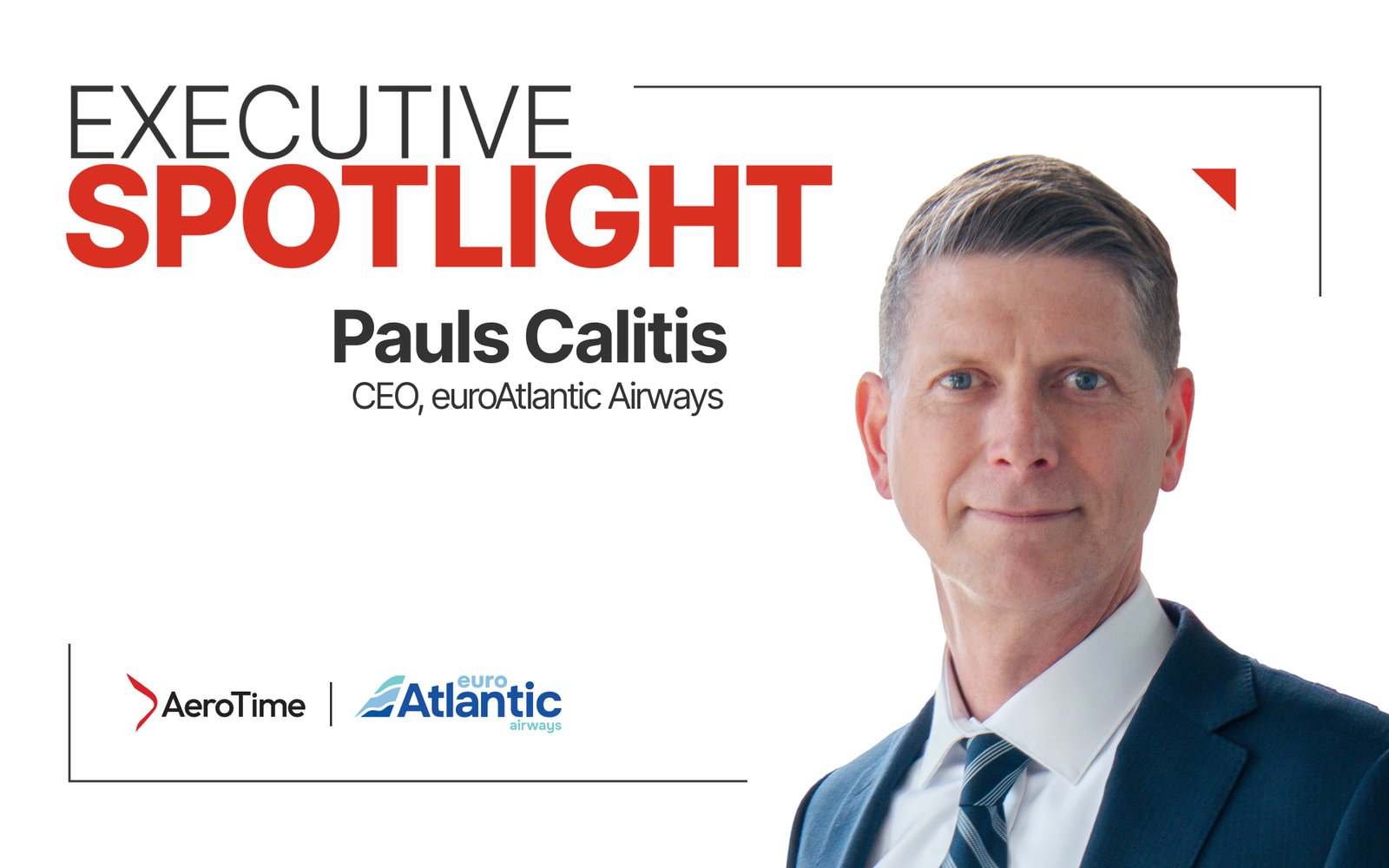
Another recent momentous change at euroAtlantic is the appointment of Pauls Calitis in May 2026. A former commercial pilot, Calitis joined euroAtlantic from airBaltic, where he rose through the ranks to the roles of Chief Operating Officer (COO) and Executive Board Member. Calitis also briefly served as airBaltic’s interim CEO after the departure of Martin Gauss in 2025.
While at airBaltic, Calitis oversaw the growth of the airline’s significant ACMI business, through which the Riga-based airline has been providing A220 aircraft to other carriers throughout Europe, mostly to the airlines of the Lufthansa Group.
AeroTime met with Calitis on the sidelines of the 82nd International Air Transport Association (IATA) Annual General Meeting (AGM) in June 2026 to gain fresh insights into euroAtlantic’s business and what its ongoing fleet transformation means for the future of the Portuguese carrier.
“It’s a company with a long history, working in a very unique part of the industry,” Calitis said. “[It is] an important part of the industry even it is maybe both a bit out of sight and undervalued.”
He also mentioned the airline’s scheduled business in Africa, operating a limited regular schedule to the Portuguese-speaking island nation of São Tomé i Príncipe.
“The scheduled flights to Sao Tome are a very small, but also important part of our business. We operate as euroAtlantic and we are also working with a subsidiary called STP Airlines for these operations,” he said. “It’s a very small part of the business with normal distribution channels, including online travel agents (OTAs) online and directly [to consumers].”
Next, Calitis referred back to euroAtlantic’s roots as a founder-owned business in Portugal and the recent ownership changes which see the airline now in the hands of Njord Partners, a London-based private equity firm.
“The company was originally founder-led, but then, in 2019, an ownership change happened, which basically has consolidated over the last years,” he said. “Under this new ownership, and for the last few years, there has been really good momentum happening, with a dynamic in which, building on this foundation, this very solid and long history is being re-energized.”
On euroAtlantic’s value proposition
According to Calitis, the company has solid operational core expertise and capacity for long-haul ACMI operations, which it is able to deliver quickly and globally.
“The big change that’s [been] happening over the last few years is not only working on very short ad-hoc contracts, but the capacity to establish long-term relationships, to do long-term work with our customers. Those are two very different types of things.”
Calitis compared the one-off short-term contracts which often aim to fulfill some unwanted operational gap, from one in which the ACMI provider supports the long-term growth plans of its customers.
“One thing is when someone just needs to fill a hole because of a maintenance event, maybe a bird strike or whatever, perhaps because of some planned or unplanned maintenance that is taking place,” he explained. “That’s one type of operation, but the second is building a relationship with a customer in which you structurally fill that customer’s capacity needs. There are a number of reasons why someone would need that structural capacity.”
The capacity shortages experienced by many operators globally in recent years, due to aircraft delivery delays as well as generalized engine issues and supply chain shortages, are just one part of the story.
“Those are some drivers, but there are a lot of other things. Sometimes customers just want to test new markets,” Calitis said. “This is a good way of getting limited exposure on the customer’s side. That’s also a way to bring in the specific [aircraft] size that is needed for a specific market and that we can offer.
“There’s all other sorts of issues, for example, it could be a crew issue, in which the operator doesn’t have the people to fly, and so on…”
He continues: “So, we see this part of the business where we want to have success, and we build on that in terms of having work that isn’t already contracted for, working with specific customers time ahead and flying their way, so that the product feels seamless from their perspective, and offering the type of service that they want and need.”
How does euroAtlantic make sure its cabins are a good fit for its different customers’ service standards? And, perhaps more importantly, with the passengers’ expectations?
“This is an important part of the consideration and something that, from the customer side, they pay a lot of attention to and have strict requirements about,” Calitis said. “As a provider, it’s our job to meet those needs, and provide the service as seamlessly as possible.”
If you are an airline, attracting a partner that is able to provide an exact replacement for your product is never easy, particularly when you are the one ultimately answerable to the passenger. Still, Calitis acknowledged the ACMI provider’s duty to adapt to expectations when flying a mission for a third-party operator. The capability of being able to offer widebody aircraft from different manufacturers is aligned with this approach.
“At the end of the day, the better we can cooperate and find solutions, the better it is for all sides involved. So, for example, one key thing is, and what sets us apart is that, in terms of fleet we operate both Boeing and Airbus widebody aircraft,” Calitis said, referring to the recent (2025) induction of the airline’s first A330-200 aircraft into its fleet.
The dual-fleet strategy
“We have 777s, 767s and A330s and we’re getting more A330s right now and in the next few months. We’ll be up to eight aircraft [in] total with the three A330s, and that’s something that’s been part of this new momentum and dynamic that’s been happening for the last few years,” he added.
“We used to operate only Boeing with the 767s and the 777s , but now we are also entering the market with Airbus,” he explained, adding that this decision is also part of a strategy to meet client needs. “For some it’s more seamless and more appropriate to have this type of aircraft and what we can do with it versus what we can do on the B777 and vice versa.”
Calitis further elaborated on the dual-fleet strategy, something that appears to be a cornerstone of the company’s strategy.
“The strategy is to keep broadening the business successfully, and that’s to be done by adding more capacity, having more aircraft in the fleet, but also by having the right fleet mix,” he explained. “That’s why we’re going forward with both bringing in newer aircraft and, in that sense, an improved product, and also by having the two fleets.”
The arrival of new aircraft will also bring down the average age of a fleet which includes some rather veteran aircraft.
“Although, the 767s are flying well, a lot of work has been done from a maintenance perspective and quality perspective to make sure these aircraft are in good condition, and also interior-wise,” Calitis said. “So, part of it is to make the interiors also feel as seamless and competitive as possible for the different potential customers.”
Calitis acknowledged that cabin interiors are particularly important in the long-haul markets in which euroAtlantic operates. This is an area in which ACMI operators like euroAtlantic must walk the fine line between aligning with their customers’ requirements and keeping a neutral interior to appeal to different operators.
“Especially in long-haul, you can’t design the cabin to be specific for each operator, but the ambition is to [offer] high quality and also be as universal as possible, so that it works from up on a product level for the customers,” he said.
So, what’s next for euroAtlantic?
He concluded, “Moving forward, the fleet will keep both these two pillars, the Boeing and Airbus [aircraft], and also a slow profitable growth forward is the plan.”
