


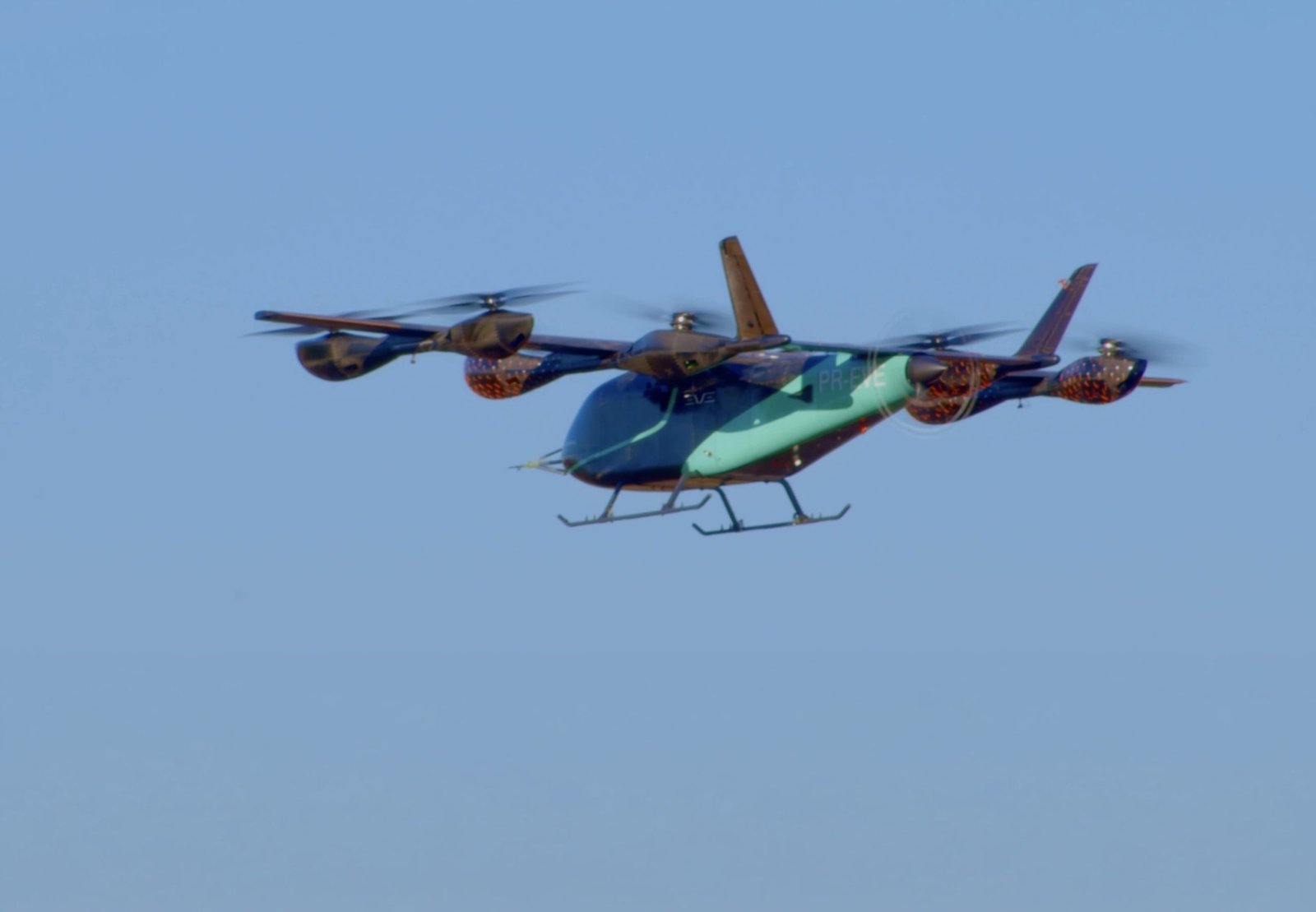
The Embraer-controlled company aims to achieve wingborne flight before year-end.
Eve Air Mobility recently completed an initial and partial test of its electric air taxi’s ability to transition from vertical to forward flight, kicking off a complex phase of flight testing and aiming to demonstrate a full transition flight before year-end.
The company, majority owned by Brazilian airframer Embraer, said on 3 August that its remotely piloted engineering prototype performed a “first partial transition flight”, signifying “the start of the transition phase from vertical to wingborne flight”.
The flight occurred in the second half of July. It involved the aircraft’s pusher propeller being activated for the first time while airborne, the company says. The aircraft flew for 3min and 9s, ascended to 90ft and achieved a ground speed of 30kt (56km/h). Its overhead propellers, not its wings, provided vertical lift during the initial test.
“It went very well … What made us very happy is that the transition happened as we expected,” Eve’s head of engineering, Marcelo Basile, tells FlightGlobal.
Transition flight is among the most challenging manoeuvres required of electric air taxis being developed by Eve and several other start-ups.
Eve’s aircraft is designed to take off vertically with lifting thrust provided by eight overhead propellers. Its single aft pusher propeller provides forward thrust, accelerating the aircraft into wingborne flight. The company aims to have its aircraft certificated in late 2028.
Eve first flew its engineering prototype in December 2025. It recently paused flight testing for several months to prepare for the transition-flight demonstrations.
During that downtime, Eve completed a “very important modification” to the flight-control system’s control laws, says Basile. Until then, the aircraft had been flying with control laws not designed for transition flight.
The team installed updated control laws and completed a “shakedown” of the system ahead of starting transition flights, he says. “The secret here is we have to synchronise when we have to turn off the lifter propellers and rely only on the wing-lift capability.”
He adds that transitioning from vertical to forward flight is as complex and in some ways technically different than the opposite – transitioning from forward to vertical flight for landing.
With the first partial transition now complete, the test team will push deeper in the transition realm by progressively bringing up the aircraft’s forward speed.
Basile expects within the two months to have the engineering prototype achieving “speed where we are at the edge of turning off the propellers” – meaning the edge of where the wing provides all lift. He anticipates achieving full transition to wingborne flight before year end – a target aligning with Eve’s expected finalisation of a critical design review for Eve 100, its planned production aircraft.
“What we are learning with the engineering prototype is being fed to the critical design review,” Basile says.
Eve aims soon to start assembling the first of six planned Eve 100 production-conforming prototypes, doing so in San Jose dos Campos, where Embraer is based. Eventually, Eve intends to establish a manufacturing site in Taubate, northeast of San Jose dos Campos.
The post Eve begins challenging ‘transition’ phase of air taxi flight-test programme first appeared on FlightGlobal.
