


Lara Bohinc’s jewelry business picked up quickly after she graduated from London’s Royal College of Art. Everything seemed to be going to plan—soon after setting up shop, she embarked on a decade-long stint with Cartier and went on to collaborate with Gucci and Montblanc, among other brands. But eventually, she got bored. “I felt really limited by jewelry,” she says. “You can’t use many different materials, it’s difficult to use color, the weight is always a problem, and it’s difficult to explore certain shapes.”
From left: Bohinc Studio’s limited-edition marble and brass Juno Box; the studio’s tubular Apollo dining chair.
Juno Box: Philippe Fragniere; Apollo dining chair: Guido Rizzuti
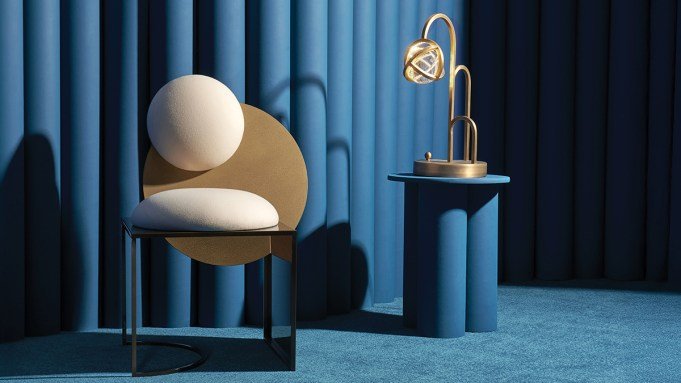
So, she pivoted. In 2016, she opened Bohinc Studio and began designing home decor and furniture. The subsequent work certainly revels in the freedom that comes with operating in a new medium. Her early Planetaria series drew upon her metalworking background—it included intricate lamps reminiscent of tiny planets as well as rounded seats resembling cosmic thrones. In the decade since, she has deftly explored all sorts of materials: The bulbous upholstered seats in the Anima collection look like Seussian creatures; her Betsy tables are inspired by birds, with layered leather that conjures feathers.

Jessica McCormack’s tableware collaboration with L’Objet.
Courtesy of L’Objet
Bohinc is among a handful of jewelry designers who have decided to cross over into home design. Many are now working in the decor world, lending their distinct perspective to a new product category—though not a dissimilar one. “With jewelry, I spend a lot of time thinking about wearability, and how a piece sits, moves, and feels on the body—it has to be comfortable,” says jeweler Jessica McCormack. “Designing for the home involves many of the same considerations.” In September, she debuted her first home collection—in cooperation with design and fragrance brand L’Objet. The resulting shell-shaped bowls and caviar dish were informed by McCormack’s childhood in New Zealand, where the ocean was a constant presence. It’s a narrative thread that she has referenced in her jewelry practice, too, most notably in the breezy Hello Sailor and Beaches lines.
Bernard James’s installation at USM’s New York City flagship store.
Marco Galloway
For jewelry designer Bernard James, a collaboration started from something that he personally wanted but couldn’t find anywhere: the perfect jewelry box. When he went looking for a partner, he turned to Swiss furniture company USM Modular. Early in Bernard’s career, when the studio was based in his Williamsburg apartment, he used USM for displays.
His first collection with USM consisted of smaller objects, like the jewelry box that he longed for, as well as an incense holder and valet trays. The move toward more diminutive items was a departure for USM, but each nevertheless featured the brand’s signature metal frame. This fall, both parties took the idea a step further: James set up shop in USM’s New York showroom, interpreting a new space for his work and his atelier using the brand’s design language. It serves as the jewelry company’s home while its Greenpoint store is being renovated. Naturally, as part of the project, James designed another piece of furniture that he loves. This time it’s a desk: the Makers’ Desk. “I wanted to add a jewelry bench, but I couldn’t find a sexy one, so, like, how do we make one?” he says. “It’s 100 percent going in my studio, if not my home.”
Left to right: Anna Karlin’s blown-glass and aluminum Triplet lamp; Karlin’s monolithic ceramic bar cabinet.
Johnny Miller
Designer Anna Karlin has done the opposite. Karlin started with furniture and subsequently added a jewelry studio to her practice. Unsurprisingly, the transition came quite naturally—she always had a love for jewelry and found herself frequenting New York’s diamond district for casts for her furniture. She brought her classic-meets-contemporary aesthetic to a new category and continues to produce one-off accessories to this day. Like the others, she found that there were obvious, intrinsic synergies between the two categories. “I sort of see it, essentially, as kind of one and the same,” she says. “It’s usable sculpture.”
Authors

Helena Madden

