


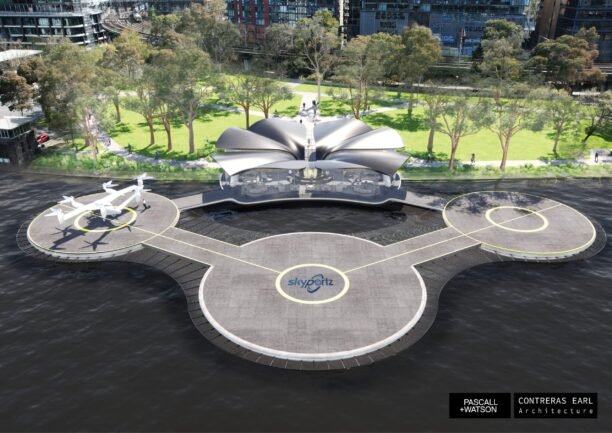
Updated guidance addresses landing areas, charging infrastructure, and airport integration as advanced air mobility moves toward commercial operations.
The Federal Aviation Administration (FAA) has released updated draft design standards for facilities supporting vertical takeoff and landing (VTOL) aircraft. The proposal marks another step toward building the infrastructure needed for advanced air mobility (AAM) operations.
Announced October 22, the draft covers facilities serving helicopters, powered-lift aircraft, and other VTOL vehicles. It aims to help airport operators, developers, and infrastructure providers plan facilities for emerging aircraft technologies.
“The next generation of aircraft is here, and we are ensuring we have the infrastructure built to support safe takeoffs and landings for them across the National Airspace System,” said FAA Administrator Bryan Bedford. “These aircraft have tremendous potential to generate new jobs, connect communities, and strengthen American leadership in aviation.”
Standards for the Next Generation of Aircraft
The proposed guidance combines earlier FAA design standards for heliports and vertiports into a single framework.
It addresses several key infrastructure requirements:
- Landing and safety areas: Design standards for touchdown zones, approach areas, and safety clearances.
- Lighting and markings: Visual guidance systems to support safe approaches and landings.
- Charging and fueling: Infrastructure to support electric and conventional aircraft.
- Airport integration: Guidelines for adding vertical flight facilities at existing airports.
- Rooftop facilities: Design considerations for elevated landing areas and suitable building structures.
These standards address a practical challenge for the AAM industry. Aircraft certification alone will not enable widespread operations. Operators also need suitable landing facilities and supporting infrastructure that can safely accommodate new aircraft designs.
Public Comment and Next Steps
The draft, designated AC 150/5390-4, Vertical Flight Aircraft Infrastructure Design, would replace the FAA’s existing heliport advisory circular and its 2024 vertiport engineering brief.
The FAA is accepting public comments through January 11, 2027. The agency will also hold a virtual Industry Day on November 10, 2026, from 10 a.m. to 1:30 p.m. Eastern, to discuss the proposed standards.
The FAA expects to issue final guidance in summer 2027. It also plans to use operational data from its electric vertical takeoff and landing (eVTOL) Integration Pilot Program to inform future updates.
The proposed standards could give airport operators and developers a more consistent framework for planning facilities as the AAM industry moves toward commercial deployment.
Read more:

Miriam McNabb is the Editor-in-Chief of DRONELIFE and CEO of JobForDrones, a professional drone services marketplace, and a fascinated observer of the emerging drone industry and the regulatory environment for drones. Miriam has penned over 3,000 articles focused on the commercial drone space and is an international speaker and recognized figure in the industry. Miriam has a degree from the University of Chicago and over 20 years of experience in high tech sales and marketing for new technologies.
For drone industry consulting or writing, Email Miriam.
TWITTER:@spaldingbarker
Subscribe to DroneLife here.
