


The FAA has proposed a noise-based certification standard that would allow civil aircraft to fly faster than the speed of sound over land for the first time since the early 1970s.
Aircraft flying at Mach 1 and above travel at more than 770mph (1,239km/h), compared with the 550-600mph (885-966km/h) typical of commercial airliners.
The proposed rule sets an interim standard permitting supersonic flight provided sonic boom overpressure at the surface does not exceed 0.11 pound per square foot (psf). It would repeal the general prohibition on civil supersonic flight in the US contained in the current regulations, first enacted in 1973 to protect the public from sonic booms.
Under the proposal, an operator would need to demonstrate through measurement, modeling or other approved methods that both primary and secondary sonic boom overpressure stays within the 0.11psf limit. The operator would then receive a finding from the Administrator and operate under any conditions and limitations the FAA issues.
The FAA expects the first generation of aircraft seeking approval to rely on flight testing to demonstrate compliance, with modeling and other methods becoming viable as the pool of test data grows. The rule is performance-based, leaving manufacturers free to develop their own means of keeping booms below the threshold rather than mandating a specific technology.
One anticipated approach is Mach cutoff, a flight technique in which aircraft design, speed, altitude and atmospheric conditions combine so that the sonic boom refracts within the atmosphere and does not reach the ground at full intensity. The FAA said initial operations under the rule are expected to be based on the technique, which leaves only low-level “evanescent waves” that NASA has measured at around the level of background street noise.
The FAA plans to propose a second rule later this year covering landing and take-off noise for supersonic aircraft, and aims to finalize both by mid-2027.
“Advances in aerospace engineering, materials science, noise reduction, and new operational concepts will eliminate the old sonic boom,” said Bryan Bedford, FAA Administrator. “This means we can ultimately repeal the ban from the 1970s on supersonic flight over US territory while minimizing noise impacts to residents in communities along the route and near airports.”
The FAA said it is drawing on research from ICAO, NASA, industry and academic institutions to inform the noise standards. In setting the 0.11psf threshold, the agency referenced data from NASA’s Farfield Investigation of No-boom Thresholds study and a 1980 study of secondary sonic booms from Concorde flights off New England.
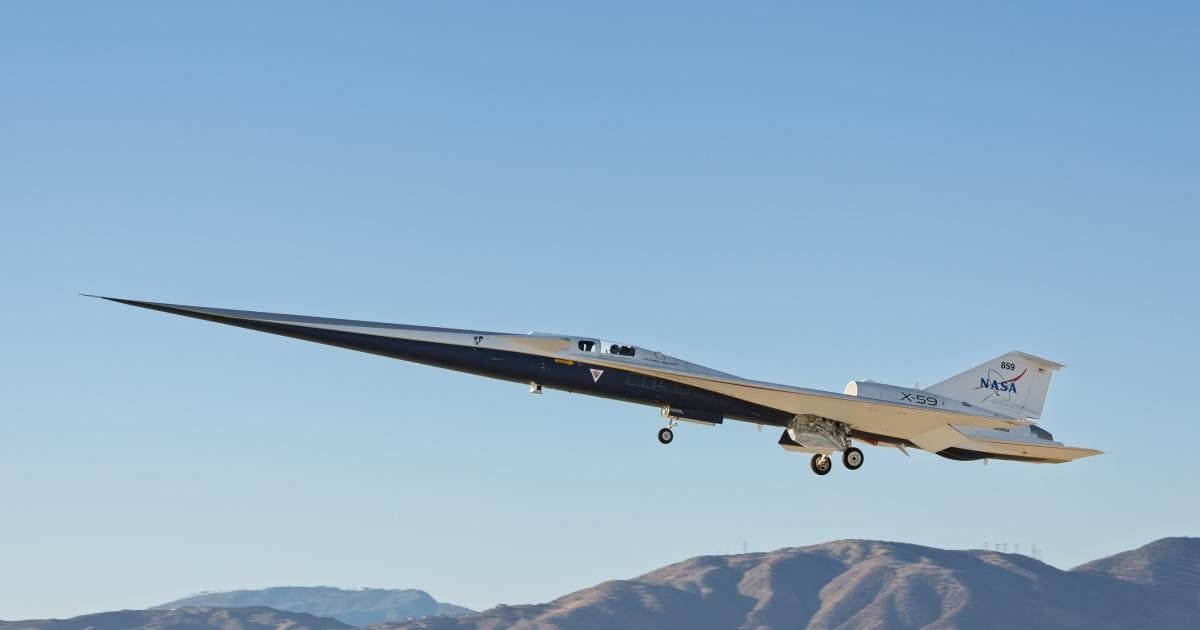
Much of the supporting data is expected to come from NASA’s Quesst mission and its X-59 quiet supersonic aircraft, which completed its first flight in October 2025. The aircraft is designed to break up the shock waves that coalesce into a boom, producing a quieter “thump” instead.
The X-59 flew supersonic for the first time on June 5, 2026, reaching approximately Mach 1.1 at 43,400ft (13,230m), and a week later reached its mission-conditions target of Mach 1.4 at 55,000ft, according to NASA. Later mission phases will measure the aircraft’s acoustic signature and fly it over selected US communities to gather public-response data for regulators.
The FAA cautioned that low-boom aircraft design of the kind the X-59 is validating still requires further research before it can be applied to commercial aircraft, and the interim rule would not permit operations producing surface overpressure above 0.11psf.
Only four special flight authorizations for supersonic testing have been issued to date in the US, most recently to Boom Supersonic and Hermeus, according to the FAA.
