


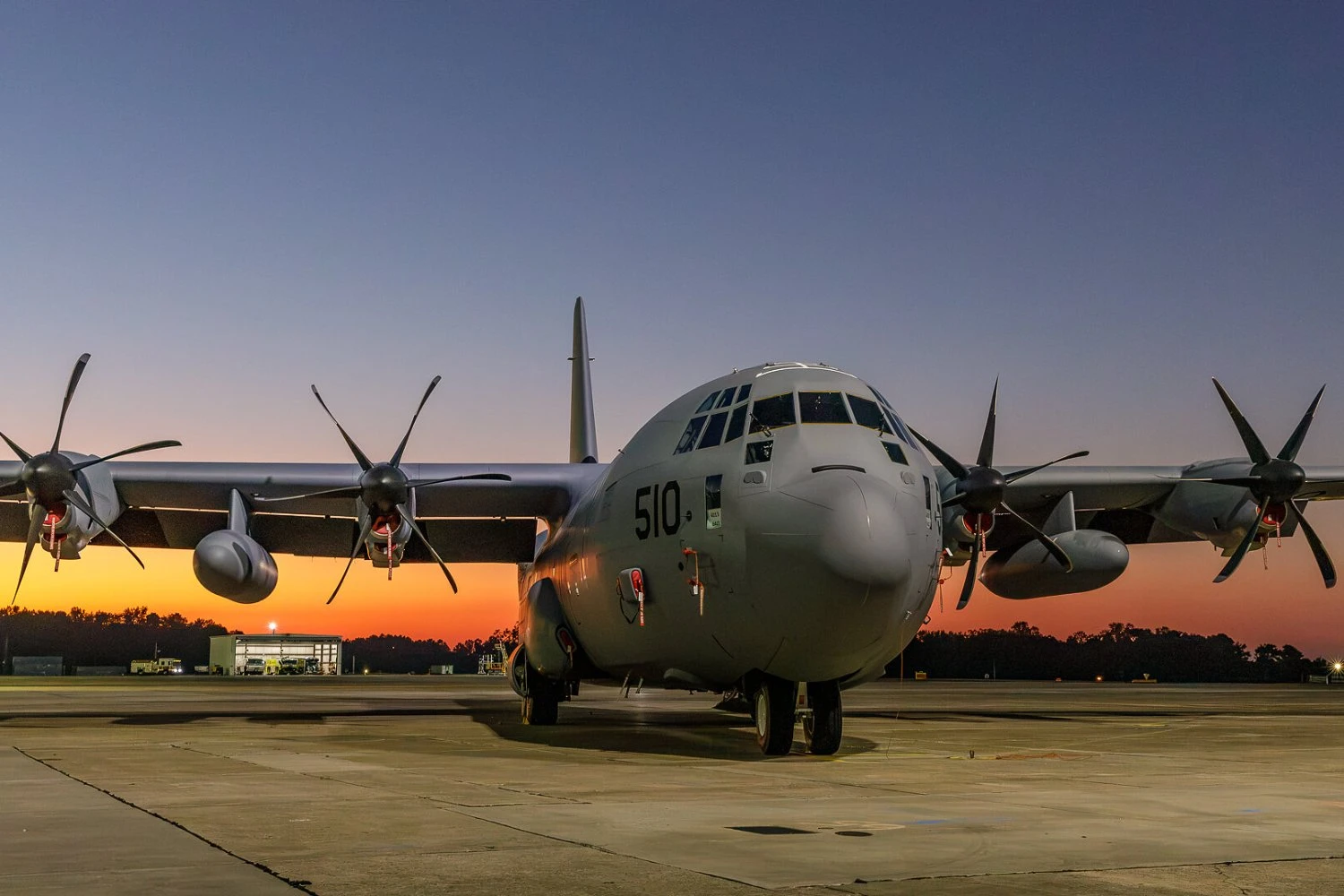
Lockheed Martin has delivered the first C-130J-30 Super Hercules that will be converted into the US Navy’s E-130J Phoenix II, a new airborne command-and-control aircraft for communications with the country’s nuclear forces.
The aircraft was handed over at Lockheed Martin’s facility in Marietta, Georgia, on October 15. It will now be transferred to Northrop Grumman, which is responsible for integrating the mission systems required for the Take Charge and Move Out (TACAMO) role.
The delivery means the aircraft is not yet an operational E-130J. Lockheed Martin has supplied the basic C-130J-30 airframe, which will receive communications equipment and other modifications before entering flight testing in its final configuration.
Northrop Grumman is the prime contractor for the E-130J programand leads an industry team that also includes Lockheed Martin, Collins Aerospace and Raytheon. The Navy initially ordered three aircraft for the engineering and manufacturing development phase.
Return to the Hercules
The E-130J will replace the Boeing E-6B Mercury in the TACAMO mission, which provides an airborne communications link between US command authorities and nuclear forces, including ballistic-missile submarines.
Follow Air Data News: WhatsApp | Instagram | LinkedIn | Twitter | Facebook
Its introduction will also return TACAMO to the C-130 family after more than three decades. The Navy began the mission with modified Hercules aircraft in 1963 and later operated the EC-130Q before transferring the role to the E-6 in the early 1990s.
Unlike the E-6B, which also performs the Airborne Launch Control System mission associated with land-based intercontinental ballistic missiles, the E-130J program is focused on the Navy’s TACAMO requirement.
The service selected the stretched C-130J-30 as the new platform after deciding that a commercial-derived jet was not necessary for the mission. The four-engine turboprop provides the endurance and low-speed characteristics required to deploy the very-low-frequency trailing-wire antennas used to communicate with submerged submarines.
Phoenix II
The Navy formally announced Phoenix II as the E-130J’s popular name in August 2025. The designation refers to the return of TACAMO to a Hercules-based aircraft after the E-6 era.
Air Data News reported earlier this year that Lockheed Martin had also been selected to provide training systems for the E-130J program, including devices for pilots and maintenance personnel.
The Navy currently operates 16 E-6B Mercury aircraft, based on the Boeing 707 airframe. The type entered service in 1989, initially as the E-6A, and was subsequently upgraded to the E-6B configuration.
The first delivered C-130J-30 will now enter mission-system integration before the E-130J begins its flight-test program.
