


Tahoe International Airport in Reno was one of the latest additions to our YouTube channel featuring an automated live stream. Using a CamStreamer camera, we provide a live stream that shows activity 24 hours a day at Reno Airport, capturing all aircraft takeoffs and landings—whether passenger, cargo, or general aviation. For more information about our automated live streams, you can check this link.
Origins
The beginnings of Reno’s current airport go back nearly a century, more precisely to 1927, with an incident that almost ended in tragedy. In September 1927, the famous pilot Charles Lindbergh landed his plane at Reno’s original airfield, formerly known as Blanch Field. After nearly crashing his famous custom-built single-engine monoplane “the Spirit of St. Louis” into parked cars and other objects within the perimeter, Lindbergh declared that the airfield was unsafe and needed major changes to accommodate aviation operations.
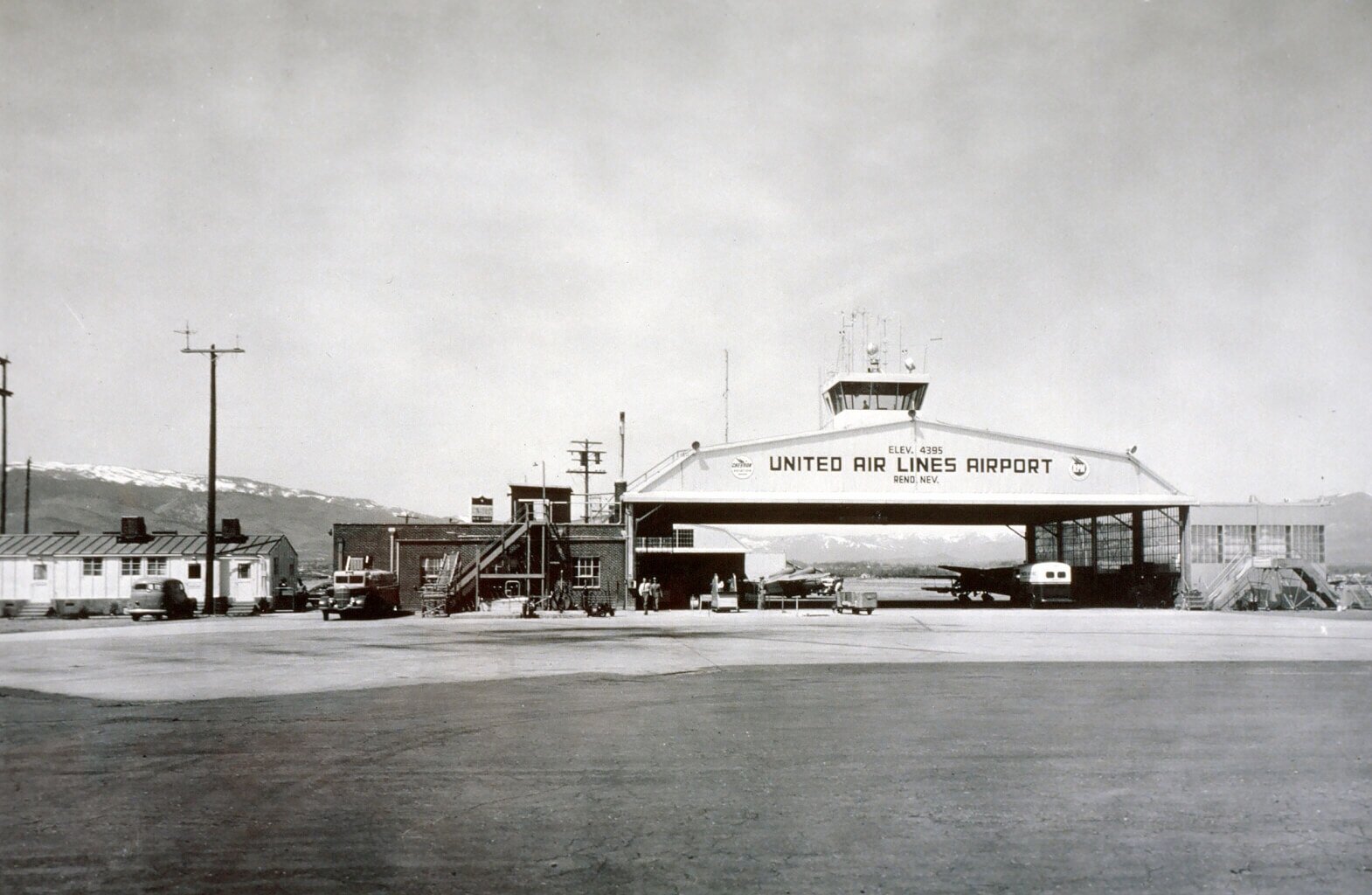
As a consequence of this public warning, Boeing Transport Inc. decided to acquire approximately 120 acres of land east of Blanch Field in 1928, with the goal of building a functional, state-of-the-art airfield equipped with the necessary infrastructure, designed primarily as an airmail stop. Construction of this new airfield was completed in 1929, receiving the name Hubbard Field.
The airport was subsequently operated by United Airlines for a few years before being sold to the City of Reno to serve as a municipal airport. In addition, it temporarily functioned as a United States Air Force air base during World War II.
First expansion
Its first major expansion took place in the late 1950s, with the building of its main passenger terminal in preparation for the 1960 Winter Olympics, which were held in Squaw Valley, California. The new, modern international gateway represented a massive change for Reno Airport, increasing available space for passengers, check-in counters, and baggage handling. Given Squaw Valley’s limited development at the time, Reno served as the primary aviation hub for the Olympic Games.
Also in the 1960s, Reno Airport achieved another milestone in its history: its first jet flight. United Airlines welcomed Reno into the jet aircraft era with an inaugural flight on a brand-new Boeing 727-100 in June 1964. The first jet flight became possible due to the airport’s expansion, mainly in infrastructure, which included the extension of the main runway from 7,800 feet to about 9,000 feet—a length of approximately 2,300 meters to nearly 2,750 meters.
The introduction of jet aircraft permitted Reno to expand its daily operations as well as its domestic connections within the United States. Initial jet services were to and from San Francisco, with longer routes—such as Los Angeles, Chicago, and Denver—being implemented later in the decade. On April 28th, 1968, Reno welcomed its first scheduled flight on a Boeing 737-200, also operated by United Airlines.

Cannon, and then Reno-Tahoe
In 1977, Reno Airport was renamed Cannon International Airport in honor of US Senator Howard Cannon, who was dedicated to the development of commercial aviation. Seventeen years later, the airport authority changed the name to Reno-Tahoe International Airport, with the aim of boosting the Lake Tahoe brand—a tourist attraction located a few kilometers from the airport—among global travelers.
Regarding terminal growth, the former Cannon International Airport expanded with the addition of two satellite concourses in the early 1980s, known as Concourse B and Concourse C, both of which remain in operation. Between the two, the airport possesses 23 jet bridges, in addition to other remote parking positions for commercial aircraft. A dedicated international arrivals terminal was built in the late 1990s.

The new Reno-Tahoe
In March 2026, Reno-Tahoe International Airport made one of the most significant announcements in its history: the construction of two new terminals for $650 million—Concourse A and Concourse B—which will replace the current concourses starting in 2028 and 2029, respectively.
The project plans to nearly double the current total space, increasing it from 130,000 square feet per concourse to 250,000 square feet. It also includes the addition of 24 new jet bridges equipped to handle larger aircraft, such as the Boeing 737 MAX 10, and greater passenger amenities.

The present
According to our database, Reno-Tahoe International Airport serves approximately 160 daily arrivals and departures, including commercial flights, cargo flights, and general aviation, such as private jets and flight school operations. Over the past seven days, the airport handled about 2,300 operations, comprising around 1,150 arrivals and 1,150 departures.
Reno-Tahoe has three runways, each with a different length. The main runway, 17R-35L, is 3,353 meters long, or about 11,000 feet. Runway 17L-35R is 2,743 meters long, while the shortest runway, 08-26, is 1,860 meters long. Last week, 76% of operations were performed on runway 17R-35L, 20% on runway 17L-35R, and the remaining percentage on runway 08-26, all of which used runway 26.

Las Vegas, Denver, and Los Angeles are Reno’s leading regular destinations, with 86, 55, and 53 weekly flights, respectively. Phoenix, San Francisco, San Diego, Salt Lake City, Seattle, Dallas, and Portland complete the top 10, with 43, 42, 39, 27, 26, 25, and 21 flights per week. Reno also has cargo flights, primarily conducted by Kalitta Air, FedEx, and UPS, with the latter two operating several flights using wide-body aircraft.
Routes

| Destination | Airline | Flight(s) | Aircraft |
|---|---|---|---|
| Atlanta | Delta Air Lines | 6 weekly | Boeing 757-200 |
| Austin | Southwest | 4 weekly | Boeing 737-800 |
| Burbank | JSX | 8 weekly | Embraer 135/145 |
| Burbank | Southwest | 10 weekly | Boeing 737-700 |
| Chicago MDW | Southwest | 5 weekly | 737-700 / 7M8 |
| Chicago ORD | United Airlines | 7 weekly | Boeing 737-700 |
| Dallas DAL | Southwest | 1 weekly | Boeing 737-800 |
| Dallas DFW | American Airlines | 24 weekly | 738 / 7M8 |
| Denver | Southwest | 21 weekly | 737 / 738 / 7M8 |
| Denver | United Airlines | 34 weekly | A319 / A320 / 737 |
| Guadalajara | Volaris | 5 weekly | Airbus A320neo |
| Las Vegas | Frontier | 14 weekly | A20N / A21N |
| Las Vegas | JSX | 4 weekly | Embraer 135/145 |
| Las Vegas | Southwest | 68 weekly | 737 / 738 / 7M8 |
| Long Beach | Southwest | 13 weekly | 737 / 738 / 7M8 |
| Los Angeles | Delta Air Lines | 28 weekly | Embraer 170/175 |
| Los Angeles | Southwest | 8 weekly | 737 / 738 / 7M8 |
| Los Angeles | United Airlines | 17 weekly | 738 / 7M9 / E175 |
| Minneapolis | Delta Air Lines | 7 weekly | Boeing 737-800 |
| Minneapolis | Sun Country | 2 weekly | Boeing 737-800 |
| New York JFK | jetBlue | 7 weekly | Airbus A220-300 |
| Phoenix | American Airlines | 25 weekly | A320 / 738 / E175 |
| Phoenix | Southwest | 18 weekly | 737 / 738 / 7M8 |
| Portland | Alaska Airlines | 21 weekly | 738 / 739 / E175 |
| Salt Lake City | Delta Air Lines | 27 weekly | 738 / 739 / E175 |
| San Diego CLD | JSX | 4 weekly | Embraer 135/145 |
| San Diego SAN | Alaska Horizon | 14 weekly | Embraer 175 |
| San Diego SAN | Southwest | 25 weekly | 737 / 738 / 7M8 |
| San Francisco | United Airlines | 42 weekly | A319 / A320 / 737 / 738 / 7M8 / E175 |
| San Jose | Southwest | 4 weekly | Boeing 737-700 |
| Santa Ana | JSX | 7 weekly | Embraer 135 |
| Seattle | Alaska Airlines | 26 weekly | 738 / 739 / E175 |
Alaska Airlines (AS/ASA), American Airlines (AA/AAL), Delta Air Lines (DL/DAL), Frontier (F9/FFT), jetBlue (B6/JBU), JSX (XE/JSX), Southwest (WN/SWA), Sun Country Airlines (SY/SCX), United Airlines (UA/UAL), and Volaris (Y4/VOI) are the passenger airlines currently operating in Reno; all are US carriers except for the last one, which is from Mexico. In terms of the number of weekly flights, Southwest is the leading airline, with approximately 175 operations a week within eight routes.

Our other automated live streams are located in Las Vegas, Sint Maarten, Lanzarote, New Orleans, and New York LaGuardia.
Las Vegas
Sint Maarten
Lanzarote
New Orleans
New York LaGuardia
Cover photo: © SR1 – JetPhotos (Reno-Tahoe International Airport)
The post From Lindbergh to livestream: Nearly a century of aviation in Reno appeared first on Flightradar24 Blog.
