


America Makes has selected General Atomics Aeronautical Systems, Inc. (GA-ASI) to lead a $5.5 million program developing material allowables for a scandium-aluminum alloy across three classes of laser powder bed fusion (LPBF) 3D printers.
Funded by the Office of the Under Secretary of War’s Manufacturing Technology Office (OSD ManTech), the program is called Generation Of Technical-data for High-strength Aluminum Alloy Material (GOTHAAM), and was announced earlier this year.
The funding itself is modest by defense standards. But the problem it targets is not. Qualifying a metal alloy for additive manufacturing has typically meant tying qualification closely to a specific machine, set of process parameters, and production site. Change any one of those variables and the manufacturer may face additional testing or requalification, depending on the impact of the change.
“Qualifying advanced AM materials to deliver robust material data supporting durable, corrosion-resistant components for critical defense applications directly strengthens the defense industrial base,” said John Martin, Additive Manufacturing Research Director at America Makes.
Qualifying Alloy Across Multiple Platforms
According to America Makes, GOTHAAM’s technical objective is to generate qualification data for a 7075-T73-equivalent alloy, specifically Scalmalloy, that can be established across small, medium, and large-format LPBF systems. The machines named in the program scope include the EOS M290 and M400/4, the Nikon SLM 280, SLM 500, and NXG/E, and the GE/Colibrium Additive M2. That is six 3D printer models from three different OEMs.
The team GA-ASI has assembled reflects the breadth of the project. Seventeen partners span virtually every layer of the additive supply chain. Lockheed Martin, Northrop Grumman, and Airbus Space & Defense + AP Works represent the defense and aerospace primes participating in the project.
Nikon SLM Solutions and EOS America are the machine builders whose platforms are included in the cross-platform qualification effort. Valimet, Toyal America, Equispheres, AMG Aluminum, Rio Tinto, Sunrise Metals, and NioCorp cover powder and raw material supply. MIMO Technik, Quadrus Corporation, Hadrian Additive, and Scot Forge sit on the contract manufacturing side. Dyndrite provides the software layer.
The inclusion of Dyndrite points to a particular approach for addressing cross-platform qualification. Dyndrite has also been selected to apply its SASSQUATCH methodology under a separate America Makes initiative called Delta Qual 2.0. That program is developing methods to qualify ranges of AM process parameters for defense production so that engineers can make adjustments within those ranges without triggering complete requalification.
In GOTHAAM, the methodology will be used to harmonize LPBF processes across different 3D printers by giving engineers programmatic control over variables that are otherwise controlled through machine-specific software and process settings. Those variables include laser assignment, toolpath zoning, stitching zones, gas-flow considerations, laser power, scan speed, and Z-height.
Testing the Limits of Qualification
That premise has not yet been proven at the scale GOTHAAM proposes. Qualification has been one of AM’s significant bottlenecks. Differences between machines, process conditions and manufacturing environments can affect process repeatability, making qualification and validation more demanding when production is transferred or scaled.
GOTHAAM is one of three overlapping programs where Dyndrite is working with America Makes on different facets of this qualification problem. AIM-4AM, an approximately $2 million effort with MIMO Technik and RTX, is using AI and physics-based modeling to reduce the volume of physical testing needed to establish material allowables for LPBF 17-4PH stainless steel.
Delta Qual 2.0 addresses the process window problem. GOTHAAM adds the cross-platform dimension, testing whether qualified knowledge about a material and process can transfer between different machine classes and manufacturing environments.
The three programs, taken together, outline what a future qualification framework might look like. Fewer physical tests per material, validated process windows instead of fixed parameter recipes, and material data that travels across machine classes. Those are the directions the three programs are exploring; GOTHAAM and the other efforts have not yet established that such a framework can be implemented at production scale.
But the fact that OSD ManTech is funding the attempt, alongside participation from major aerospace and defense companies, underscores the US defense manufacturing community’s interest in addressing the qualification burden associated with scaling LPBF across different machines and production environments.
3D Printing Industry is inviting speakers for its 2026 Additive Manufacturing Applications (AMA) series, covering Energy, Healthcare, Automotive and Mobility, Aerospace, Space and Defense, and Software. Each online event focuses on real production deployments, qualification, and supply chain integration. Practitioners interested in contributing can complete the call for speakers form here.
To stay up to date with the latest 3D printing news, don’t forget to subscribe to the 3D Printing Industry newsletter or follow us on LinkedIn.
Explore the full Future of 3D Printing and Executive Survey series from 3D Printing Industry, featuring perspectives from CEOs, engineers, and industry leaders on the industrialization of additive manufacturing, 3D printing industry trends 2026, qualification, supply chains, and additive manufacturing industry analysis.
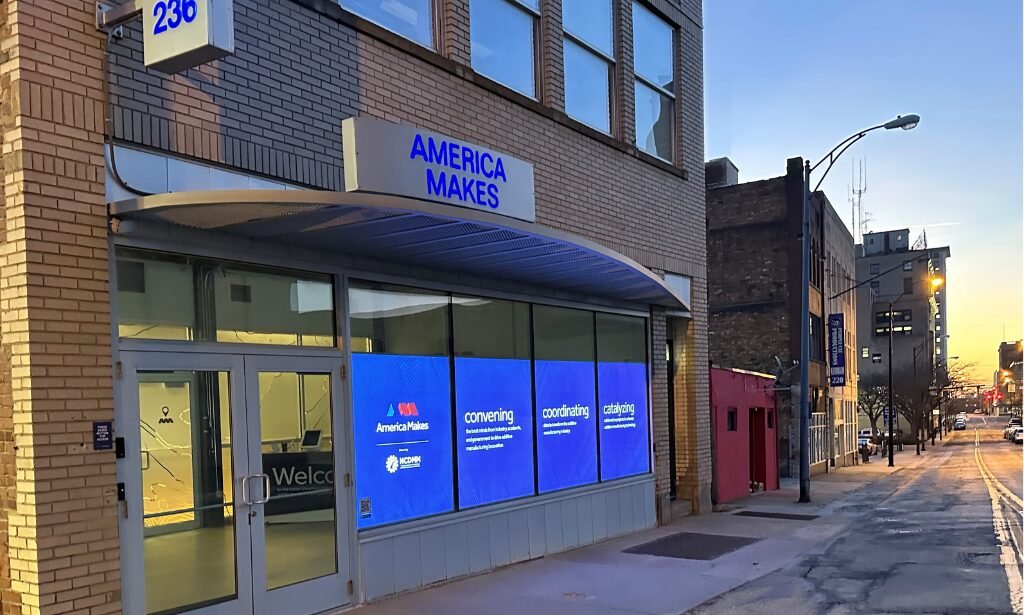
Featured image shows the America Makes facility in Youngstown, Ohio. Photo via America Makes.
