


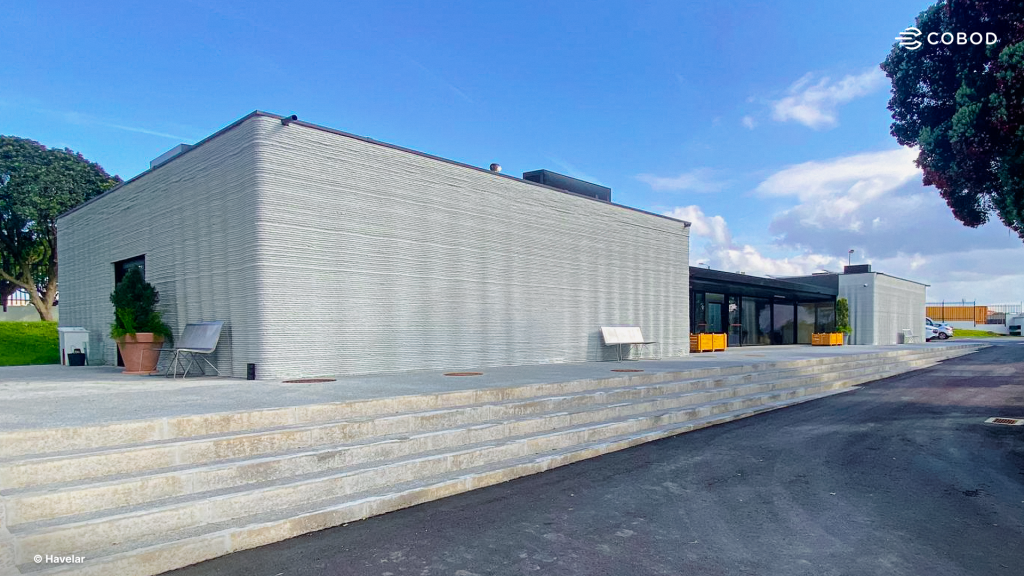
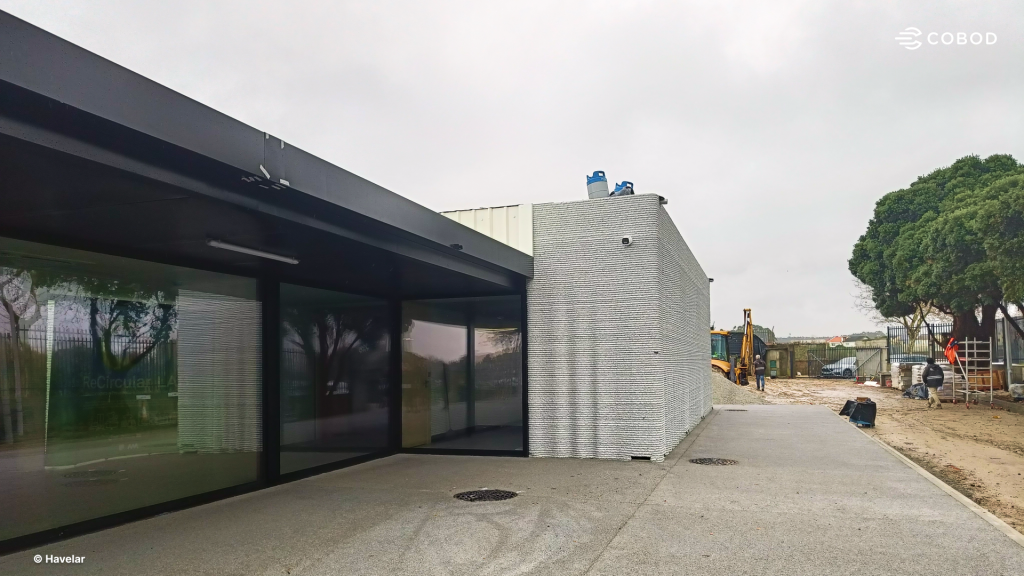
Portuguese firm Havelar erected a 500 m² recycling center office at the Ecocentro de Perafita in Porto for the Matosinhos municipality using a COBOD BOD2 3D printer, a four-person crew, and nine working days. More unusually still, the project came in on budget, a feat the partners themselves described as rare for public works in Portugal.
The building’s most visible feature is also its most instructive. Curved concrete walls run throughout the structure, the kind of geometry that typically demands expensive custom formwork and adds weeks to a conventional timeline. With 3D printing, those curves emerge directly from the digital model, requiring no additional labor or material cost.
According to Bárbara Rangel, Researcher at the Faculty of Engineering of the University of Porto: “With 3D construction printing, trades can work in parallel; there is no waiting for walls or slabs to dry before the electrician, tiler, or carpenter comes in. The curved walls on the exterior also serve a structural purpose, and through the shade they generate, we are able to enhance solar gains through the interplay between shade and sun exposure.”
Beyond design freedom, the efficiency gains are substantial. José Maria Ferreira, Founder and CEO of Havelar, put it plainly: “The main advantage is time. In construction terms, it is a third: a third of the time, a third of the materials, and a third of the people. Here it is not just about the recycling aspect; it is also that we had a team of only four people to construct a building like this.”
Havelar’s Strategy and a Sector Gaining Momentum
The Matosinhos project is part of a deliberate expansion by Havelar into both public and residential construction. Since completing the recycling center, the company has printed 32 housing units in Porto, with 53 additional homes scheduled for 2026 across different regions of the country. The firm is clearly moving from proof-of-concept to operational scale.
Philip Lund-Nielsen, Co-founder and CCO of COBOD International, did not understate the shift. “Havelar delivered a public building on budget with a four-person crew and beat the conventional construction timeline. Construction 3D printing isn’t an alternative method anymore. For projects like this, it’s clearly the superior option.”
That trajectory mirrors what is happening elsewhere in Europe. In France, the ViliaSprint² project, a collaboration between PERI 3D Construction, COBOD, Holcim, and Plurial Novilia, delivered 12 apartments across three floors and around 800 m² of livable space, making it the continent’s largest 3D printed multi-family residential building to date, with the printing phase wrapping up in 34 days against an original estimate of 50. The project also demonstrated that design and performance can coexist: the building integrated perlite insulation, timber balconies, 500 m² of photovoltaic panels, and a hybrid heating system, achieving roughly 60% energy self-sufficiency.
In Denmark, the picture is equally ambitious. The Skovsporet development in Holstebro delivered 36 student apartments across six buildings, covering a total printed area of 1,654 m², using a COBOD BOD3 printer designed for high-volume, low-rise construction with extendable ground-based tracks that allow multiple buildings to be produced in sequence without repositioning.
That framing is no longer just marketing. Across Europe, a maturing ecosystem of companies is moving the technology from demonstration to delivery. Projects in Portugal, France, and Denmark are doing what early advocates only promised: meeting budgets, satisfying regulators, and slotting into established building workflows.
3D Printing Industry is inviting speakers for its 2026 Additive Manufacturing Applications (AMA) series, covering Energy, Healthcare, Automotive and Mobility, Aerospace, Space and Defense, and Software. Each online event focuses on real production deployments, qualification, and supply chain integration. Practitioners interested in contributing can complete the call for speakers form here.
To stay up to date with the latest 3D printing news, don’t forget to subscribe to the 3D Printing Industry newsletter or follow us on LinkedIn.
Explore the full Future of 3D Printing and Executive Survey series from 3D Printing Industry, featuring perspectives from CEOs, engineers, and industry leaders on the industrialization of additive manufacturing, 3D printing industry trends 2026, qualification, supply chains, and additive manufacturing industry analysis.
Featured image shows Exterior view of the completed Ecocentro de Perafita office, Matosinhos, Portugal. Photo via COBOD.
