


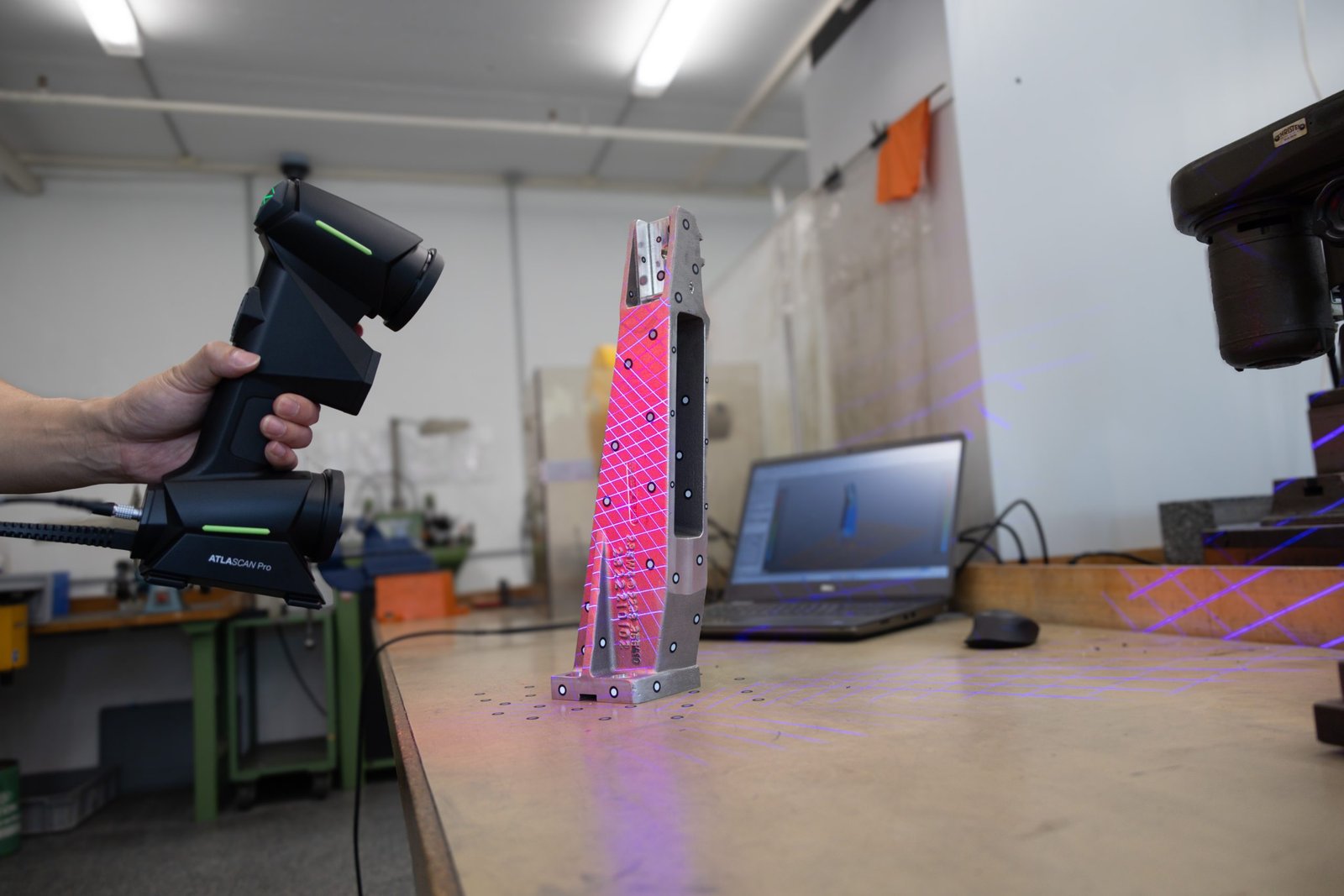
Hexagon‘s Portable Metrology Division has introduced a reverse engineering workflow for maintenance, repair and overhaul (MRO) teams that connects its ATLASCAN Pro handheld 3D scanner directly to Geomagic Design X software. The company says the combination lets engineers rebuild a CAD model up to eight times faster than with mainstream CAD tools, addressing a common problem in aviation and defense maintenance: replacing parts for which no CAD data exists.
Addressing a Persistent MRO Bottleneck
Civil aviation and defense MRO teams frequently need to reproduce aging interior components, such as seat shrouds, armrests, tray tables, galley doors, latches and hinges, that are cracked, delaminated or no longer manufactured. On-demand manufacturing has become a common response to this gap. The US Air Force has reverse-engineered and 3D printed F-35 canopy frames for testing, and the Royal Air Force fitted its first in-house 3D printed part to a Typhoon aircraft in 2025, part of a broader push by the European Defence Agency to scale that approach further across member states.
Hexagon states that reverse engineering from scan data can reduce errors from manual measurement and outdated drawings, but the process often requires trained CAD and scanning expertise to convert an incomplete scan into a usable 3D model.
According to the company, rebuilding an accurate model with non-specialist CAD software can take three to eight times longer than with Geomagic Design X, which pairs direct scanner control with automated tools including Region Segmentation, Modelling Wizards and Auto Sketch, along with NURBS surfacing, to convert freeform shapes into editable, parametric CAD models with full history retained.
Aziz Tahiri, global director of aerospace and defense at Hexagon, said defense customers are showing rising interest in mobile units that combine a scanning arm, reverse engineering software and a 3D printer in a single container, so a damaged part can be “scanned, rebuilt and repaired on site.” He added that reverse engineering a single mechanical component can otherwise involve multiple people and manual repair, and that the new workflow makes it possible to “reverse engineer directly back into CAD in a matter of hours.”
How the Workflow Operates
Hexagon says the ATLASCAN Pro scanner is designed for use without specialist training, allowing MRO technicians or manufacturing engineers to scan smaller components from any angle in hangar, shopfloor or field environments. The scanner is built to hold its accuracy under those less controlled conditions and to capture fine detail and high-density data with less manual clean-up.
Within Geomagic Design X, an Accuracy Analyzer tool checks constructed surfaces against the original scan data at each stage of the rebuild, which Hexagon says lowers the risk of rework, tooling iterations and fit problems. Once the model is finished, it can be transferred via LiveTransfer into CAD platforms including SOLIDWORKS, Siemens NX, Autodesk Inventor and PTC Creo. Hexagon describes both the scanner and software as vendor-agnostic, meaning they can also work alongside third-party scanning devices, software and file formats already in use at a given facility.
Availability
The ATLASCAN Pro and Geomagic Design X reverse engineering package is available now through Hexagon, with regional support and maintenance. The company’s Portable Metrology Division team will be available for briefings at the Farnborough International Airshow this month.

Closing the No-CAD-Data Gap
For many legacy components, turning captured geometry into an editable CAD model suitable for manufacturing remains a key bottleneck in the reverse-engineering workflow. Designs that predate digital archiving or are no longer supported by their original manufacturers often leave engineers rebuilding parts from scratch, making scan-to-CAD one of the most time-consuming stages of the replacement process.
The U.S. Navy has tackled the same problem through its RESTORE lab, which restored a failing component of an AN/TRC-194 antenna’s azimuth drive by scanning it and converting the geometry into a usable CAD model, a method its chief engineer called “the scan-to-CAD-to-fab method.” The original casting for the antenna’s pedestal could no longer be located, making scanning the only practical route to a replacement. Peel 3D has approached the gap from the software side with Peel.CAD Pro, aimed at businesses reverse engineering relatively simple parts for MRO work without requiring deep scanning or CAD expertise.
Across these efforts, the common thread is clear: scanning is becoming an increasingly common starting point for reproducing parts whose original CAD data no longer exists.
3D Printing Industry is inviting speakers for its 2026 Additive Manufacturing Applications (AMA) series, covering Energy, Healthcare, Automotive and Mobility, Aerospace, Space and Defense, and Software. Each online event focuses on real production deployments, qualification, and supply chain integration. Practitioners interested in contributing can complete the call for speakers form here.
To stay up to date with the latest 3D printing news, don’t forget to subscribe to the 3D Printing Industry newsletter or follow us on LinkedIn.
Explore the full Future of 3D Printing and Executive Survey series from 3D Printing Industry, featuring perspectives from CEOs, engineers, and industry leaders on the industrialization of additive manufacturing, 3D printing industry trends 2026, qualification, supply chains, and additive manufacturing industry analysis.
Featured image shows Hexagon MI H3DS ATLASCAN Pro scanning a component for reverse engineering. Photo via Hexagon.
