


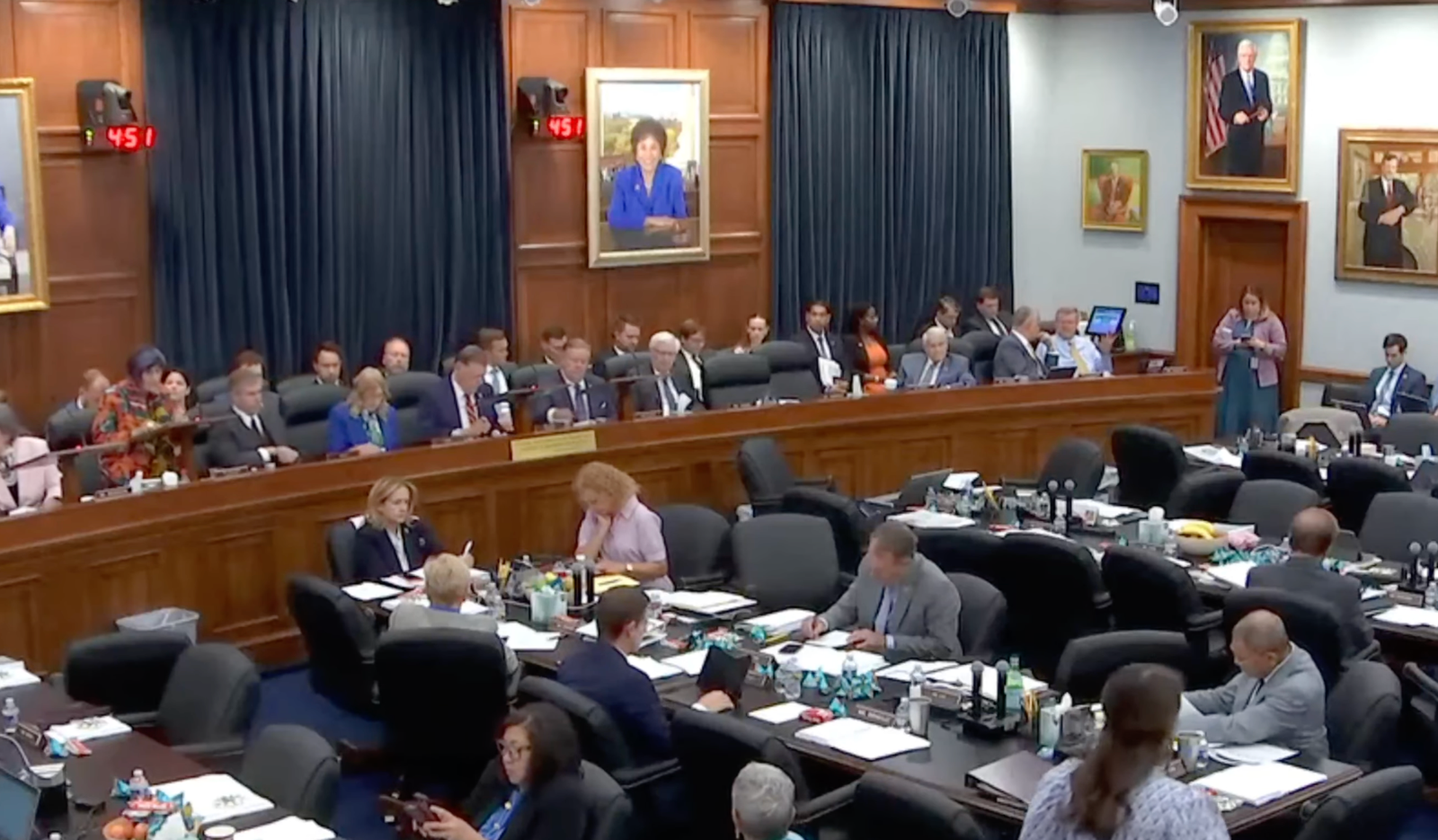
WASHINGTON — The House Appropriations Committee on June 24 advanced a fiscal 2027 defense appropriations bill providing $1.07 trillion for the Pentagon, a $234 billion increase over enacted 2026 funding. For the Space Force, the bill allocates about $55.5 billion, including $35.3 billion for research and development, $9.6 billion for procurement, $8.8 billion for operations and maintenance, and $1.78 billion for military personnel.
The funding level tracks the recommendation approved earlier by the House Appropriations defense subcommittee and excludes roughly $12 billion the Trump administration proposed to provide the Space Force through a separate budget reconciliation package. The White House has sought to raise the service’s total budget to more than $71 billion by pairing traditional discretionary appropriations with mandatory funding, an approach that has drawn skepticism from lawmakers in both parties.
The committee made clear it broadly backs the Space Force’s trajectory.
In a report accompanying the legislation, lawmakers said the service “has made remarkable progress in maturing into a true warfighting service, accelerating the delivery of critical capabilities and prioritizing resilience across its architecture.”
The committee said its bill “makes critical investments in space and ground architectures, consistent with the President’s budget request, with robust funding in space launch, missile warning, satellite communications and global positioning.”
The report also endorsed one of the Space Force’s internal reforms: reorganizing acquisitions around Portfolio Acquisition Executives, senior officials with broader authority over related programs.
“The Committee has for several years urged the Space Force to reduce the distance between program-level decision-making and the authority to act,” lawmakers wrote.
But the praise was accompanied by pointed criticism of the service’s acquisition performance.
The committee said it remains “concerned with the persistent challenges in Space Force acquisition programs, including significant cost growth, schedule delays, and execution difficulties across several major efforts.” Those problems, lawmakers said, have persisted despite efforts to streamline procurement and increase funding.
No funding for ‘dynamic space operations’
The report said lawmakers are “alarmed” that the commander of U.S. Space Command has repeatedly identified “dynamic space operations” as essential to achieving space superiority while the budget “does not reflect the urgency of this need.”
Dynamic space operations call for satellites that maneuver frequently rather than remaining in predictable orbits, allowing them to avoid attacks, reposition for new missions and operate more effectively in a contested environment where rivals such as China and Russia are developing anti-satellite capabilities.
Lawmakers also challenged the Pentagon’s approach to secrecy in military space.
The report criticized what it called “excessive classification” and directed the Defense Department to “aggressively reduce unnecessary classification on Space Force capabilities and operations,” reflecting longstanding complaints from industry that excessive secrecy slows collaboration and discourages broader commercial participation.
Another issue the HAC called out is military’s low Earth orbit satellite architecture.
The committee criticized the absence of funding for Tranche 3 of the Transport Layer within the Proliferated Warfighter Space Architecture, a constellation being developed to relay military data through hundreds of satellites in low Earth orbit. The report expressed concern that the proposed Space Data Network could become too dependent on a single provider and urged the Space Force to preserve competition as it builds the next generation of military communications networks.
“The transport layer is a critical component of the Proliferated Warfighter Space Architecture and was designed and purpose-built as a tactical communication layer with the resiliency to withstand adversary attacks and reliably deliver mission critical data directly to service members through the United States and North Atlantic Treaty Organization Link-16 network,” the report said.
The committee directed the Air Force to continue developing the Tranche 3 Transport Layer program and ensure Link-16 compatibility remains a requirement for future tactical data transport architectures.
Lawmakers also took aim at how the administration intends to finance Golden Dome, the proposed missile defense architecture designed to integrate space-based sensors with systems capable of detecting, tracking and helping defeat ballistic, cruise and hypersonic missiles.
The Trump administration has proposed funding roughly $17 billion for Golden Dome largely through budget reconciliation rather than the annual appropriations process.
The committee rejected that approach.
“The committee strongly believes that a program of this strategic importance deserves sustained, transparent funding through the discretionary budget, with rigorous congressional oversight and competition-driven efficiencies.”
