


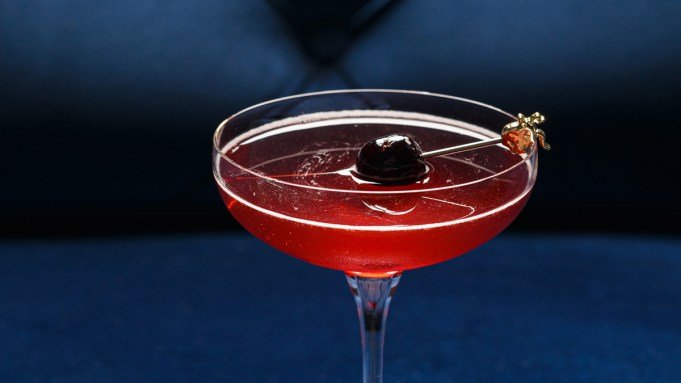
The Left Hand is a distinct cocktail. Indisputably so. It has a name. More than that, it’s a neo-classic—the recipe has been confirmed by dozens of publications big and small, and most cocktail bartenders around the world can make you one from memory. But here’s a fair question: Is it? Is it its own drink? Or is it just a Boulevardier wearing a lazy disguise?
Like all creative endeavors, mixology can suffer from a crisis of originality. Imagine for a moment that you’re a bar manager of a cocktail bar. You have an idea for a drink for your menu, a combination of ingredients that you think will work. You try it, and it’s good! You workshop it for a few weeks and now it’s great, hey, even better. But right before your menu comes out, you discover that a bar on the other side of town already has a cocktail with those exact same ingredients. You didn’t know it at the time—you’ve never had their drink, hell, you’ve never even been there—but there it is, nonetheless, making yours look plagiarized. What do you do?
This can be a fairly acute problem these days, but 20 years ago was barely a concern; not only were there orders of magnitude fewer cocktail bars than there are today, but the collected mixological knowledge of western civilization—thousands upon thousands of cocktails, preserved across 150 years of drinks books—were out of print, yet to be resurrected or digitized. And so one day in 2006, a bartender named Sam Ross, working at Milk & Honey in New York City, got inspired by the then-brand-new Bitterman’s Mole Bitters to create “a love child of a Negroni and a Manhattan,” as he’d later recall. He combined the bitters with two parts bourbon and one part each of sweet vermouth and Campari, and given that it has both Italian and American ingredients, named it the Left Hand, for “Lefty,” the Al Pacino character in the 1997 film Donnie Brasco.
What Ross didn’t know is that a couple years earlier, a bartender named Dominic Venegas had made nearly the same drink (with rye for bourbon, and no bitters) that he called the 1794, at a bar called Range in San Francisco. Not a huge problem, they’re plausibly different, and in that nascent internet era, two similar drinks 3,000 miles apart isn’t raising any eyebrows. But what neither of them knew at the time is that they both were playing in the shadow of the Boulevardier (bourbon, campari, and sweet vermouth, a Left Hand without bitters), a towering giant of a classic cocktail, one which was invented some 80 years earlier. Today, it would be ludicrous to dash bitters into a Boulevardier and claim it your own—akin to starting a shoe company called Niké and wondering why everyone’s so upset—but 20 years ago, the classic was all but unknown, tucked away on page 80 of a cocktail book that had been out of print for the better part of a century.
The 1794 has fully faded away, but the Left Hand endures. But, back to our question: Is it its own drink? I say yes, for two reasons. First, the mole bitters deepen the experience, adding a broody chocolatey depth in the mid-palate and slapping an exclamation mark on the finishing bitterness. I’ve found over the years that it’s not the same craving; I can be in the mood for one or the other, which to me is proof that the flavor is sufficiently different. But second and more importantly, it’s its own drink because it has a name and we all know it. It’s grandfathered in, a proper neo-classic, and one that’s every bit as worth making as its long lost father.
Left Hand
- 1.5 oz. bourbon
- 1 oz. sweet vermouth
- 1 oz. Campari
- 1-2 dashes chocolate bitters
Add all ingredients to a mixing glass with ice, and stir for 15 to 20 seconds. Strain up into a coupe or on a big piece of ice in a rocks glass, and garnish with a cherry or orange peel.
NOTES ON INGREDIENTS
Bulleit
Bourbon: I broadly follow my Boulevardier template here, in that I like a bourbon with a higher rye content, like 1792 or Bulleit, but honestly, this tastes good with all bourbons.
Vermouth: I was torn here. Carpano Antica is good—powerful, if a bit noisy. Cocchi Vermouth di Torino is good—elegant and clean, if a little vanilla sweet. Dolin is good—light and lithe, if a bit thin. I don’t know. Cocktails are only as good as their weakest link so don’t use a $4 bottle you bought at a drug store, but choose a quality vermouth and I think they’re all pretty good here.
Chocolate Bitters: As mentioned, this was made specifically for Bitterman’s Xocolatl Mole Bitters, and that’s what you should use. Not only is it the best choice for this drink—the dry cacao spice deepening the drink without adding any distracting candy notes—but it is one of the few bottles of bitters all cocktail fans should own, alongside Angostura and Peychaud’s.
Ratios: Mostly what you’ll find across the internet is less Campari and sweet vermouth than I use, 0.75oz each (a 2:1:1 ratio). This is because these are Ross’s original specs, and that does indeed make a fine drink. The difference is what you’re going for—the original specs make a bitter Manhattan, while mine make a bourbon Negroni. Both are great. It’s difficult to choose. I’d say to choose based on how you’re going to serve it: If you’re putting it up in a cocktail or martini glass, use the original ratio. If you’re serving it on the rocks, use the extra body to counter the eventual dilution and go with my ratios printed above.
Garnish: It was originally garnished with a cherry, again because it was a Manhattan riff. This is neutral for aroma. Cherries are delicious and go ahead and do this if you want to, but personally I find an orange peel adds more.
Authors

Jason O’Bryan

