


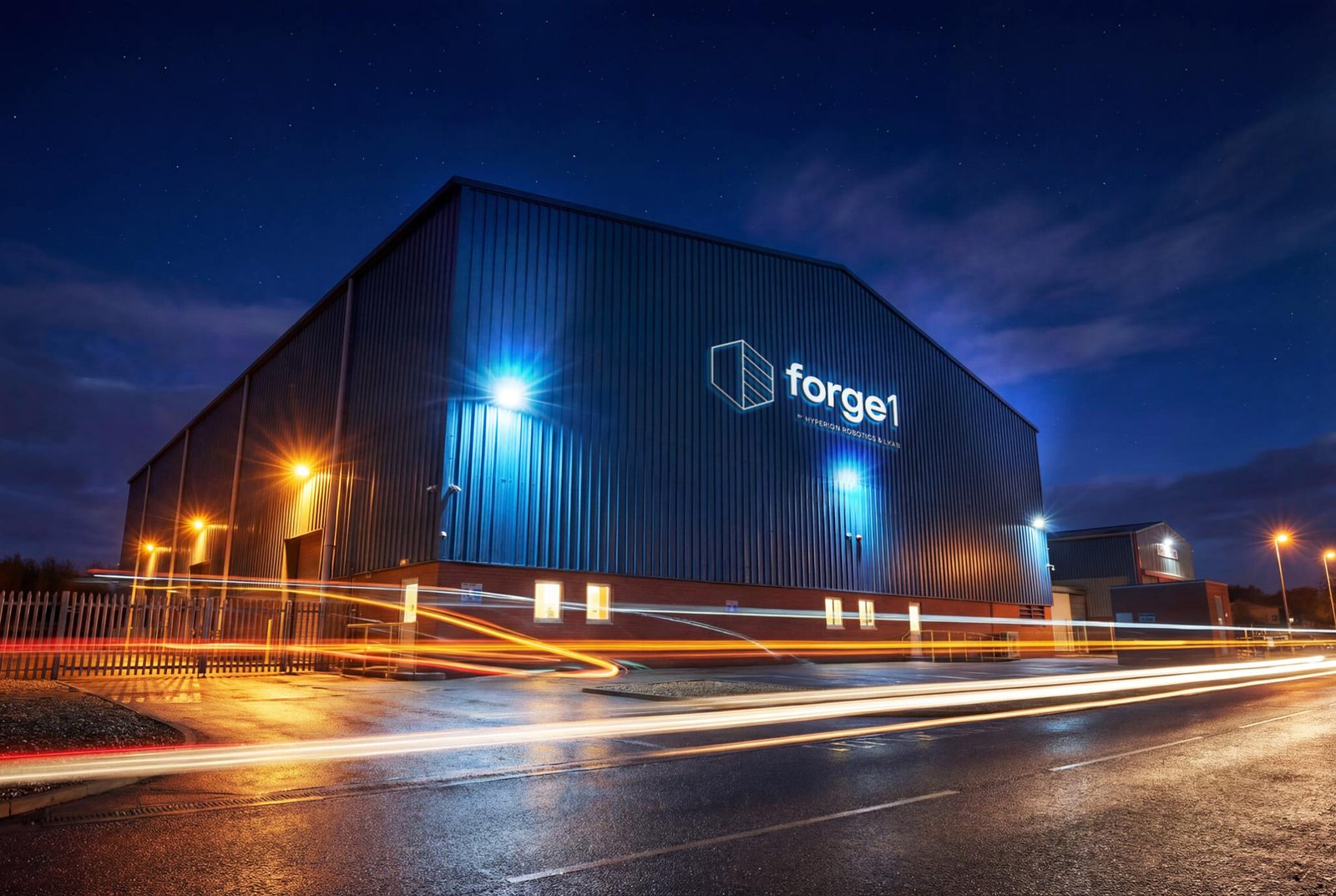
Finnish concrete 3D printing specialist Hyperion Robotics has chosen Flixborough, near Scunthorpe, as the location for its first UK concrete manufacturing facility.
The specialist has signed an agreement with Swedish company LKAB Minerals to set up a prefabricated concrete production plant on LKAB’s industrial site in North Lincolnshire.
Named Forge I, the factory is scheduled to open before summer 2026 and will produce pre-cast concrete foundation units using robotic and automated manufacturing systems. LKAB will supply both the mineral inputs used in the concrete mix and the physical site, while Hyperion takes responsibility for developing and operating the facility.
Steve Handscomb, Managing Director Cementitious, LKAB Minerals UK, said, “By supplying climate-efficient mineral inputs directly into Hyperion’s computational design and robotic production platform, we are helping to establish a new automated raw-materials-to-infrastructure value chain in the UK. It demonstrates how materials innovation and industrial digitalisation can work together to accelerate the transition to lower-carbon, high-performance construction.”
Manufacturing Foundations for UK Utilities
Forge I is designed to manufacture more than 50 foundation units per week, with each unit measuring up to 3m x 3m in footprint and 2.5m in height. All units will be Eurocode-compliant and CE-marked, with Hyperion initially targeting infrastructure clients across the energy, water, data centre and utilities sectors. These are the sectors where foundation work represents a significant and repeatable component of project costs and timelines.
The Finnish company’s approach offers a practical answer to longstanding inefficiencies in construction. By producing concrete foundations under controlled conditions and delivering them ready to install, it reduces the volume of labour and heavy vehicle activity needed at project sites, and shortens program delivery compared with conventional on-site construction. This also allows for tighter control over material use and consistency, with implications for both cost and carbon output.
Last year, Hyperion partnered with National Grid and the University of Sheffield to trial the design, manufacture and structural testing of 3D printed concrete foundations for electricity substations in a UK first.
Foundations produced by Hyperion underwent full-scale load-bearing tests at Sheffield before field trials were conducted at National Grid’s Deeside Centre for Innovation in North Wales. Funded through Ofgem’s Network Innovation Allowance, the initiative projected a 70% reduction in concrete use, 65% lower embodied carbon and an estimated £1.7 million in consumer savings if adopted across the network.
Adding to that, the Finnish specialist has also worked on projects with Yorkshire Water, Welsh Water and Mott MacDonald Bentley.
The Flixborough site will become the company’s primary UK manufacturing base as it looks to scale its operations nationally. According to the company, this facility is expected to create around 10 jobs at the outset, with roles spanning advanced manufacturing, robotics and digital production systems. Further growth anticipated as production ramps up.

Moving Construction from Site to Factory
Infrastructure development is traditionally constrained by the logistical volatility of on-site construction, where weather, labor availability, and site-specific variables consistently drive cost and schedule overruns.
Having shifted foundation manufacturing from the job site to a factory-controlled environment, Hyperion is fundamentally changing the procurement model: foundations transition from a site-built engineering variable into a standardized, shippable product. This move isolates production from external site limitations, allowing for the repeatable, just-in-time delivery cycles required by high-volume sectors like utilities and data centers.
This shift mirrors developments elsewhere in the concrete industry, where manufacturers are increasingly utilizing off-site facilities to address on-site constraints.
For example, the Progress Group operates a dedicated concrete facility in South Tyrol using Selective Paste Intrusion (SPI) to manufacture complex components, a process that removes the need for traditional formwork and ensures consistent material properties. Elsewhere, 3D concrete printing specialist Vertico established a robotic concrete 3D printing facility in Eindhoven, where they utilize industrial arms to achieve the precision and detail required for architectural and commercial applications.
In adopting these manufacturing principles, Hyperion is applying established factory-based techniques to utility-scale infrastructure, treating structural foundations as repeatable industrial outputs.
3D Printing Industry is inviting speakers for its 2026 Additive Manufacturing Applications (AMA) series, covering Energy, Healthcare, Automotive and Mobility, Aerospace, Space and Defense, and Software. Each online event focuses on real production deployments, qualification, and supply chain integration. Practitioners interested in contributing can complete the call for speakers form here.
To stay up to date with the latest 3D printing news, don’t forget to subscribe to the 3D Printing Industry newsletter or follow us on LinkedIn.
Explore the full Future of 3D Printing and Executive Survey series from 3D Printing Industry, featuring perspectives from CEOs, engineers, and industry leaders on the industrialization of additive manufacturing, 3D printing industry trends 2026, qualification, supply chains, and additive manufacturing industry analysis.
Featured image shows Hyperion Robotics’ fully digital, automated low-carbon infrastructure factory. Image via Hyperion Robotics.
