


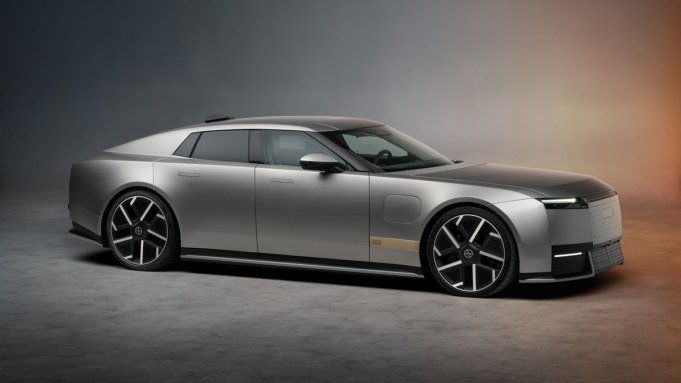
When Jaguar unveiled the E-Type in 1961, the world sat up and was stunned. When the XJS was unveiled in 1975, the world sat up and argued. The new Type 01—revealed today in New York—will be judged by the same standards, with the arguments already begun and the marque, again, putting its future on the line.
The Type 01 is the first production car since the brand’s reinvention, and the most powerful, most aerodynamic, and most technologically advanced car Jaguar has ever built. The four-door grand tourer makes more than 1,000 hp from three motors, two at the rear and one up front. The trio allows the vehicle to cover zero to 60 mph in a claimed 3.1 seconds. The electric motors run on an 850-volt architecture that promises up to 400 miles of range, with up to 200 miles added in as little as 13 minutes of charging.
An example of the Jaguar Type 01 in the marque’s Visionary Silver color scheme.
Jaguar
“Iteration is easy,” Rawdon Glover, Jaguar’s managing director, said at a preview for journalists, describing why he felt the brand needed a new car that is unlike anything it has previously built. Jaguar’s customers were also aging, and its competition—previously BMW, Mercedes, Lexus, Audi, and the like—were going electric, too. “It was very clear that we didn’t need to make incremental steps,” Glover said. “It was time for a much bolder change of direction.”
That change also means a big increase in price. Glover said Jaguar’s average U.S. transaction price had been around $60,000 to $70,000, while the Type 01 will start at $130,500. “If we double the price point, the expectation is going to double in terms of how you treat this individual,” he said. In practice, that means Jaguar will bring a test car to a potential customer’s doorstep—or country club.

Capped by a panoramic glass roof, the interior boasts 12-way electrically adjustable seats, a 24-inch OLED driver display, and a 7-inch portrait-display screen in the center.
Jaguar also built a car with long, low proportions that are unique in its segment and required a new platform. “We realized it actually didn’t work on any of our architectures,” Glover said. “We looked at everybody else’s architectures, and it didn’t work on theirs either.” The Jaguar Electric Architecture gives the car near 50/50 weight distribution and the stiffest structure of any Jaguar ever.
While Jaguar ‘s press release states that the “interior is inspired by the layered tones of travertine stone,” the cabin is replete with tech-forward fabrics.
Initially, 18 full-size models were built during an internal competition called Project Renaissance, from which the winning design was selected. Jaguar knew it would be a departure, which is exactly what it wanted, according to Andy Wheel, who led the design work. Wheel remembers seeing the XJS’s debut as a kid, and the controversy around it. “Try and do something that meets all requirements and you tend to end up with something which is vanilla,” Wheel said. He cited a German idiom one of his designers brought with them, the “wooly egg-laying milk pig”: a creature built to do everything, and one that doesn’t exist. Jaguar also asked for ratings from thousands of prospective buyers, and Glover said the car drew more ones and twos out of ten than the company usually sees, but also more nines and tens.
“Great design should have the confidence to polarize,” Glover noted. “These purchases are not about need, they’re about desire. We’re not interested in sixes, sevens, and eights.” More than 50,000 people have registered interest in the Type 01, Glover explained, and 78 percent of them are new to Jaguar.
“Great design should have the confidence to polarize,” says Rawdon Glover, Jaguar’s managing director.
Jaguar
For engineers, having a blank slate was both an appeal and a terror. Jon Darlington, a chief engineer for Jaguar who’s been with the company for decades, said he had to ask himself an uncomfortable question: “Do I want to be the one who tells them they can’t do it?” He decided he didn’t. “This was a true, true clean sheet of paper,” Darlington said. “In 31 years, that’s the first time that’s ever truly been the case.”
Tom Holden, chief designer for interiors, said the core team started with just over a dozen people, and every Friday for a year they printed a full-size section of the car, spread it across a table, and went at it with marker pens. Meetings routinely ran for five or six hours. The validation came about two and a half years in, when Darlington put a prototype in front of the board. “I actually got a hug off a couple of board members going, ‘This is going to be amazing,’” he said.
The Type 01, shown above in Jaguar’s Compelling Blue color scheme, will start at $130,500.
Jaguar
The project always seemed destined to one day hit showrooms. “I have worked on projects that have started and then stopped,” said Mary Crisp, Jaguar’s chief materiality designer. “This one never felt like that.” Alexey Andreev, an exterior designer, remembers a call in the middle of the pandemic when the team was told what it was about to attempt: “You will never get this chance again in your life. Not even in your career—in your life.”
The only question left is whether buyers agree, and Jaguar has been explicit about betting the company on it. “This was the biggest moment since the Jaguar name was born in 1935,” the automaker stated Tuesday. “Jaguar is back.” First deliveries of the Type 01 are expected in the second half of 2027, though orders open early in the year.
Click here for more photos of the Jaguar Type 01.
Jaguar debuts its all-electric Type 01, a four-door grand tourer.
Jaguar
Authors

Erik Shilling

