


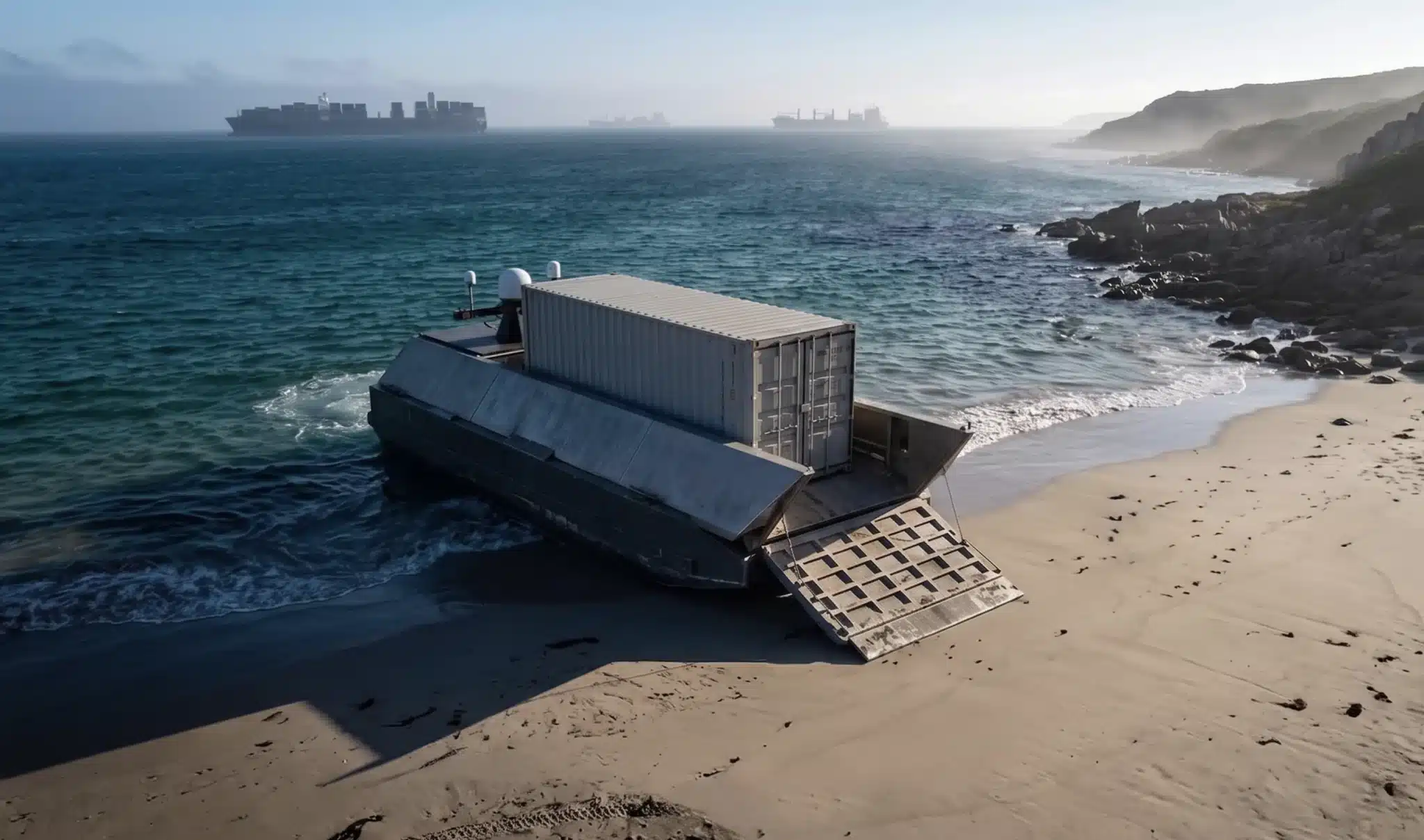
Japan’s Onomichi Dockyard Backs Bulwark Dynamics To Scale Autonomous Landing Craft For US And Allied Forces
A commercial Japanese shipyard is partnering with US defense tech startup Bulwark Dynamics to build autonomous landing craft—offering a crucial manufacturing bridge for US Navy and US Marine Corps littoral operations.
Maritime defense startup Bulwark Dynamics has announced the completion of its seed funding round, highlighted by a strategic manufacturing partnership with Japan’s Onomichi Dockyard. The collaboration represents a notable shift in naval industrial integration: combining silicon-valley-style defense tech development with the deep, scaled manufacturing capacity of commercial Japanese shipyards.
While initial industry attention focused on the investment, the broader strategic implication lies in cross-Pacific defense manufacturing. Speaking exclusively to Naval News, Yuta, co-founder and COO of Bulwark Dynamics, provided key insights into the company’s vision, production timeline, and market alignment across the Indo-Pacific.
Bridging Industrial Capacity Across the Pacific
As the US Navy and US Marine Corps double down on littoral maneuver concepts—such as Expeditionary Advanced Base Operations (EABO)—the demand for low-cost, high-volume autonomous vessels has surged. However, Western shipyards face severe capacity bottlenecks.
By partnering with Onomichi Dockyard, Bulwark Dynamics secures access to premier Japanese shipbuilding expertise and manufacturing throughput.
“Bulwark is pursuing the Caravel platform for both the U.S. and Japanese markets, including potential civilian/commercial applications,” confirmed Yuta, co-founder & COO of Bulwark Dynamics, in an interview with Naval News.
This dual-market positioning fits directly into current US-Japan efforts to deepen defense-industrial cooperation, allowing Japan’s commercial shipbuilding base to support allied naval logistics and force projection without over-extending domestic naval yards.

The Caravel USV: Scaling Production and Variant Strategy
At the core of Bulwark’s portfolio is the Caravel series—designed primarily as an uncrewed, autonomous landing craft intended to support distributed maritime operations and resupply missions in contested littoral waters.
When asked about manufacturing volume and near-term milestones at Onomichi, Bulwark highlighted a deliberate, demand-driven scaling strategy:
“We are currently building our first 35-foot prototype, so we can’t share specific production figures yet,” Yuta noted. “Our initial target is to reach production of several dozen units annually as we scale, though we’ll assess recurring and long-term demand carefully before committing to mass-production capacity.”
Regarding design variants, Bulwark is taking a focused approach centered around littoral transport:
“Caravel comes in different sizes — a 15-footer and a 35-footer. The 35 is our main focus; think of the 15 more as a complement, similar to how Saronic’s Cutlass relates to Corsair, unless there’s specific demand for the smaller craft. We may build a larger Caravel (i.e., a larger autonomous landing craft) down the line, but we’re not looking at entering the Medium Unmanned Surface Vehicle (MUSV) category at this stage.”
Furthermore, Bulwark reiterated that its immediate design roadmap remains strictly dedicated to the Caravel uncrewed series rather than branching into traditional manned defense vessels.

Naval News comments:
Leveraging an established commercial shipbuilder like Onomichi Dockyard enables rapid scaling of small-to-medium uncrewed surface vessels without clogging prime naval shipyards already facing severe backlogs. A 35-foot autonomous landing craft directly addresses a critical operational need for the US Marine Corps, providing low-cost, risk-worthy resupply capabilities essential for distributed maneuver across archipelagic environments like the First Island Chain. Furthermore, while US military logistics remains a primary target, Japan’s Self-Defense Forces face severe manpower shortages, making autonomous littoral craft an equally compelling solution for Japan’s own Southwestern Island defense requirements.
