


Digital manufacturing firm VulcanForms and Massachusetts-based aerospace startup Specter Aerospace have partnered to produce airbreathing hypersonic weapons at scale, establishing what the companies describe as a first-of-its-kind domestic manufacturing capacity for the sector. The deal pairs VulcanForms’ metal additive manufacturing platform with Specter Aerospace’s hypersonic vehicle development work, aiming to scale production of low-cost hypersonic munitions, interceptors, and cruise missiles for the Department of War.
The companies frame the partnership as a direct response to demand from Congress, the Department of War, and mission partners, tied to a broader push to rebuild U.S. industrial manufacturing capacity.
From development to full-rate production
Specter Aerospace has spent close to a decade developing hypersonic vehicles alongside the Department of War, relying on VulcanForms’ 3D printing and high-volume manufacturing expertise to shorten design cycles, strengthen its supply chain, and cut costs.
VulcanForms brings fully integrated U.S. facilities that combine metal additive manufacturing, precision machining, automation, inspection, and proprietary software into a single platform; Specter brings vertically integrated production and testing built specifically around airbreathing hypersonic missiles and targets. The new partnership is meant to convert that combined track record into full-rate production, integrating both companies’ capabilities into a dedicated, long-term manufacturing operation that the release describes as turning “critical minerals into critical munitions.”
The companies are conducting a nationwide site evaluation for a future production facility, while using their existing production-ready sites to begin the work now. Specter Aerospace CEO Felipe Gomez del Campo tied the move to the urgency of fielding hypersonic capability quickly: “Specter is partnering with VulcanForms to build America’s first dedicated hypersonic manufacturing capacity from the ground up,” he said, framing the goal as delivering affordable hypersonic weapons to fighter aircraft and joint operations.
VulcanForms Executive Vice President Matthew Rose positioned the partnership within a wider argument about how defense manufacturing should work going forward, describing VulcanForms’ cross-industry customer base as an advantage that lets the company “learn and share faster.” Rose said the companies winning in this space are the ones that “embrace physical AI and leverage lessons from commercial industries.”
Neither company disclosed the location of the planned production facility, a timeline for its completion, or the financial terms of the partnership.
What VulcanForms Was Building Before This Deal
VulcanForms has spent the past several years scaling up in exactly the direction this partnership extends. Founded out of MIT in 2013, VulcanForms raised $355 million in 2022 to open its first two digital production facilities, powered by proprietary 100kW-class laser powder bed fusion systems delivering roughly 250 times the laser power of other commercial machines.
In 2024, the company brought in Kevin Kassekert as CEO, formerly COO at Redwood Materials and a Tesla infrastructure leader, alongside President Jay Martin from Globus Medical, to drive expansion across medical, aerospace, and consumer sectors and it also hired David Kalinske, a Marine Corps retiree with Lockheed Martin Advanced Development Programs experience, as VP & GM of Aerospace and Defense.
That defense push accelerated further this year. VulcanForms secured $21.26 million in Massachusetts state tax credits to build a facility of up to one million square feet at its Devens site, projected to add over 1,000 jobs across medical, aerospace and defense, industrial, and consumer goods work, before raising $220 million in an oversubscribed round to expand domestic production and cut reliance on foreign supply chains. The Specter Aerospace partnership is the latest step in that buildout, moving VulcanForms from securing capacity and capital toward a dedicated, named application for it.

A Hypersonic Push Inside a Bigger Reindustrialization Effort
Geopolitical pressure, supply chain security concerns, and defense readiness demands have pushed government and private capital toward rebuilding U.S. domestic industrial capacity, with additive manufacturing offering a way to produce complex parts faster and closer to where they’re needed. Hypersonics is part of that push: the U.S. has tested the technology without yet matching the production scale competitors have reportedly built, leaving manufacturing capacity, not design, as the bottleneck VulcanForms and Specter Aerospace are aiming to close.
Government-backed programs have targeted that gap for years. ASTRO America proposed a Hypersonic Production Accelerator Facility under a DARPA-commissioned study, consolidating suppliers and integrators under one roof after finding the U.S. lagged competitors’ dedicated factory capacity.
The Pentagon’s GAMMA-H initiative pushed further, awarding Aerojet Rocketdyne a $22 million contract and Sintavia a separate contract to develop 3D printed hypersonic propulsion components.
Primes have since moved from prototypes toward production. Lockheed Martin is 3D printing the guidance section and fins for its Mako missile at a tenth of the cost and time of conventional methods, while Elmet is installing new systems to print refractory-metal heat exchangers, aiming to localize a supply chain that depends on a thin base of suppliers.
VulcanForms and Specter Aerospace extend that pattern further, aiming to convert prototype-level hypersonic manufacturing into dedicated, full-rate domestic production.
3D Printing Industry is inviting speakers for its 2026 Additive Manufacturing Applications (AMA) series, covering Energy, Healthcare, Automotive and Mobility, Aerospace, Space and Defense, and Software. Each online event focuses on real production deployments, qualification, and supply chain integration. Practitioners interested in contributing can complete the call for speakers form here.
To stay up to date with the latest 3D printing news, don’t forget to subscribe to the 3D Printing Industry newsletter or follow us on LinkedIn.
Explore the full Future of 3D Printing and Executive Survey series from 3D Printing Industry, featuring perspectives from CEOs, engineers, and industry leaders on the industrialization of additive manufacturing, 3D printing industry trends 2026, qualification, supply chains, and additive manufacturing industry analysis.
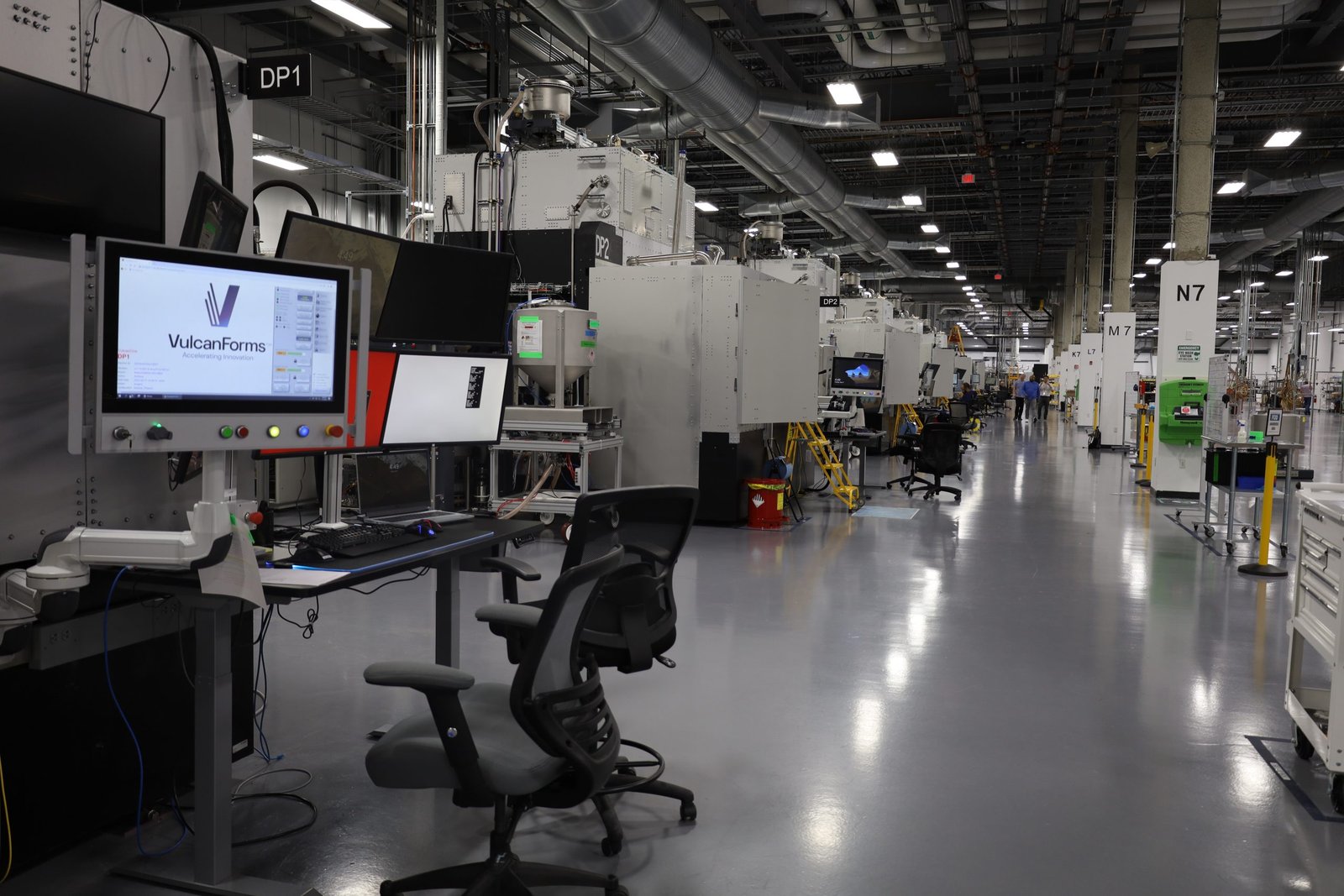
Featured image shows VulcanForms’ new facility houses a fleet of 100kW laser 3d printing systems. Image via VulcanForms.
