


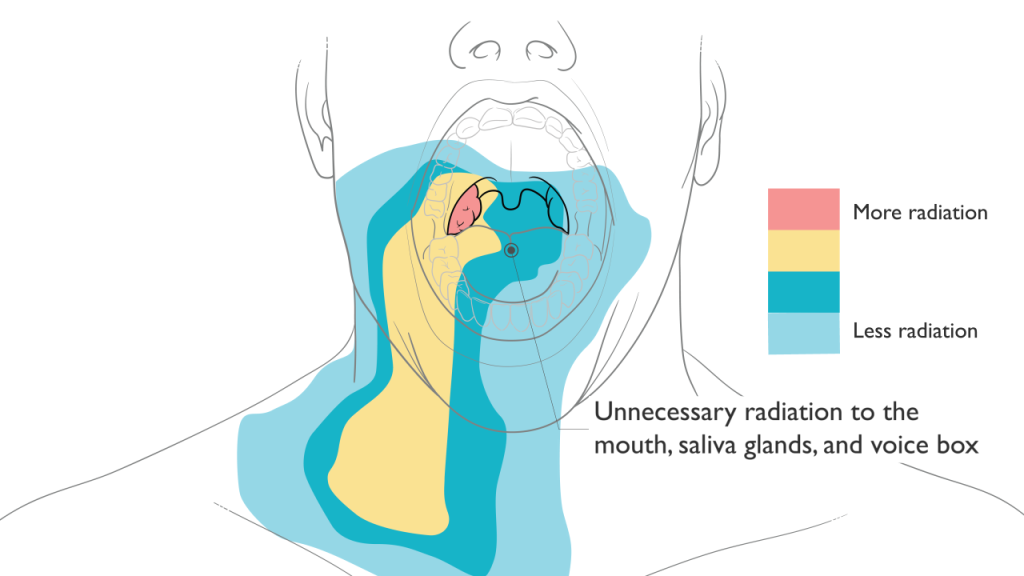
Personalized cancer medtech Kallisio has launched an expanded access program aimed at connecting head and neck cancer patients with Stentra, its FDA-cleared, custom-fit 3D printed intraoral device used during radiation therapy. The program is designed to reach eligible patients directly, even at treatment centers that have not yet adopted the technology.
Stentra received FDA 510(k) clearance (K232293) and is built from a digital scan of each patient’s mouth. Worn throughout every radiation session, the device holds the tongue, lips and other oral structures in a fixed position, helping ensure the radiation beam reaches its intended target consistently across the full course of treatment while sparing surrounding healthy tissue.
Closing the Access Gap
The program is built around a direct outreach model. Patients or caregivers can contact Kallisio through its website before radiation begins, and the company handles the logistics from there: confirming clinical eligibility with the patient’s radiation oncologist, arranging the required digital dental scan through a local provider, and coordinating with the treatment team to get the device into use. If a hospital hasn’t yet brought Stentra into its own workflow, Kallisio covers the cost for eligible patients directly, so a center’s internal timeline doesn’t become the deciding factor in whether someone gets access
“Patients preparing for head and neck radiation deserve every option that may make treatment more tolerable,” said Rajan Patel, CEO of Kallisio. “We want to help ensure eligible patients have access to Stentra even if their care team has not yet adopted the solution. So we are working directly with patients, oncology teams, and dental partners to bridge that gap.”
Clinical Use and Early Results
Stentra is already in clinical use at a number of U.S. cancer centers, including a recently announced implementation at Stanford Health Care. Data gathered so far comes from an observational case series, where the device held up across patients’ complete radiation regimens without disrupting the day-to-day consistency of positioning.
Kallisio reports that no patient in the series lost a treatment day or saw their schedule disrupted because of the device. A complete account of those findings is currently being readied for submission to a peer-reviewed journal.

Behind the 72-Hour Turnaround
Kallisio’s speed claim rests on a data pipeline designed to slot into existing clinical routines without adding new hardware or software on the provider side. Scans or diagnostic files, accepted in STL, DICOM, or most standard optical scanner formats, are sent securely to Kallisio’s lab for processing, with onboarding the company says takes under 15 minutes and no IT setup. Notably, the workflow is structured to keep patient health information out of the transfer entirely, so it stays HIPAA-compliant without requiring hospitals to exchange PHI.
Proprietary software then builds a device model incorporating the patient’s anatomy, clinical indication, and prescription, which is manufactured in biocompatible materials through ISO-certified partners and delivered in as little as 72 hours. Kallisio developed the platform alongside academic medical centers, including The University of Texas MD Anderson Cancer Center, which the company says shaped the system around real clinical workflows rather than as a standalone engineering build.
The clinical case for the approach draws on broader published research: a 2020 study found patient-specific oral stents were linked to up to a 77.6% reduction in severe oral mucositis, one of the most common side effects of head and neck radiation therapy.
Access Push in 3D Printed Healthcare
Personalized medical devices only help patients who can actually get them. Kallisio’s approach with Stentra tackles that head-on, reaching patients before institutional adoption catches up, and covering the device’s cost when a treatment center hasn’t yet adopted it. That decouples access from hospital procurement timelines.
Other parts of the sector have chipped away at the same barrier from different angles. In October 2025, 3D printing was recognized as a reimbursable method for prosthetic fabrication under Medicare, a policy shift that removed a major cost obstacle standing between patients and custom, digitally fabricated orthotic and prosthetic devices. That change built on groundwork already laid by programs like the Atlanta VA Healthcare System‘s rollout of the ActivArmor platform, which produces custom 3D printed casts and splints for veterans in as little as three hours using iPhone-based scans.
Radiation oncology has seen a comparable push through institutional adoption rather than policy change. Adaptiiv Medical Technologies, maker of 3D printed boluses used in external beam and brachytherapy treatments, saw its software adopted by Walter Reed National Military Medical Center to treat veterans with cancer, bringing a personalized 3D printed device into a major treatment center specifically to reach a patient population that had been underserved by standard-issue accessories.
Across these cases, the pattern is consistent: the technology is ready before the access model is. Kallisio’s direct-to-patient program is one more attempt to close that remaining gap.
3D Printing Industry is inviting speakers for its 2026 Additive Manufacturing Applications (AMA) series, covering Energy, Healthcare, Automotive and Mobility, Aerospace, Space and Defense, and Software. Each online event focuses on real production deployments, qualification, and supply chain integration. Practitioners interested in contributing can complete the call for speakers form here.
To stay up to date with the latest 3D printing news, don’t forget to subscribe to the 3D Printing Industry newsletter or follow us on LinkedIn.
Explore the full Future of 3D Printing and Executive Survey series from 3D Printing Industry, featuring perspectives from CEOs, engineers, and industry leaders on the industrialization of additive manufacturing, 3D printing industry trends 2026, qualification, supply chains, and additive manufacturing industry analysis.
Featured image shows Stentra, an FDA-cleared Custom Mouthpiece for Head and Neck Cancer Radiation Therapy. Image via Kallisio.
