


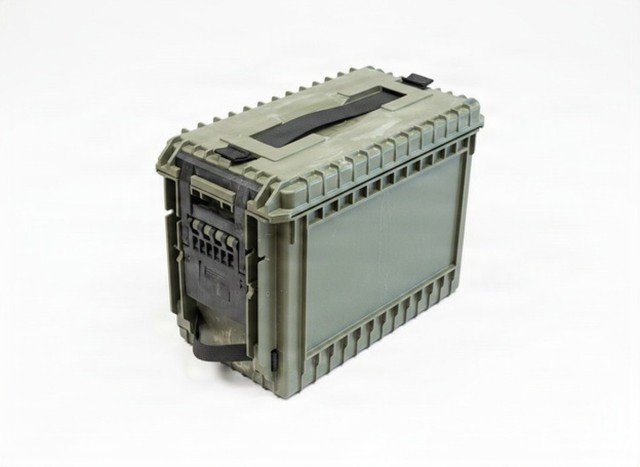
The U.S. Army‘s Combat Capabilities Development Command Armaments Center unveiled SixPAC on August 26, 2026, at Picatinny Arsenal, New Jersey, the first major redesign of small-caliber ammunition packaging since World War II. The system pairs two lightweight polymer ammunition containers, or PACs, inside a single steel outer shell, and after successful use with 6.8mm rounds, the Center plans to adapt it across multiple existing small-caliber production lines.
Replacing a decades-old wood design
SixPAC eliminates the wirebound wooden box overpack that has been standard since WWII. That wood packaging required manual assembly, was prone to mold, and depended on chemical preservative treatments that carried environmental costs and supply chain risk. The new steel outer pack removes those dependencies while fitting more containers and ammunition onto each pallet, drawing from a larger domestic supply base than wood ever offered. The polymer inner containers add further weight reduction and can be manufactured through automation, cutting production time compared to the old approach.
According to Senior Scientific Technical Manager for Packaging Jason Runell, the project’s technical lead, the redesign was driven less by the wood box’s flaws and more by a broader need to modernize for current logistics, portability, and supply chain demands. His team tested multiple materials and gathered feedback from user communities before settling on the polymer-and-steel combination. Runell noted that polymer packaging is less proven within the U.S. military than in some other countries’ forces, partly because American units must be ready to deploy into a wider range of climates, and any polymer used has to hold up to years of storage under those varying conditions.
Engineering for weight and manufacturing flexibility
Mechanical engineer and polymer designer Edward Lucas, who worked on the container’s material selection, described polymer development as an evolving discipline with room to keep improving the design. “It’s a developing field, and polymers are unique — you can modify them, include additives that improve impact performance, stiffness or dimensional stability,” Lucas said.
Several inner-pack designs remain in development, with early tactical polymer containers expected to weigh roughly half as much as the legacy steel M2A2 container. That reduction is intended to ease the load individual soldiers carry, and it carries particular value for weight-sensitive platforms such as light watercraft and aircraft, where added weight can affect whether a vehicle can launch or maneuver effectively during an engagement.
The manufacturing approach also opens up the supply base. Because the polymer inner packs are produced through injection molding, a process that typically uses a single custom mold rather than a dedicated fabrication line, the Armaments Center estimates more than 800 injection molders across the United States could be capable of producing them. That pool of potential suppliers is expected to increase competition, lower costs, and reduce barriers for new manufacturers entering the program.
Field testing and what comes next
Soldiers tested SixPAC throughout 2024 and 2025, providing feedback the Armaments Center has described as largely positive. The inner-pack design continues to be refined, including evaluation of a patent-pending polymer rectangular container, or PRC. The Center said it intends to keep investing in multiple PAC configurations and to share performance requirements, dimensional constraints, and lessons learned with industry to encourage further innovation in the space.
Runell credited a team that included Lucas, Program Lead Andriy Vasiyschouk, Lightweight Steel Outer Pack Lead Designer Nick Baxter, and Small Caliber Packaging Supervisor Karl Weiss, along with Director of Special Projects Robert Kowalski for helping secure funding for the effort.
Part of a Wider Push to Modernize Military Hardware
SixPAC’s shift from a WWII-era wood design to a steel-and-polymer system fits into a broader effort within the U.S. military to replace legacy equipment and materials with alternatives that can be produced faster, sourced from a wider industrial base, and adapted as operational needs change.
Elsewhere in defense manufacturing, that same drive has centered on additive manufacturing. Stratasys Direct was recently selected to join the Department of War’s JAMA IV Pilot Parts Program, a multimillion-dollar initiative to validate and deploy 3D printed components across military platforms, with DoW additive manufacturing funding reaching $3.3 billion in fiscal year 2026.
On the materials side, Clemson University and 3D Systems have an $11 million agreement with the Army Research Laboratory to develop 3D printed components for ground vehicles, aircraft, and munitions, the same category of equipment SixPAC is designed to support.
Across packaging and parts, the common thread is a military system working to replace decades-old designs and processes with ones built for faster, more flexible production.
3D Printing Industry is inviting speakers for its 2026 Additive Manufacturing Applications (AMA) series, covering Energy, Healthcare, Automotive and Mobility, Aerospace, Space and Defense, and Software. Each online event focuses on real production deployments, qualification, and supply chain integration. Practitioners interested in contributing can complete the call for speakers form here.
To stay up to date with the latest 3D printing news, don’t forget to subscribe to the 3D Printing Industry newsletter or follow us on LinkedIn.
Explore the full Future of 3D Printing and Executive Survey series from 3D Printing Industry, featuring perspectives from CEOs, engineers, and industry leaders on the industrialization of additive manufacturing, 3D printing industry trends 2026, qualification, supply chains, and additive manufacturing industry analysis.
Featured image shows Armaments Center unveils SixPAC. Photo via U.S. Army.
