


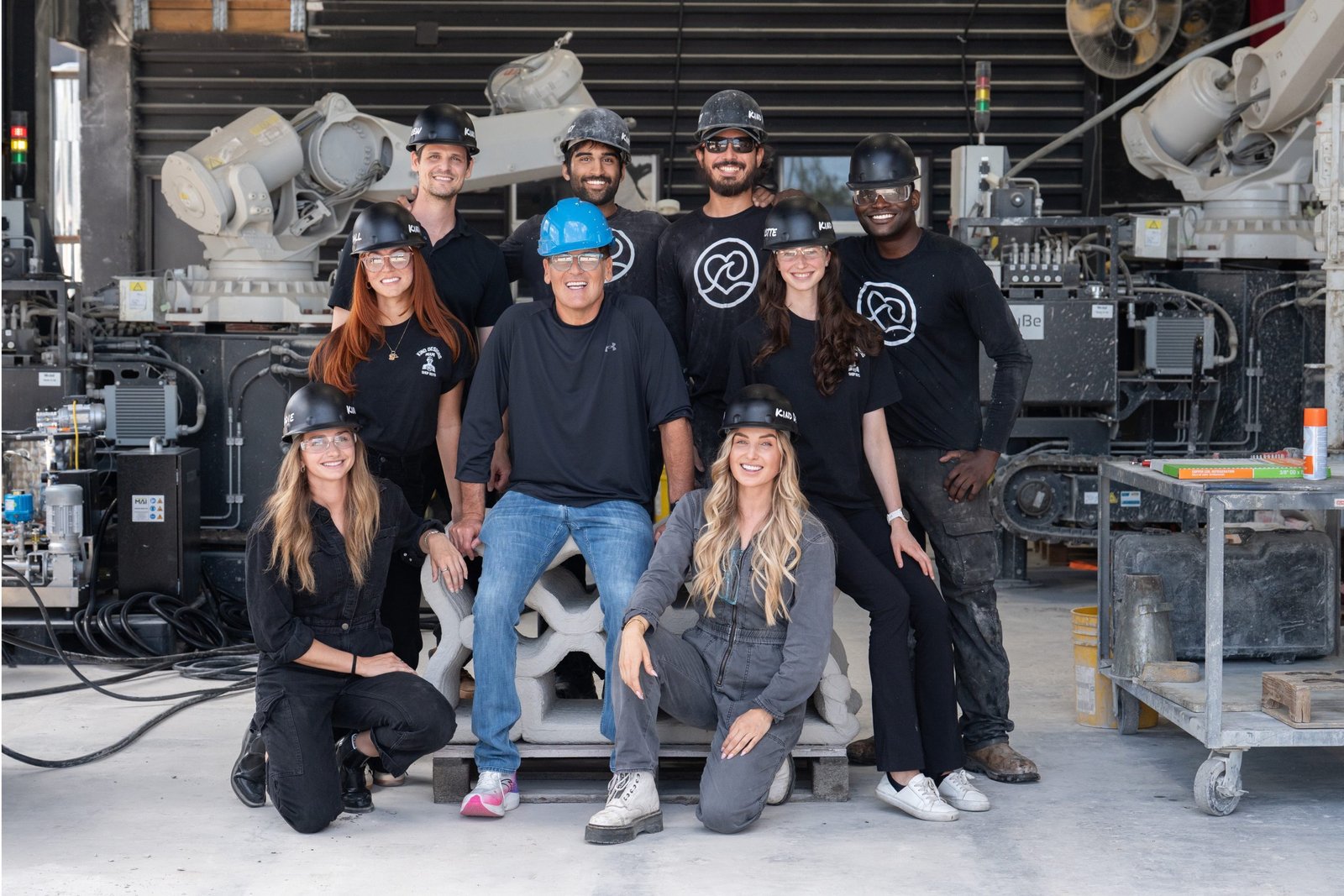
Miami-based Kind Designs, which 3D prints concrete seawalls designed to function as marine habitat, has closed a $10 million Pre-Series A at a $70 million valuation, doubling a round it originally set at $5 million after investor interest reached nearly $20 million. The company has now raised $21.5 million in total.
NBA forward Kyle Kuzma joined the round alongside returning backers Mark Cuban and former Washington D.C. mayor Adrian Fenty, with participation from NY Angels and TaMiami. “Most climate founders pitch you on saving the planet. Anya pitched me on an opportunity to disrupt a multi-billion-dollar coastal infrastructure market in a way that’s faster, cheaper, and also better for the environment,” commented Cuban.
The funding comes as Kind Designs reports a sharp increase in commercial traction. The company generated $1 million in revenue in 2025 and has since secured $10 million in contracted revenue against a $175 million active pipeline. Among the new work is a $2 million US Navy contract, moving the company into federal defence infrastructure alongside its municipal and hospitality projects.
3D Printed Living Seawalls Gain Commercial Traction
Kind Designs prints concrete seawall panels on robotic large-format systems, replacing the flat cast slabs used along Florida shorelines with textured surfaces and cavities intended to host marine organisms while still functioning as barriers against waves, flooding and erosion. The company says its printers produce panels up to 20 times faster than conventional methods, and its patent-pending Living Seawall was named one of Time‘s Best Inventions of 2025.
Its product line now includes Living Seawall Tiles, modular panels that retrofit existing walls rather than replacing them, alongside 3D printed artificial reefs and living shorelines aimed at commercial, municipal and defence projects.
Recent installations include seawalls for the Fontainebleau, Pagani and Ritz-Carlton in Miami Beach, as well as municipal projects in Miami Shores and Longboat Key. Outside Florida, the company has secured its first projects in New York City, Charleston and Nassau, while pursuing opportunities in California tied to coastal erosion and rail protection.
Fresh Investment Fuels Kind Designs’ US Expansion
The new capital will fund expansion into New York and California, triple factory capacity through additional robots and production lines, provide working capital for municipal and federal contracts, and support engineering and operations hiring. The capacity target is the operative constraint: a $175 million pipeline against a factory sized for a residential business is a throughput problem before it is a demand problem.
Regulation has moved in parallel. Miami-Dade County updated its seawall codes to grant expedited permitting and environmental mitigation exemptions for the company’s systems, while Florida Governor Ron DeSantis signed SB302 directing the state Department of Environmental Protection to create incentives for Living Seawall adoption.
“We’re done building at the pace permission allows,” Freeman added. “The technology is proven. The demand is here. Now it’s about scaling a new generation of coastal infrastructure that protects America while making this country more beautiful.”
The gap: proving printed marine structures at infrastructure scale
Ecological construction has been the most active frontier in concrete 3D printing, but almost entirely at pilot volumes, modules dropped on a seabed, monitored, written up. Kind Designs’ strategy is to sell into the procurement channel that already exists. Seawalls are a category municipalities and property owners must buy regardless, which lets the ecological function ride along on a replacement cycle rather than compete for restoration grants.
Others are attacking the same problem from the restoration side. FIU’s BioCAP tiles retrofit existing concrete at Morningside Park rather than replacing it, while Florida construction firm 1Print moved from terrestrial building into marine work, producing reef structures standing eight feet tall. In the Maldives, rrreefs deployed hundreds of fired terracotta modules at a commercial resort, engineered at microscopic scale to encourage coral larval settlement.
Durability is the recurring open question. In Aqaba, Sperra and Voyacy are printing reef units on Vertico large-format machines with testing focused on permeability and chloride ingress, the two mechanisms that degrade concrete in seawater over decades. Public money has also flowed toward the approach: Okaloosa County sank 25 printed modules off Destin-Fort Walton Beach under a $1.26 million Florida Fish and Wildlife Conservation Commission grant. Few of these projects have published long-term structural data.
That is the threshold Kind Designs is now closest to crossing. A seawall carries a design life measured in decades and a liability attached to it; a reef module does not. Tripling output and taking federal contracts moves the company from demonstrating that printed marine structures host life to proving they hold a shoreline.
3D Printing Industry is inviting speakers for its 2026 Additive Manufacturing Applications (AMA) series, covering Energy, Healthcare, Automotive and Mobility, Aerospace, Space and Defense, and Software. Each online event focuses on real production deployments, qualification, and supply chain integration. Practitioners interested in contributing can complete the call for speakers form here.
To stay up to date with the latest 3D printing news, don’t forget to subscribe to the 3D Printing Industry newsletter or follow us on LinkedIn.
Explore the full Future of 3D Printing and Executive Survey series from 3D Printing Industry, featuring perspectives from CEOs, engineers, and industry leaders on the industrialization of additive manufacturing, 3D printing industry trends 2026, qualification, supply chains, and additive manufacturing industry analysis.
Featured image shows Kind Designs Founder & CEO Anya Freeman with team members and investor Mark Cuban. Photo via Kind Designs.
