


![Aviation YouTuber Trent Palmer’s Legend Nomad was built in northeast Texas by the American Legend Aircraft Co. [Credit: Hunter Minke]](https://tbh.express/wp-content/uploads/2026/04/Legend-Nomad-Review-Flying-the-160-Horsepower-‘Fire-Breathing-Dragon.jpg "Legend Nomad Review: Flying the 160 Horsepower ‘Fire-Breathing Dragon’")
Why have a five-point harness, if there’s not a crotch strap?” I yelled from the front seat of the two-place taildragger in the direction of a man I had just barely met.
“I don’t know…,” said Danny Goggans in his thick East Texas accent. “If you don’t wreck it, you won’t have to worry about it.”
With a little laugh and shrug of my shoulders, I turned around to my instructor, Levi Noguess, who looked right at home in the Legend Nomad’s back seat, although it was a stark contrast from his usual front-seat view.
“Are you ready?” I asked.
“Let’s do it,” Noguess replied as he began to walk me through the Rotax 916iS’ starting procedure.
Producing 160 hp, the turbocharged, fuel-injected 4-cylinder engine is a beast I have flown behind one other time during a demo flight in CubCrafters’ Carbon Cub UL at Sun ’n Fun. In the 10 months in between, I had entirely forgotten how to start the 916.
“Turn the red key next to the G3X straight up and down to engine power,” said Noguess.
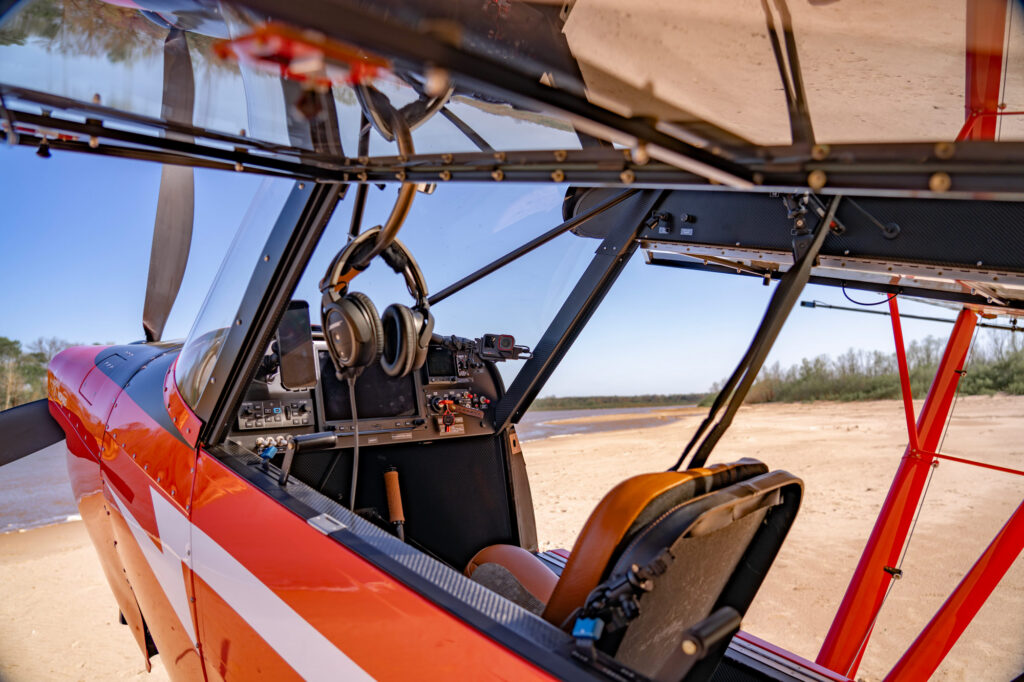
Similar to engaging a master switch, turning the key brought the Garmin G3X to life. After waiting a few moments for the glass to power up, Noguess redirected my attention to the black knob to the right of the red key.
“Turn that knob to Lane A,” he said. “We’re checking for two red warning lights, and that the ECU voltage is rising.”
With a positive voltage check and Lane A’s red warning light extinguished, we repeated the process by checking Lane B, another simple twist of the same black knob.
Lastly, a final check of twisting the knob to both Lane A and B indicated that ECU voltage was at 12.8 volts each, meaning we were ready to start.
“Just push it,” said Noguess, as I pushed inward on the knob.
Without skipping a beat, the Rotax enthusiastically hummed to life—in a far quieter and smoother fashion than almost any Continental or Lycoming.
“The battery backup switch is your first go-to if we lose the engine,” said Noguess as we donned our Bose A30 headsets.
Although I was feeling calm and confident, surrounded by the familiar aesthetic of tube and fabric, this airplane was a stark difference from the underpowered Cubs I flew as a teen. This is the Legend Nomad—a modern, powerful take on Piper’s iconic PA-18 Super Cub.
American Legend Aircraft Co., founded in 2004 at Texas’ Sulphur Springs Municipal Airport (KSLR), in response to an estimated 18- month-long wait for an aircraft kit, began out of simple necessity.
“I wasn’t waiting that long,” said owner and founder Darin Hart. “So we set out to take something old and make it new again.”
With Piper’s original Cub drawings and engineering plans accessible to anyone who so desires them, Hart took to the Smithsonian and the Cub Club to gather his baseline.
“Cubs are proven,” said Hart. “But we made it even better through modern safety advancements, widening the fuselage, and creating custom options.”
Since 2004, American Legend has expanded its lineup by following the natural evolution of Piper’s iconic designs. The development, beginning with the AL-3, a tribute to the J-3 Cub, progressed through the closed-cowl AL-11 (modeled after the PA-11 Cub Special) before culminating with the AL-18 Super Legend HP, based on the PA-18 Super Cub.
However, the company began carving out its own identity in 2019 with the introduction of the MOAC (Mother of All Cubs) kit. This shift marked a move away from historical replicas and toward purpose-built, backcountry aircraft. That momentum has only accelerated with Legend’s most recent offering, the addition of the Rotax-powered Nomad, made famous by YouTuber Trent Palmer.
While the Nomad might be the new kid on the block, its DNA is undeniably Piper.
“If you took a PA-18 fuselage and stuck it next to our fuselage, they’re gonna look basically the same,” said Hart.
But how close cousins would they actually be? It was time to find out.
As I applied a touch of power to taxi out of our grassy parking spot, two things became immediately apparent—the intense sensitivity of the Beringer heel brakes in combination with the decreased ground maneuverability of a beefy, unfamiliar tailwheel.
Working diligently to keep my inputs delicate, my old Cub mindset of treating the airplane as if it had no brakes at all was proving to be a hard habit to break.
Luckily, Noguess offered to feel things out.
“Oh, yeah, this tailwheel is different,” he said. “I bet it’s way easier to handle in the grass.”
The tailwheel package, a complete tire and assembly kit from TK1 Racing, wasn’t exactly my cup of tea, but that’s a hallmark of working with Legend, where it’s truly to each their own.
Holding short of the runway for a preflight briefing, I finally felt like I was beginning to understand the ways of the Beringer brakes and TK1 tailwheel. However, I found myself still wishing for the familiarity of my standard Acme Stinger and Scott/Baby Bushwheel pairing.
“If you don’t like something, say something,” I said to Noguess as I glanced down at the G3X’s engine page. “I’m a bit rusty with the tailwheel flying.”
“Sounds good, I’m right here at the controls if you need me,” he said.
With that, I announced our departure and lined up on Runway 19.
Once I was lined up on centerline, I straightened out the tailwheel and confirmed my heels were indeed far from the brakes. Putting the brand new 82-inch Catto propeller straight to pavement was the exact opposite way I wanted to kick-start this demo.
Adding right aileron to counteract the 10-15 knot variable crosswind, I began to slowly apply power. Before I was halfway to full throttle, I noticed the airplane began drifting slightly left of centerline. As I started to make the minor correction with my feet, while continuing to add power, the Rotax’s torquey turbocharger kicked in. Pushing me back into my seat, we were slingshotted into the East Texas sky in a takeoff roll that lasted a mere six seconds, or at a speed of approximately 32 mph.
“Holy cow, wow, just wow,” was all I could muster after Noguess reminded me we were indeed flying.
Feeling as though I was still sitting back on the runway, my brain couldn’t comprehend what had just happened. “Wow, that’s almost scary,” I said as I reached up with my left hand to raise the flaps.
Noguess, whose laughter was probably heard from the ground, shot back with, “You weren’t ready for all that were you?”
“Heck no, I wasn’t ready. This thing is a fire-breathing dragon,” I replied.
As I worked to gather my composure, I set the nose to climb out around 60 to 65 mph.
“Look back at the runway,” Noguess said. “I think you’re shooting for the moon.”
![[Credit: Hunter Minke]](https://planeandpilotmag.com/wp-content/uploads/sites/4/2026/02/DSC05021-1024x683.jpg)
As I turned crosswind, I took Noguess’ advice and glanced down and back toward the runway. Our dramatic climb rate became obscenely clear.
Feeling slightly overwhelmed, and like we should have been in a fighter jet as opposed to a distant relative of the 65 hp Piper J-3 Cub, I pulled the power back to 32 inches and 5,200 rpm.
Having a moment to glance down at the G3X, I quickly pulled out my phone to grab a picture of the screen for later reference. We were indicating a true airspeed of 100 mph against a 10-knot crosswind and indicating a fuel burn of 6 gph at 2,500 feet. Impressive to say the least.
With my nose pointed north, it was time for a little airwork. Noticing the easy maneuverability and lightweight feel of the ailerons, I reached back to my left side along the fuselage and added a touch of nose-down trim.
The airplane’s sight picture is tricky at first, but once you realize that pointing the nose toward the ground is the attitude that stops you from shooting for the moon, everything else falls into place.
After a few turns, it was time to see how the wing behaved. With my power back at idle and the nose pulled well above the horizon, the Nomad resisted the power off stall in every way imaginable. With the stick pulled completely back, and sitting in a rather uncomfortable attitude for what felt like a few minutes, the tail began to gently buffet around 34 mph.
With a little airwork behind me, I felt eager—yet slightly nervous—to head back for a landing. The nerves were healthy and justified, as I had spent the vast majority of the past few months flying a Cirrus SR20 rather than the Cub variety.
“Do you want me to give it a shot?” offered Noguess.
“No, it’s time for me to put my big girl pants on,” I replied.
Aiming for around 75 mph in my highly modified, not-so-standard downwind, I pulled the flap handle but was met with resistance.
“You’re flying it fast. It’st not the Cirrus,” said Noguess. “Slow down to about 65 then try again.”
Following his advice, I pulled the power to idle and raised the nose slightly toward the horizon. With the airspeed bleeding off, I was finally able to successfully engage the first and second notch of flaps.
Now established on a short, less than quarter-mile final to Sulphur Springs’ parallel grass runway, I quickly realized the Nomad was far from a floater—she was a sinker. Adding a few smooth blips of power to avoid landing in the muddy lake, just shy of the runway, I crossed the runway threshold around 45 mph.
Setting up for a three-point, I kept my eyes glued to the end of the grass strip and slowly added back pressure to begin my flare. Touching down a few seconds later in a fully stalled, three-point attitude, I felt like I had earned my tailwheel keep.
“Nicely done,” said Noguess.
“Thanks. This airplane is a beast.” I replied. Although I was still admittedly worked up about the TK1 tailwheel, I added, “Now, I just have to see how this thing acts on the grass.”

Redirecting my attention to ground maneuverability, I sashayed the rudder pedals from left to right in an attempt to give the tailwheel and brake combo a more positive review. As suspected, the maneuverability was far improved on the grass’ more forgiving surface.
During my far more successful taxi back to the hangar, I couldn’t help but think that this is an airplane that just has to be experienced in order to completely comprehend.
With its torquey, 160hp Rotax, massive, three-bladed Catto prop, and impressively light, 959-pound airframe, this combination is an attention-grabbing performer to say the least.
Back in our parking spot, I turned the engine power to off, and in classic Rotax fashion, with its harsh clunk of a stop, the Nomad settled back into its role of an unassuming Super Cub-like taildragger.
“Well, what do you think?” asked Goggans as I climbed out of the airplane.
“I’ve got a bone to pick with you,” I jokingly replied. “That’s no Cub. That’s like a P-51. Y’all better rename that thing before people think it’s a modern version of their grandpa’s old taildragger.”
“I tried telling you it was going to be ready to fly long before you were,” Goggans said between laughs. “You have to be ready for it.”
“Well, I tried,” I replied.
For pilots interested in testing their own readiness against the sheer performance of the beastly Nomad, or for those simply passing through the Sulphur Springs area, the Legend team encourages visits from fans and customers alike.
“We have people stopping by and flying in every day,” Hart said. “…We’d love to show you what we’re all about.”
This article first appeared in the March/April 2026 issue of Plane + Pilot magazine.
