


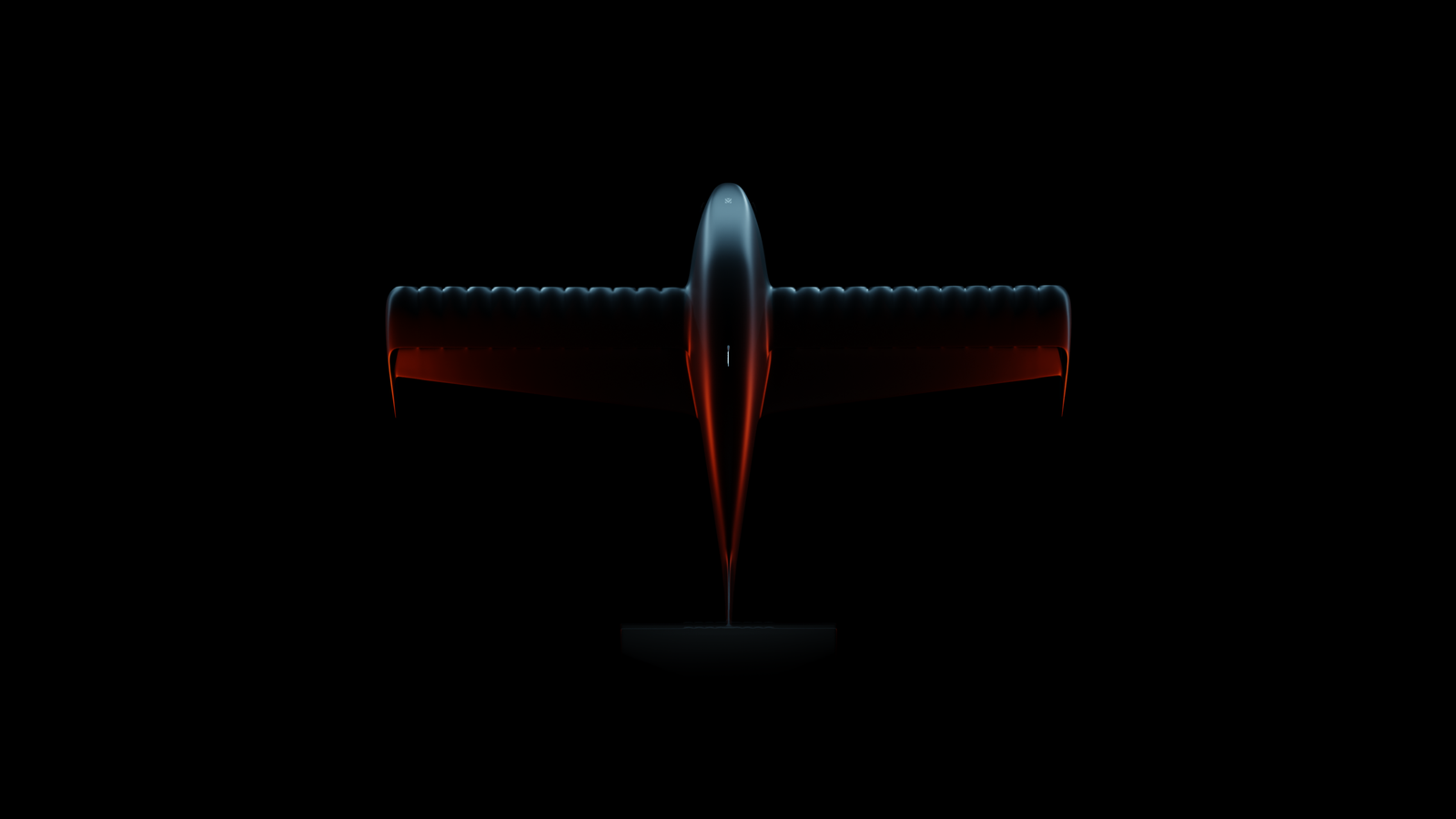
A rendering of the Mach Industries Atlas UAS for the Defense Innovation Unit and Navy Runway Independent Maritime Expeditionary Strike (RIMES) program. (Image: Mach Industries)
Startup weapons developer Mach Industries on June 16 announced it won a contract award to serve as aircraft integrator for a Defense Innovation Unit (DIU) program focused on developing runway-independent long-range drones for the Navy.
DIU and the Navy in February launched the Runway Independent Maritime Expeditionary Strike (RIMES) program to find runway independent long-range UASs that could be deployed as suicide drones or deliver a munition then rearm while based on surface combatants without large flight decks.
The solicitation wanted attributes including the ability to deliver a 1,000-pound class munition like those used on Navy fighters or palletized munitions and a range of 1,400 nautical miles for one-way attack.
Mach said as integrator it will lead development and overall program execution for the Atlas aircraft, which it bills as a next-generation aircraft with a “novel aero and propulsion approach that gives the warfighter an entirely new advantage for operations in contested environments.”
Atlas will meet the RIMES attributes as a hybrid-electric propulsion aircraft capable of runway-independent operations while carrying a 1,000-pound payload with a range of 1,400 nautical miles, Mach said.
Mach’s strategic partner on Atlas is Whisper Aero, a firm developing quieter and more efficient propulsion thrust for drones and other aircraft. It specifically cites integrating Whisper Aero’s JetFoil in a scalable aircraft design.
Mach said this means it will leverage its expertise in rapidly developing, testing and manufacturing defense systems while using the aerodynamics and propulsion technologies developed by Whisper Aero.
“We developed JetFoil to propel the next generation of conventional, short, and vertical takeoff and landing aircraft silently and efficiently. With JetFoil, Atlas can effectively meet the needs of the RIMES mission to operate even from Destroyer class vessels,” Mark Moore, CEO of Whisper Aero, said in a statement.
Mach billed the Atlas as being able to use unimproved rotary-wing landing zones “while maintaining the control simplicity of a fixed-wing aircraft and a thrust-to-weight ratio that is less than half of what is required for vertical flight. This, along with highly efficient propulsors, result in significantly increased range, as well as radical reductions in acoustic signature. The combination of these attributes, along with price points that enable low-cost mass, gives Atlas the ability to reduce cost per effect and fuel per effect in a contested environment.”
Atlas will not only have the ability to launch and recover from austere locations but also will have a radically reduced part count with highly redundant propulsion architecture to simplify sustainment and keep costs low, Mach said.
“Mach’s speed to prototype and production, coupled with Whisper Aero’s novel aerodynamics and propulsion makes Atlas a revolutionary air mobility platform. After more than a decade focused on industrial scale and operations in contested environments, I am confident that this platform can redefine how the Joint Force projects power by delivering radical improvements in mission lethality, logistics footprint, acoustic signature, system safety, and energy efficiency,” Nathan Diller, president and chief strategy officer at Mach Industries, said in a statement.
Diller previously served as assistant director of aeronautics in the White House Office of Science and Technology Policy and as an appropriations professional staffer on Capitol Hill. During his government career, Diller helped launch the Air Force’s AFWERX Agility Prime in 2019. Agility Prime leverages commercial advanced air mobility technologies.
A version of this story originally appeared in sister publication Defense Daily.
