


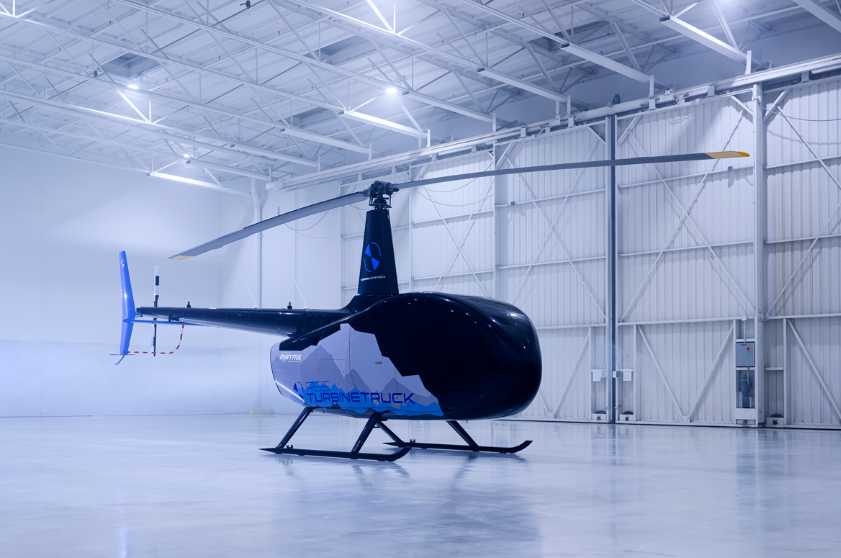
Robinson Unmanned’s new R66 Turbinetruck equipped with Sikorsky’s MATRIX autonomy system. (Photo: Robinson Unmanned)
The Marine Corps has selected Sikorsky and Robinson Helicopter’s R66 Turbinetruck for the second increment of the Medium Aerial Resupply Vehicle–Expeditionary Logistics (MARV-EL) development program, the companies said on April 27.
Sikorsky said it received a $15.5 million deal for the MARV-EL Increment 2 work, with the Turbinestruck featuring its MATRIX autonomy capability integrated onto a modified version of Robinson’s R66 helicopter airframe.
“The ability to deliver ammunition, medical supplies and other essential equipment at the point of need – regardless of terrain, weather, or enemy threat – is critical to the U.S. Marine Corps’ continued success. The MARV-EL program fills a capability gap between small tactical drones and large strategic airlifters, delivering a reliable ‘middleweight’ uncrewed logistics platform capable of operating from austere forward operating bases, ship decks or unimproved landing zones,” Sikorsky said in a statement. “The R66 TURBINETRUCK will support mission success when ground or crewed aviation assets are unavailable and keep personnel out of danger in high‑risk scenarios.”
Sikorsky and Robinson announced a new collaborative agreement last month to work on the R66 Turbinetruck, with the latter noting the project reconfigures its R66’s design without a cockpit or crew station to allow for a “high-volume fuselage, cargo floor and a nose-mounted clamshell door to facilitate rapid loading of palletized freight” with an internal payload capacity of up to 1,300 pounds.
“The R66 TURBINETRUCK represents a significant step forward in expanding proven rotorcraft into scalable, autonomous cargo solutions for demanding operational environments. Together, we are delivering a game‑changing capability that will enhance warfighter readiness and open new opportunities for safe, reliable and affordable autonomous transport,” David Smith, Robinson’s president and CEO, said in a statement on April 27.
The Marine Corps’ has been working on MARV-EL for several years to develop an unmanned medium aerial resupply capability, and previously evaluated offerings from Kaman Aerospace and a team of Leidos and Elroy Air.
Sikorsky noted the Marine Corps’ MARV-EL requirements include having an uncrewed aircraft that can be operated through a common digital handheld device to carry logistic payloads between 1,300 and 2,500 pounds with a combat radius of 100 nautical miles.
“Capability demonstrations will showcase MATRIX’s platform-agnostic and open architecture design operating on the R66 TURBINETRUCK airframe,” Sikorsky said.
In October, Sikorsky detailed a similar project called U-Hawk which also utilizes its MATRIX autonomy capability to cover a UH-60L Black Hawk helicopter into a large unmanned platform.
“Similar to the U-Hawk helicopter, the operator enters the mission objectives into a digital tablet. The system then automatically creates a flight plan, using sensors and algorithms to guide the R66 TURBINETRUCK safely to the target location,” Sikorsky said.
The Marine Corps also previously tapped Sikorsky to help inform its Aerial Logistics Connector program by demonstrating its optionally-piloted UH-60M Black Hawk, also integrated with the MATRIX autonomy software, and the company said it will be “bringing that experience to MARV-EL Increment 2.”
The ALC effort also aims to develop an unmanned cargo-carrying air platform, and a Marine Corps official told sister publication Defense Daily the week of April 20 that the service is “keeping open [its] options” on whether it will move forward with one or multiple vendors for the next phase” of the program as it continues test efforts with offerings led by Airbus U.S. and Near Earth Autonomy.
A version of this story originally appeared in sister publication Defense Daily.
