


Last month, Israeli 3D printer manufacturer Nano Dimension signed a non-binding term sheet to merge with Infinite Epigenetics, an AI-powered preventive health and diagnostics company, in a proposed deal valued at $890 million. If completed, the transaction would mark the formal end of Nano’s decade-long presence in the additive manufacturing sector, and the beginning of a new chapter in healthcare AI.
The deal is not yet final: a 30-day exclusivity period began for due diligence and negotiation of a definitive agreement, which will still require board, shareholder, and regulatory approval. That window has since closed, and, as the sections below detail, the board that negotiated the deal has since been replaced following a settlement with activist investor Murchinson Ltd.
A Pivot Years in the Making
For anyone watching Nano Dimension closely, this latest move may have been foreseeable.
Established in the early 2010s, the company initially marketed itself around the promise of “factories in a box,” compact desktop systems designed to print working circuit boards on demand. As our 2016 interview illustrated, hardware sales were only one part of the business model. Speaking to 3DPI’s Editor-in-Chief, Nano Dimension’s co-founder explained the logic behind what was described by us as “an unusual approach to financing.”
The provided reason was practical, if unconventional for the time. Traditional funding routes had closed off early. As co-founder Simon Fried explained at the time, the combination of advanced hardware, complex software, and nano-chemistry was “too big of a bite for any angels and too risky for the VCs.” The company eventually found private investors willing to back it, but only on the condition that it operate as a listed entity, giving them, in Fried’s words, a “liquidity get out clause.” The vehicle they chose was a reverse merger on the Tel Aviv Stock Exchange in 2014.
Reverse mergers, which use a public company as a vehicle to access capital markets rather than pursuing a traditional IPO, had fallen out of fashion after becoming closely associated with the wave of Chinese companies that flooded U.S. exchanges in the early 2010s. The SEC responded by tightening listing rules, suspending trading in dozens of those companies, and issuing formal warnings to retail investors. As a result, the mid-2010s saw a plateau in the number of companies pursuing reverse mergers, prompting 3DPI’s curiosity in 2016.
For Nano Dimension, repeated rounds of ADS offerings on Nasdaq built a substantial financial reserve. By the first quarter of 2021, Nano Dimension held $1.47 billion in cash and equivalents, with $811,000 in quarterly revenue. That cash pile attracted attention: in January 2022, Murchinson Ltd., a Toronto-based activist investment fund, disclosed a minority stake in Nano and began pushing for board-level changes.
Murchinson’s intervention intensified the dispute over Nano Dimension’s strategy and control of its cash reserves. In the period that followed, Nano expanded its acquisition activity, which it presented as an effort to consolidate a fragmented AM market. The company described its balance sheet at the time as leaving it “ideally positioned to act as a consolidator in the highly fragmented market landscape.”
Under the leadership of former CEO Yoav Stern, Nano Dimension became one of AM’s most aggressive consolidators, at one point launching a failed hostile takeover to buy Stratasys. Eventually, Nano Dimension assembled a portfolio spanning electronics printing, microscale manufacturing, and industrial metal systems through acquisitions of Desktop Metal, Markforged, and Fabrica. The roll-up strategy was a bet that scale could validate what organic growth had not. It ultimately failed to produce a durable consolidated AM group: Desktop Metal entered bankruptcy proceedings, while Nano sold or discontinued several other businesses and product lines, including Fabrica. It has also agreed to sell most of Markforged to Stratasys, although that transaction has not yet closed.
Nano Dimension Plans 3D Printing Exit
The latest announcement landed on June 15, 2026, following a multi-month strategic review that assessed around 20 companies across multiple sectors. Infinite Epigenetics was selected as the most compelling path to long-term value creation, a conclusion Nano’s board reached after determining that the chronic disease diagnostics market, at over $90 billion, offered a fundamentally larger opportunity than continuing to scale within additive manufacturing.
David Stehlin, then CEO of Nano Dimension, framed the decision in straightforward terms: “Infinite Epigenetics represented the most attractive opportunity for us to enhance shareholder value. The company checked the key boxes we were looking for: a proven technology platform with revenue-generating operations, a large growing addressable market, world-class customers and partners, and a strong leadership team, experienced board members, and highly accomplished investors.”
The reversal, from aggressive consolidator to full exit, is striking, and the board’s own language makes the reasoning explicit: a follow-up press release issued on June 16 states that “the chronic disease diagnostics market exceeds $90 billion, significantly larger than the 3D printing industry.” That amounts to an unusually direct comparison between the perceived opportunities in the two sectors from a company that spent years betting on AM growth.
The Standoff: Murchinson’s Objections and the Fight for the Board
The transaction was not without internal friction. Murchinson argued the proposed merger resembled a SPAC without a redemption right, and that it would dilute existing shareholders by effectively handing Nano’s cash and listing to a private company on unfavorable terms. In response, Nano defended both its review process and the target company, pointing to Infinite Epigenetics’ operational credentials: a CLIA-certified laboratory, more than 120,000 epigenetic samples collected since 2020, a network of over 7,500 healthcare providers, and research collaborations with Harvard, Yale, Duke, and Stanford. The board cited Exact Sciences and Tempus AI as public-market comparators that it believes demonstrate the commercial potential of the diagnostics model.
Murchinson escalated by requisitioning an Extraordinary General Meeting (EGM) with the intent to replace a majority of Nano’s board, a direct challenge to the proposed deal.
On July 9, ahead of the scheduled July 31 EGM, Nano’s board published a shareholder letter arguing that Murchinson’s push to replace three of five directors would, in effect, hand it control of the entire board, since two of the three seats up for removal had originally been Murchinson’s own nominees. The letter also disclosed an unsolicited, all-cash competing offer from Tang Capital, received after the Infinite Epigenetics announcement, adding a second potential path away from the current merger plan.
That fight never reached a vote. On July 20, Nano and Murchinson announced a settlement: the July 31 EGM was cancelled, and four directors, David Stehlin, the executive who had publicly championed the Infinite Epigenetics deal as the board’s best option, along with Robert Pons, Joshua Rosensweig, and Andy Sriubas, resigned. In their place, Nano appointed Murchinson’s three nominees: Paul Fruchthandler, Moshe Rozenbaum, and Eliezer “Eli” Tarlow.
The following day, on July 21, the reconstituted board named Rozenbaum interim CEO and Phillip Borenstein board chairman, with the company’s language shifting toward “business continuity” and a fresh evaluation of “strategic priorities,” rather than a reaffirmation of the Infinite Epigenetics transaction.
With Stehlin gone and a Murchinson-aligned board and CEO now in place, whether the Infinite Epigenetics merger proceeds on its original terms, is renegotiated, or gives way to the rival Tang Capital offer is, for the moment, an open question.
What the Original Deal Terms Looked Like
The proposed merger with Infinite Epigenetics appeared to follow the same financial logic as the acquisitions that preceded it. Viewed structurally, the transaction would also redeploy Nano Dimension’s public listing and remaining capital into a private healthcare company, economically comparable in some respects to a reverse merger, although not a conventional SPAC transaction.
Under the terms originally proposed in June, the combined company was to trade on Nasdaq under the ticker “IEAI” and operate under the Infinite Epigenetics name, with Dr. Matthew Dawson, co-founder and CEO of Infinite Epigenetics, expected at the time to lead the combined entity.
Under the term sheet, the equity allocated to existing Nano shareholders was to be calculated using Nano’s estimated net cash at closing plus a 20% premium, with the combined entity projected to hold more than $400 million in cash. Nano’s remaining AM assets were to be placed into a liquidation trust, with shareholders receiving contingent value rights on any proceeds from their disposal.
However, with the board that negotiated these terms now replaced, and the Infinite Epigenetics transaction not yet reaffirmed by the new Murchinson-aligned board, these terms should be considered provisional rather than current, particularly with Tang Capital’s rival all-cash offer still under consideration.

The Public Listing as a Strategic Asset
The redeployment of a public listing and substantial cash balance into a new business is not unprecedented in the 3D printing sector. The industry has seen related versions of this capital-markets playbook for more than half a decade.
The wave began in 2020 and 2021, when SPAC mergers became the dominant route to market for AM companies. Desktop Metal merged with Trine Acquisition and went public in December 2020, raising $580 million in the process. The logic was straightforward: use a blank-check vehicle’s listing and capital to accelerate growth. Investment in 3D printing companies accounted for nearly $11 billion worth of SPAC transactions in the years that followed. Markforged, Velo3D, and Shapeways all followed the same route, using SPACs to access Nasdaq and NYSE listings without traditional IPOs.
The long-term outcomes frequently fell far short of the valuations and growth expectations presented when these companies went public. Shapeways was delisted. Desktop Metal filed for bankruptcy. Markforged was acquired by Nano Dimension for $115 million, a fraction of the valuation at which it had gone public.
The SPAC era brought private companies into public markets through blank-check vehicles. What is now emerging is its mirror: public companies whose boards conclude that their original businesses offer less attractive prospects than opportunities in entirely different industries.
Nano’s own board upheaval, arriving barely a month after its healthcare pivot was announced, is a reminder that this mirror-image maneuver carries its own version of the SPAC era’s instability, control of the vehicle, not just its destination, remains contested.
3D Printing Industry is inviting speakers for its 2026 Additive Manufacturing Applications (AMA) series, covering Energy, Healthcare, Automotive and Mobility, Aerospace, Space and Defense, and Software. Each online event focuses on real production deployments, qualification, and supply chain integration. Practitioners interested in contributing can complete the call for speakers form here.
To stay up to date with the latest 3D printing news, don’t forget to subscribe to the 3D Printing Industry newsletter or follow us on LinkedIn.
Explore the full Future of 3D Printing and Executive Survey series from 3D Printing Industry, featuring perspectives from CEOs, engineers, and industry leaders on the industrialization of additive manufacturing, 3D printing industry trends 2026, qualification, supply chains, and additive manufacturing industry analysis.
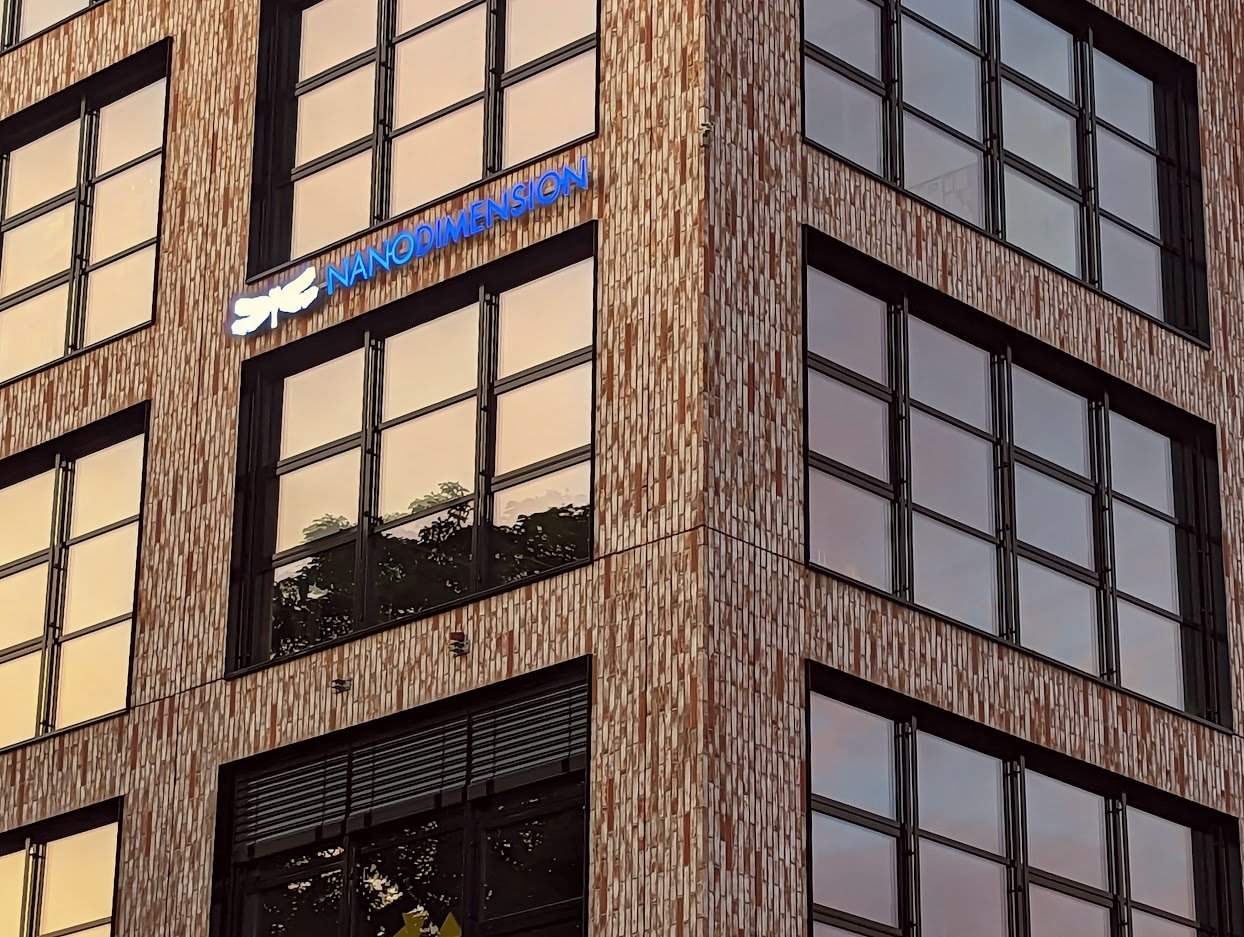
Featured image shows Nano Dimension offices in Munich. Photo by Michael Petch.
