


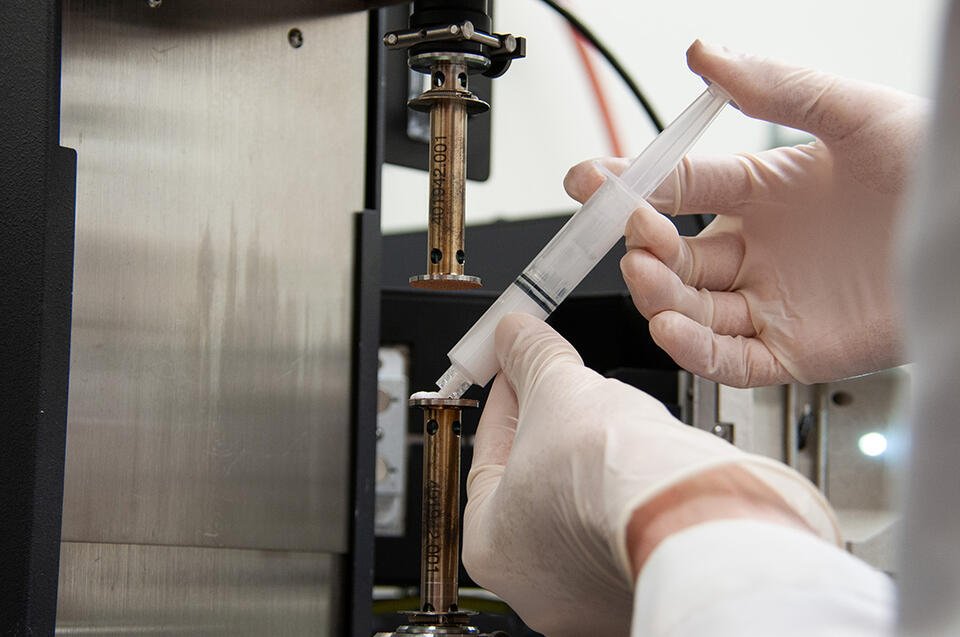
Researchers at the US National Institute of Standards and Technology (NIST) are developing a reference material, a carefully engineered zirconia slurry, to help ceramic 3D printing produce consistent, reliable parts. The problem it targets is deceptively basic: the wet ceramic feedstocks used to print are notoriously hard to measure accurately, and without a trustworthy way to check that measurement, printed ceramics vary from run to run. The material could eventually become an official NIST standard, giving the field a shared yardstick for one of its trickiest steps.
The work, led by NIST materials scientist Russell Maier alongside colleagues Ran Tao and Samuel Hales, matters because ceramics are moving from niche to critical. Technical ceramics such as alumina and zirconia are lightweight, durable, excellent electrical insulators, and able to survive extreme heat, properties that suit them to electronics, ballistic armor, rocket engine parts, and, increasingly, medical and dental implants.
Why measuring the flow is the hard part
The obstacle sits in the physics of the feedstock. Ceramic printing usually starts with a thick liquid of fine particles suspended in water or polymer, and that material is non-Newtonian: its thickness changes depending on the force applied to it. Maier reaches for ketchup to explain it. A ketchup bottle held upside down won’t pour, but a sharp tap sends a glob out, before the tap, ketchup is about five times thicker than honey; after it, roughly twice as thin. Honey, a Newtonian fluid, never behaves that way. Ceramic slurries share ketchup’s shifty character, and controlling it is what makes printing work.
“Anytime something new comes along, people are skeptical it will work,” Maier said. “Part of my research is to help make ceramic printing more consistent and reliable.”
The behavior has to be tuned differently for each printing route. In paste extrusion, a nozzle lays down ceramic like a baker frosting a cake, and the material must flow through the machine yet hold its shape once deposited, before drying and firing in a kiln. In the vat-based method, UV light projected through the transparent bottom of a slurry tank solidifies each layer in turn, finer detail, but pricier raw material and a debinding step that can take days to remove the polymers. “Understanding how the slurry flows is key to getting a good final result for both of these methods,” Maier said. “Sometimes you want the slurry to flow easily, and other times you want it to keep its shape.”
The instrument that measures this, a rheometer, squeezes a sample between two plates and rotates one while gauging the force needed to make the paste move. Getting it right is genuinely difficult. Many slurries are water-based and dry out over time, shifting their properties. The materials also have a kind of memory, like a mattress foam slowly resuming its shape, so even touching the sample as it goes into the machine can distort the reading. Worse, the ceramic can lubricate the plates so they slide across it rather than shearing it. All of which leaves users unsure whether their rheometer is even accurate.
A slurry with a known answer
That uncertainty is what a reference material fixes. A reference material ships with a list of known properties, so a lab can measure it and compare against NIST’s figures to confirm its own results. Maier’s team built theirs from tiny zirconia particles suspended in a liquid polymer, akin to wet clay, that returns the same rheometer reading over and over. To stop it drying out, they used polyethylene glycol, the same non-evaporating ingredient found in lip balm.
To handle the memory problem, the material comes with a reset routine: twist it rapidly until it is as runny as possible, then let it relax completely, so every measurement starts from the same state. The next step is an interlaboratory round, sending the slurry to labs across the country to run their own measurements and see whether everyone lands on the same answer. If they do, the slurry moves toward becoming a full-fledged standard reference material.
The payoff Maier points to is medical. Beyond dental implants, which are already commonly printed in ceramic, new implants are being developed that match bone in shape, microstructure, material, and performance. Because they can be made from the same mineral as bone and replicate its internal lattice, such implants knit with living tissue more readily than titanium does, potentially meaning easier recoveries.
Standardization as the next ceramic frontier
NIST’s strategy is a metrology play: instead of chasing a new ceramic or a faster printer, it is attacking the measurement layer beneath the whole process, on the logic that ceramic 3D printing can’t scale into regulated, safety-critical uses until its inputs can be verified the same way everywhere.
That fills a gap the industry itself has been circling. At Ceramitec 2026, Lithoz introduced upgraded medical-grade zirconia and alumina-toughened zirconia formulations explicitly framed around consistency, touting a higher Weibull modulus, a statistical measure of how much strength varies across finished ceramic parts, as key for reliable components like dental implant screws. Where Lithoz works to reduce variation in the output, NIST works to pin down variation in the input; the two meet at the same goal of trustworthy, repeatable ceramic parts.

The same pressure is reshaping how ceramics are produced at scale. In late 2025, 3DCeram Sinto detailed how automation and AI-driven process control underpin its C1000 FLEXMATIC system, built to hold part quality steady across repeated production cycles and remove one of the obstacles that has kept ceramic additive manufacturing from industrializing. But automated process control can only stabilize a build if the incoming feedstock is characterized correctly in the first place, precisely the upstream measurement that NIST’s reference slurry is meant to anchor.
Ceramic printing has the materials and the machines. What it has lacked is a common way to prove the wet feedstock is what the printer thinks it is. NIST’s slurry is an attempt to supply that missing baseline.
3D Printing Industry is inviting speakers for its 2026 Additive Manufacturing Applications (AMA) series, covering Energy, Healthcare, Automotive and Mobility, Aerospace, Space and Defense, and Software. Each online event focuses on real production deployments, qualification, and supply chain integration. Practitioners interested in contributing can complete the call for speakers form here.
To stay up to date with the latest 3D printing news, don’t forget to subscribe to the 3D Printing Industry newsletter or follow us on LinkedIn.
Explore the full Future of 3D Printing and Executive Survey series from 3D Printing Industry, featuring perspectives from CEOs, engineers, and industry leaders on the industrialization of additive manufacturing, 3D printing industry trends 2026, qualification, supply chains, and additive manufacturing industry analysis.
Featured image shows 3D printed ceramics. Photo via Boss/NIST.
