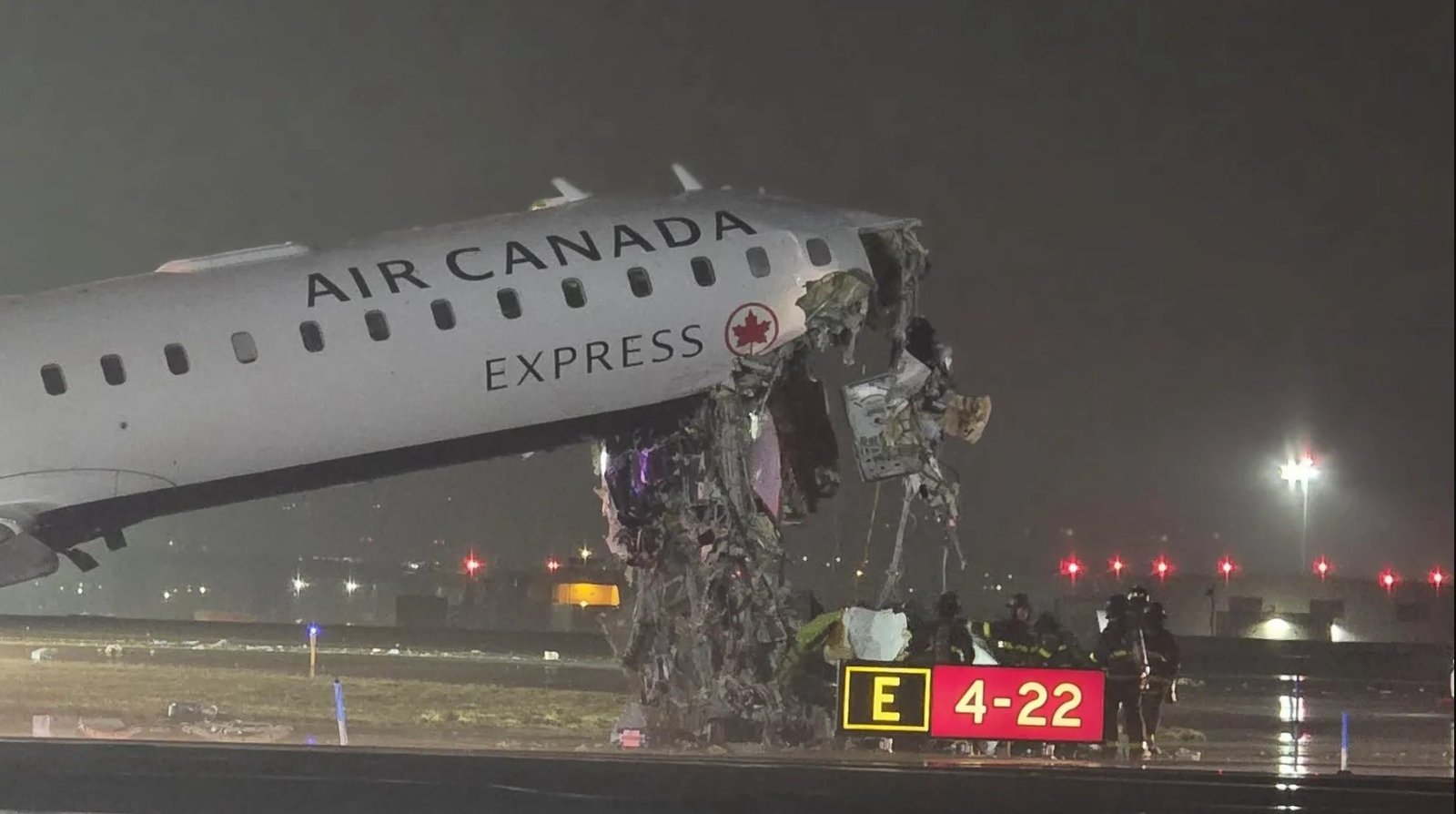
The NTSB has released the preliminary report on the Air Canada Bombardier CRJ-900 that hit a fire-and-rescue truck while landing at the LaGuardia Airport (LGA) on March 22.
According to the report, six ARFF response vehicles and one Port Authority vehicle were responding to another emergency near LGA’s Terminal B at approximately 11:31 pm. The ATC controller cleared the CRJ-900 to land at approximately 11:35 pm while the flight was at an altitude of about 1,900 ft. The accident vehicle (Truck 1) left Terminal B with 6 other vehicles and was supposed to drive along taxiway D and cross runway 4. While at an intersection, the lead vehicle attempted to call the ATC tower, but was blocked by a simultaneous radio transmission on the same frequency.
After attempting to contact ATC, Truck 1 and others were able to move to a different intersection, with Truck 1 now leading. At 11:36 pm, Truck 1 requested to cross runway 4 and received permission. At the time, the aircraft was at an altitude of 130 ft and about a quarter mile on final approach.
The flight crossed runway 4’s threshold at around 11:37 pm while Truck 1 was about 410 ft from the edge of runway 4. ATC was giving a taxiing instruction to another aircraft and immediately instructed Truck 1 to stop. Truck 1 did not stop and increased speed, according to the report. The aircraft’s main landing gear touched down a few seconds later and the vehicle crossed the hold short line, followed by the controller again instructing Truck 1 to stop. The jet’s brake application began and the thrust reversers were deployed.
RELATED STORIES:
Air Canada jet collides with fire-rescue truck at New York airport
Our Most-Wanted List: Safety improvements needed now for business aviation
Cessna 650 takes substantial hail damage due to pilot error
The nose landing gear touched down roughly 2 seconds before the collision, just as Truck 1 entered runway 4. Truck 1 turned left just before the collision and the rudder deflected about 6° to the left just before the end of the flight recorder data. The collision occurred and killed both the captain and first officer. Of the 2 flight attendants, 72 passengers, and 2 crew of Truck 1, 39 were transported to local hospitals with 6 serious injuries reported. The jet initially came to rest with its nose down, but during evacuation, it tilted upward until the tail contacted the ground. The truck ended up on its left side.Before the accident, the controller had taken over transmitting ATC instructions on both the GC and LC radio frequencies as the controller-in-charge was coordinating another emergency with an aircraft that had performed two rejected takeoffs, followed by a ground emergency.
Trending
- How The World’s Most-Delivered Widebody Of 2026 Is Quietly Retiring 3 Legacy Aircraft At 4 Airlines
- Quiz: 5 Questions To See How Much You Know About Class G Airspace
- Herradura Drops Directo de Alambique, a New Very-High-Proof Tequila
- Amnon Shashua to step down as Mobileye CEO
- FIFA World Cup Drone Security: What 700 Seizures Proved
- Challenger road landing report reveals conflicting accounts
- Ukraine moves toward deal for US drone factory
- Starship in space! See highlights of SpaceX megarocket’s epic Flight 13 test launch (video)
NTSB releases prelim report on Bombardier jet that collided with rescue truck
 By TBH.EXPRESS