


Meet the team
This fleet is operated by a full-time team of six pilots/Tactical Flight Officers (TFOs) led by Chief Pilot James Collins, who also one of two Certified Flight Instructors (CFIs) on the staff.
In addition, there is also a full-time airframe and powerplant mechanic.
Unusually, the PSO air unit does not have TFOs as a specific specialisation. All pilots are also rated as TFOs and operate in each role on an alternate shift basis.
Indeed, on the day of my visit, Collins as Chief Pilot and CFI had been operating as a TFO on his previous shift, which had concluded in the small hours of the previous morning.
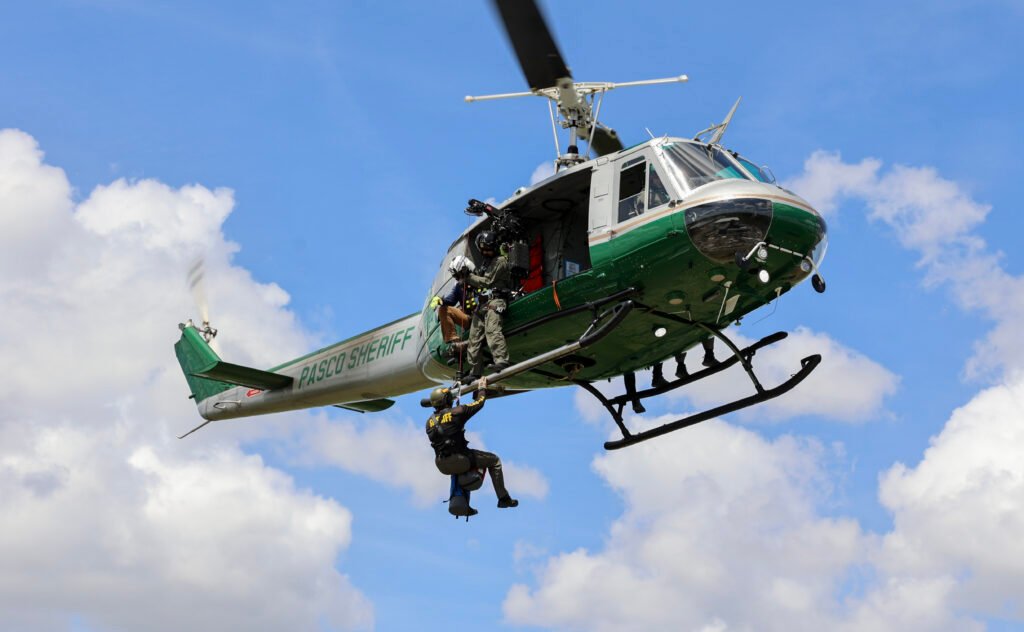
Deputies from specialist units augment the full-time team staffing the Air Support Unit of the Pasco Sheriff’s Office. Image: Gideon Ewers
“We see a lot of benefit in that multi-role capability,” he says. “It means we can be confident on missions that the pilot is thinking like a TFO and the TFO is thinking like a pilot.
“That matters even more on rescue missions when you know the guy calling the hoist is calling the distances for manoeuvre and is doing so knowing instinctively what you want to know as a pilot.”
For firefighting and search and rescue taskings, the core team is supplemented by deputies specialising in search and hoist operations, as well as by colleagues from the Fire Department.
Cumulatively, they provide seven days a week and almost round the clock patrol air support.
As with many law enforcement operators, aircrews at PSO are recruited from patrol and other specialities.
Collins, for example, was a drugs detective before joining the unit.
What is unusual is that all training – both TFO and pilot training – is underwritten by the office.
In taking pilots from zero to CPL(H), there are plans to add an in-house Instrument Rating (IR) training capability in the coming year or so.
Because while the climate allows VFR operations much of the time, they don’t call it the “sunshine state” without reason.
The area can be plagued with radiation and, especially in the late winter and early spring, advection fogs. Though typically the latter are unusual in that they burn off relatively quickly.
While Collins concedes that they have to refuse relatively few taskings a year due to weather limits, he contends that the IR “just makes pilots better and safer”.
The process is for the new recruit to the unit to begin TFO training in tandem with their pilot training – and because that takes less time than the flight training, it means that they can join the roster and gain experience as soon as possible.
Ab initio training is carried out on the OH-58, where the student will typically log around 100 hours before transitioning to the 407s.
Post-CPL, the expectation is that the new pilot will log another 150 or so hours in training or on operations (assuming completion of the CPL(H) in the minimum time) before they add the UH-1 to their licence.
Once fully qualified, all the Pilot/TFOs will fly both the 407s and the UH-1 as missions require.
In terms of missions, the 407s are employed on the type of mission thought of as a typical law enforcement role – patrol, pursuit surveillance, generally speaking the “catching the bad guys role”.
But since both aircraft had a previous life as at Volusia County in a multi-mission role and therefore arrived configured in terms of layout with a clear rear cabin, they can also be used for search and rescue as well as evacuation missions. They also have cargo hooks and are thus capable of firefighting missions.
