


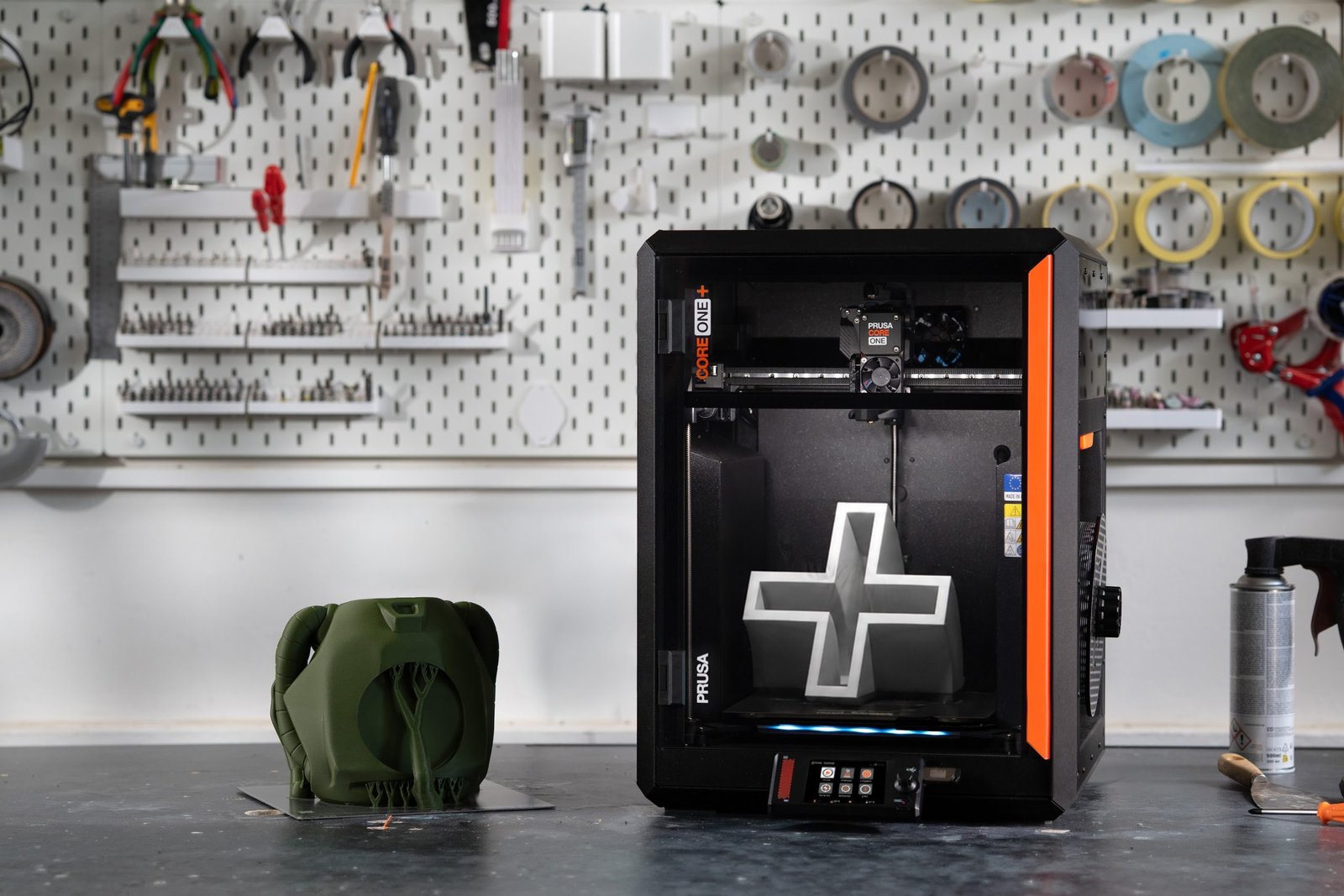
Prusa Research, the Czech manufacturer of desktop 3D printers, has refreshed its current hardware lineup with the Prusa XL+, CORE One L+ and CORE One+ (Gen 2).
The updated machines introduce changes intended to improve print preparation, surface quality and maintenance. Common additions include integrated nozzle wipers and new GT1.5 belts, while the XL+ and CORE One+ (Gen 2) receive further model-specific upgrades.
According to Prusa, prices will remain unchanged across the refreshed lineup. Existing owners will also be able to purchase upgrade kits and individual components rather than replacing their machines.
The company says the changes were developed in response to feedback from its user community, as well as companies, universities and public organizations.
Prusa XL gains cooling and faster tool alignment
The XL+ retains the previous machine’s 360 × 360 × 360 mm build volume and multi-toolhead architecture. Its most substantial change is a new 360-degree part cooling system based on cooling technology used in the MK4S and CORE One platforms.
Prusa says the redesigned system increases airflow and distributes it more evenly around the nozzle. This is intended to improve overhangs, bridges and smaller features.
Multi-tool calibration has also been changed. A permanently installed eddy-current Tool Offset Sensor now checks and aligns individual toolheads during setup. It replaces the previous calibration process, which relied on a removable pin.
Prusa claims the new process is around 20 times faster. Precise tool alignment is particularly important for multi-color prints and layer-based color mixing.
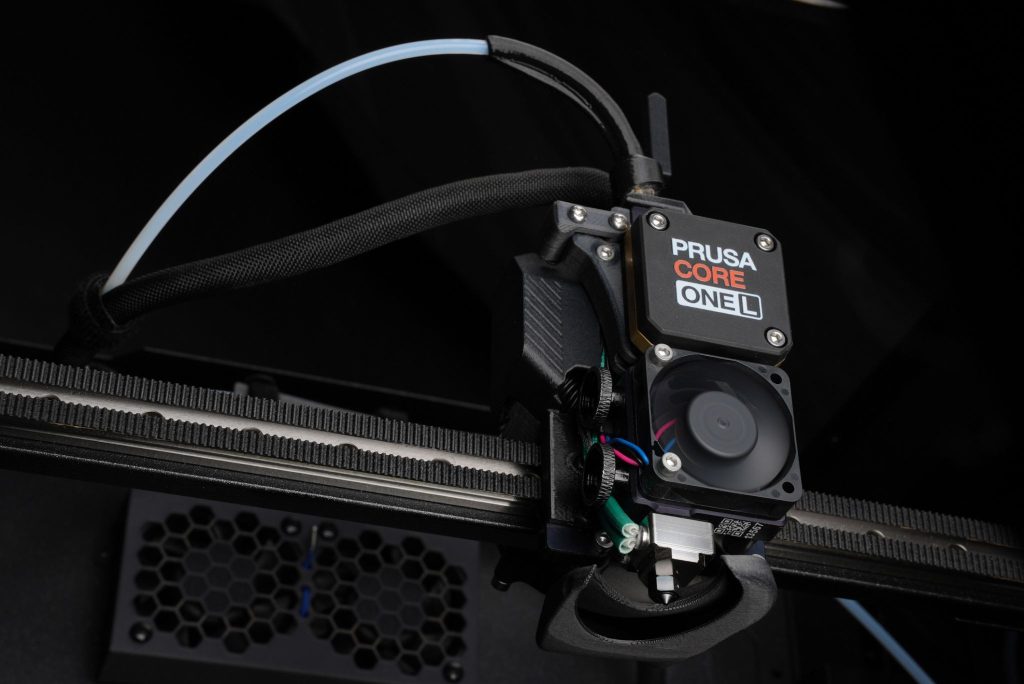
The XL+ also receives GT1.5 belts, which are intended to make fine repeating patterns less visible on printed surfaces. High-flow nozzles are now supplied as standard, while an integrated nozzle wiper removes residual filament before printing begins.
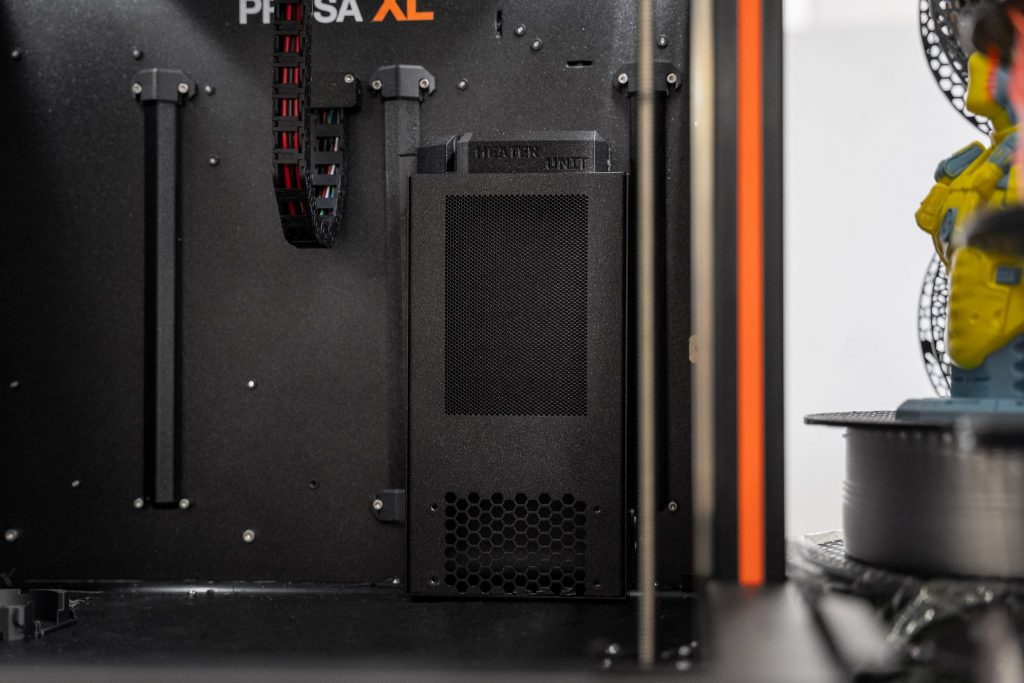
Prusa has additionally prepared the XL+ for chamber temperatures of up to 60°C. A new, better-sealed enclosure can reach around 50°C using heat generated by the printer, according to the company.
An active chamber heater is also under development. Once available, Prusa says it will allow the chamber to reach 60°C. The company says the warmer, more stable environment can help large PC Blend and PCCF components, as well as large PETG parts, remain closer to their intended shape and dimensions.
CORE One models receive shared hardware changes
The larger CORE One L becomes the CORE One L+. It maintains a 300 × 300 × 330 mm build volume, actively controlled chamber and aluminum AC heatbed.
Because the original CORE One L was developed more recently, its refresh is comparatively limited. The L+ adds the GT1.5 belts and nozzle wiper now shared across the three updated machines.
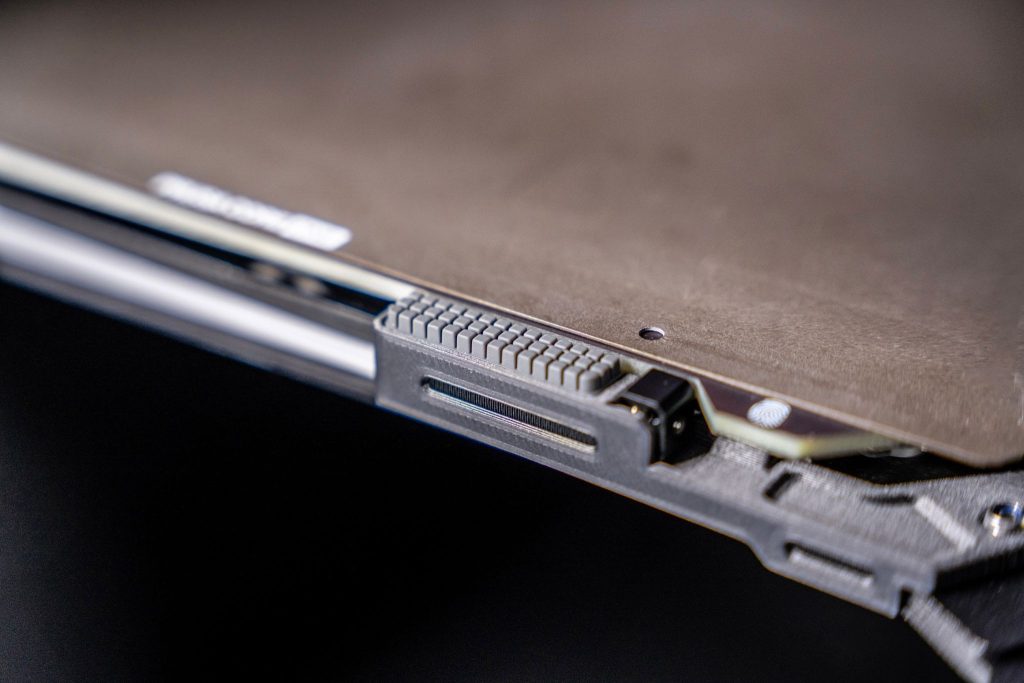
More extensive changes have been made to the smaller CORE One+. The CORE One+ (Gen 2) receives a redesigned heatbed mounting system intended to reduce the waiting period before the first layer begins.
For PLA, PETG and other materials printed with bed temperatures of 85°C or below, Prusa says the previous “Absorbing heat” stage is no longer required. Higher-temperature materials are also expected to begin printing sooner.
A snap-on top panel previously introduced on the CORE One L has also been brought to the smaller machine. The panel can be removed without tools for maintenance and cleaning, while Prusa has also revised the automatic top ventilation mechanism.
GT1.5 belts and the integrated nozzle wiper complete the Gen 2 hardware changes.
Prusa maintains upgrade paths for existing machines
Prusa said assembled CORE One+ (Gen 2) and CORE One L+ machines would begin shipping immediately following the announcement, with assembled XL+ systems following later in August.
Customers with open orders for an XL, CORE One L or CORE One+ that had not yet shipped would be automatically upgraded to the corresponding refreshed model, according to the company.
Complete upgrade kits and individual components are being rolled out separately. Prusa said CORE One+ upgrades would arrive first, followed by CORE One L+ and XL+ upgrades around the end of August and beginning of September.
Existing XL, CORE One L and CORE One printers will continue receiving firmware updates, PrusaSlicer improvements, print profiles, documentation, spare parts and support.
Additional hardware and software updates planned
Prusa is also preparing its INDX automatic tool-changing system for the CORE One+, allowing the printer to switch between colors, materials or nozzle sizes during a single print.
The company said initial units would begin shipping shortly after the announcement and confirmed that the system is compatible with the Gen 2 hardware. Testing is also underway on the CORE One L platform.
Another planned feature will automatically calibrate filament Pressure Advance before each print. Prusa says the printer’s load cell will measure the loaded filament and calibrate two parameters for a new model that accounts for changes in filament behavior at different flow rates.
The company is also developing extrusion-aware acceleration limits intended to prevent the printer from requesting changes in material flow faster than the extruder can provide them. Prusa said the automatic calibration system will be released once it has been tested across a sufficiently broad range of filaments.
PrusaSlicer 3.0 is also approaching its first alpha release. Because the slicer is shared across the company’s printer lineup, supported current and older machines are expected to receive the software changes as well.
An HT Hotend for high-temperature engineering materials is scheduled for September for the CORE One and CORE One L families. Prusa says development took longer than initially planned as it expanded testing to include a wider range of third-party filaments.
Prusa is additionally developing Prusa Connect Local as a replacement for PrusaLink. The software is intended to provide printer management over a local network without requiring a cloud connection.
The company describes Connect Local as an open, extensible, multi-protocol system that will allow the community to add support for additional integrations. An early-access release is being prepared initially for technical users comfortable testing and compiling the software themselves.
Reducing operator intervention in desktop 3D printing
Ease of use and automation are current areas of focus for desktop material extrusion systems. In 2026 additive manufacturing forecasts, Stefanie Brickwede, Managing Director of Mobility/Medical goes Additive, predicted that desktop machines would become easier to use, while Craig Monk of 3D Print Monkey pointed to automation as a way to reduce operator supervision.
Duet3D Director Tony Lock similarly noted that recent advances in lower-cost material extrusion had largely focused on ease of use, with multi-tool and mixed-material capabilities expected to become more prominent during 2026. Lock cited the Bondtech INDX system being developed for Prusa machines as one example.
Recent desktop launches show manufacturers addressing this constraint through different hardware approaches. At CES 2026, a 12-nozzle multi-material system was unveiled combining automatic nozzle swapping and calibration with sensor-based print monitoring. These features were intended to reduce setup complexity while supporting more advanced multi-material workflows.
Prusa’s refresh retains its existing XL and CORE One architectures, instead targeting routine intervention. Some of its wider automation plans, including automatic Pressure Advance calibration and further INDX deployment, remain forthcoming.
3D Printing Industry is inviting speakers for its 2026 Additive Manufacturing Applications (AMA) series, covering Energy, Healthcare, Automotive and Mobility, Aerospace, Space and Defense, and Software. Each online event focuses on real production deployments, qualification, and supply chain integration. Practitioners interested in contributing can complete the call for speakers form here.
To stay up to date with the latest 3D printing news, don’t forget to subscribe to the 3D Printing Industry newsletter or follow us on LinkedIn.
Explore the full Future of 3D Printing and Executive Survey series from 3D Printing Industry, featuring perspectives from CEOs, engineers, and industry leaders on the industrialization of additive manufacturing, 3D printing industry trends 2026, qualification, supply chains, and additive manufacturing industry analysis.
Feature image shows the Prusa CORE One+ (Gen 2). Photo via Prusa Research.
