


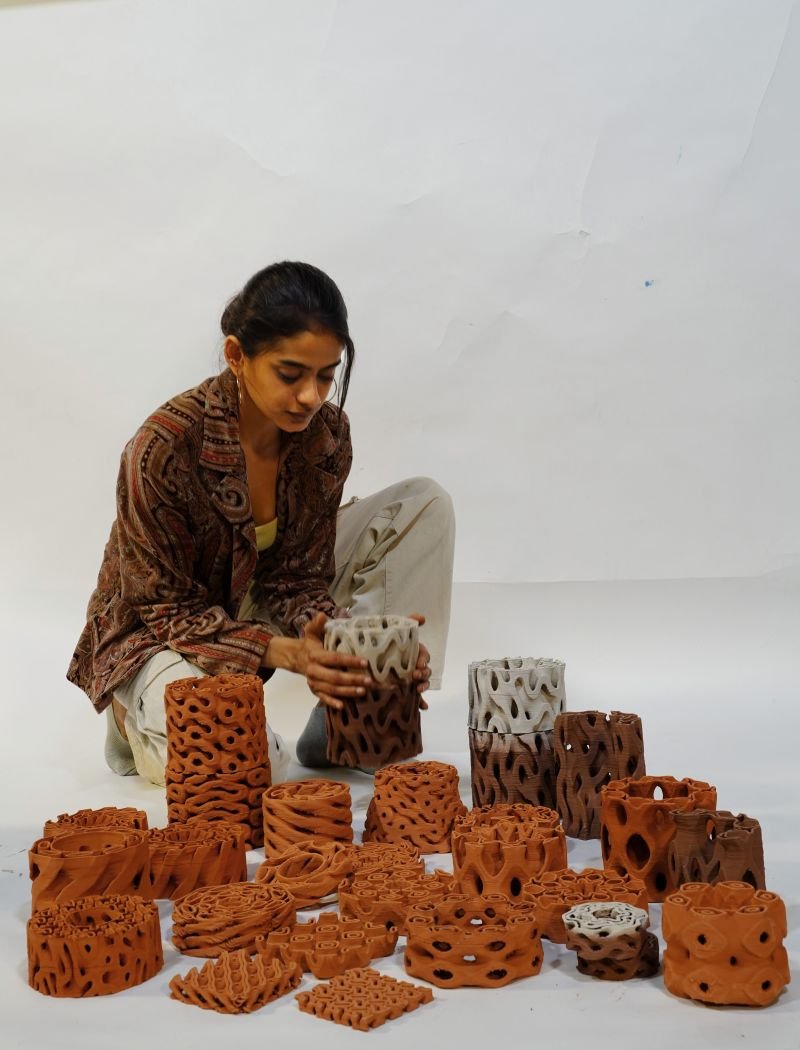
Designer Rameshwari Jonnalagedda has created Minimal Matter, a system of 3D printed terracotta components built around the mathematics of minimal surfaces, the same geometric principles found in soap films, leaf veins, and cellular membranes.
Rather than producing a single fixed object, Jonnalagedda has built a flexible framework: depending on how its geometry is tuned, the same underlying logic can yield a thermal surface, a habitat for small organisms, or a load-bearing structural piece. The project earned recognition in the Young Talents category of the Design Intelligence Award.
The ambition behind the work isn’t really architectural in the conventional sense, it’s almost biological. Jonnalagedda treats the printed forms as conditions for ongoing change rather than finished products. Most building materials are engineered to resist time: to stay rigid, stay clean, stay the same. Minimal Matter does the opposite. It’s built to host moss, insects, air, and light, and to become more complete the longer it’s left exposed to its environment.
Letting the Process Show
There’s a visual signature here that comes directly from the fabrication method. 3D printing in clay makes it possible to vary geometry continuously across modules without adding cost or production complexity, something traditional ceramic techniques can’t easily match. But it also leaves a trace: the layered deposition lines read almost like topographic contours, each one a record of a decision made by the underlying algorithm.
Most 3D printed objects are finished to erase this, sanded, smoothed, vapor-treated to remove the visible “steps” of the print. Jonnalagedda does the reverse, letting the terracotta’s warm ochre surface and its layered texture stay exposed, so the object reads less like a prototype and more like something dug out of the ground.
The system’s real strength shows up in how it scales. A single module works as a standalone sculptural piece. Stack four together and they form a column. Lay them flat across a surface and they begin to read as landscape. Jonnalagedda achieves this by holding the core geometric logic constant while letting its surface expression shift, a balance that’s notoriously difficult to pull off in material systems, since most either lose coherence at scale or become repetitive.
Designing Materials That Welcome Life, Not Resist It
Jonnalagedda’s strategy with Minimal Matter sits inside a broader strategy in how designers think about building materials: instead of engineering surfaces to repel biological growth, treat that growth as a performance feature. By using minimal-surface geometry and additive manufacturing, Jonnalagedda makes bio-receptivity a tunable design parameter, positioning terracotta as infrastructure for small ecosystems rather than just a finish material.
This approach echoes a growing thread of bio-receptive 3D printing work. Researchers at Hong Kong University designed and 3D printed hexagonal clay tiles with complex structures custom-made to encourage coral attachment, deploying them in Hoi Ha Wan Marine Park to give corals a stable base after typhoon damage devastated the reef.
More recently, the Maldives resort Anantara Dhigu worked with Swiss firm rrreefs on an installation built from 3D printed fired terracotta clay and engineered at a microscopic level to encourage coral larval settlement, biodiversity recovery, and the formation of beneficial biofilms, with the geometry’s porosity doing the biological work rather than any added chemical treatment.
Across these projects, a pattern emerges: geometry is becoming the primary tool for inviting life back into manufactured surfaces. Minimal Matter applies that same logic to architecture on land instead of underwater.
3D Printing Industry is inviting speakers for its 2026 Additive Manufacturing Applications (AMA) series, covering Energy, Healthcare, Automotive and Mobility, Aerospace, Space and Defense, and Software. Each online event focuses on real production deployments, qualification, and supply chain integration. Practitioners interested in contributing can complete the call for speakers form here.
To stay up to date with the latest 3D printing news, don’t forget to subscribe to the 3D Printing Industry newsletter or follow us on LinkedIn.
Explore the full Future of 3D Printing and Executive Survey series from 3D Printing Industry, featuring perspectives from CEOs, engineers, and industry leaders on the industrialization of additive manufacturing, 3D printing industry trends 2026, qualification, supply chains, and additive manufacturing industry analysis.
Featured image shows Rameshwari Jonnalagedda has created Minimal Matter. Photo via Rameshwari Jonnalagedda.
