


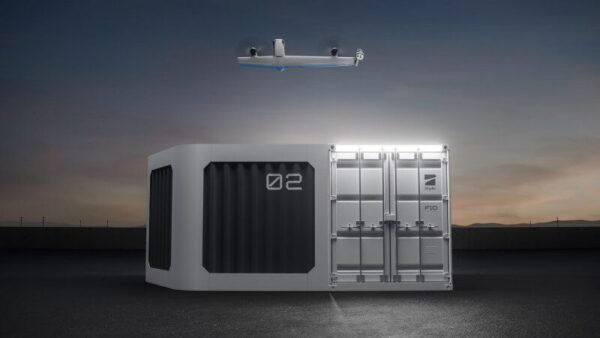
The company’s first fixed-wing aircraft flies up to 100 mph across a 30-mile radius from a five-aircraft robotic dock, alongside two new industry-specific software platforms.
Skydio announced the F10 Lightrunner, its first fixed-wing aircraft, on September 24, 2026 at its annual Ascend conference in Summerlin, Nevada. The San Mateo, California drone manufacturer also introduced MegaDock, the Asset Command and Security Command software platforms and a series of platform upgrades. F10 marks the first time Skydio has extended its lineup beyond the quadcopter. The aircraft flies at up to 100 mph (161 kilometers per hour) with a 30-mile (48-kilometer) flight radius, which gives a single launch location coverage of nearly 3,000 square miles (7,770 square kilometers). Customer deployments begin in 2027.
“F10 Lightrunner is the most advanced fixed-wing drone that has ever existed,” said Adam Bry, chief executive of Skydio. “It will bring the benefits of Drone as First Responder and fully automated drone inspection of critical infrastructure to a scale that’s never been possible before, with 100 mph speed and up to a 30-mile coverage radius.”
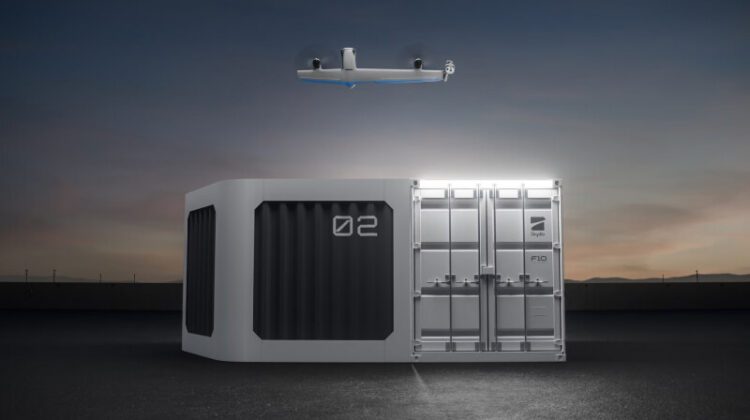
Skydio F10 Lightrunner and MegaDock design
F10 launches and lands without a ground crew. Instead, it uses a Robotic Takeoff and Landing (RTOL) system built around a suction-based robotic gripper. MegaDock, the dock designed for F10, houses up to five aircraft and supports concurrent missions from a single location.
Skydio designed the aircraft around its camera. Under the SideEye layout, the camera sits outside the rotor plane so the wing never blocks the video feed, giving pilots continuous coverage throughout a mission. Meanwhile, Foresight, the Skydio autonomy software built for fixed-wing flight, plans and adjusts the flight path in real time to reduce pilot workload. The Skydio Airspace Assurance System also maintains regulatory compliance and collision avoidance on every flight.
Asset Command and Security Command platforms
Both new software platforms extend the model Skydio established with its DFR Command offering. Asset Command serves organizations managing large portfolios of fixed infrastructure. It imports asset data directly from GIS and CMMS systems to plan and route inspections automatically, and AEP, Chevron, Dominion Energy and Southern Company served as early development partners. By comparison, Security Command turns drone fleets into a continuous security capability, dispatching aircraft with live video to give security teams aerial awareness before personnel enter potentially dangerous situations.
“We’re now tapping the true potential of software-defined, autonomous, dock-based drones with industry-specific applications for public safety, energy infrastructure, and physical site security,” said Bry. “Each Command brings together specialized autonomy, customized workflows, and deep integrations with the systems our customers already use, making drones easier to adopt and integrate than ever before, and orders of magnitude more effective once they’re operating them.”
Both platforms went on sale at Ascend, with general availability in early 2027.
Controller 2 and software updates
Skydio also introduced Controller 2, a hand-flown controller with a 7-inch sunlight-readable display, a kickstand and 5.5-hour battery life. In addition, the company released a new Skydio Mobile App for secure live-video sharing. Camera software updates include ThermalBoost, arriving this winter, and Low-Light Enhance, arriving next spring. Skydio is also rebuilding its Transparency Dashboard, which public safety agencies use to publish flight and policy data, with expanded tools rolling out later this year.
More information is available at Skydio.
